Is San Marino Too Touristy?
An honest look at whether San Marino is too touristy as a day trip from Ravenna, with timing advice and quieter alternatives among the eight UNESCO monuments.
Ravenna, the inland mosaic city of Emilia-Romagna about 8 km from the Adriatic coast, is one of the natural bases for a day trip to San Marino, and the question of whether the tiny republic has been swallowed by tourism comes up on every planning thread. The honest answer, reported here by the editorial desk of Ravenna Travel Guide, is that San Marino is busy at predictable times and quiet at other times, and that the crowding is concentrated in a small historic core rather than spread across the mountain. What follows separates the timing question from the experience question, and points to what the area around Ravenna offers when the mountain republic is at its most crowded.
Is San Marino Too Touristy?
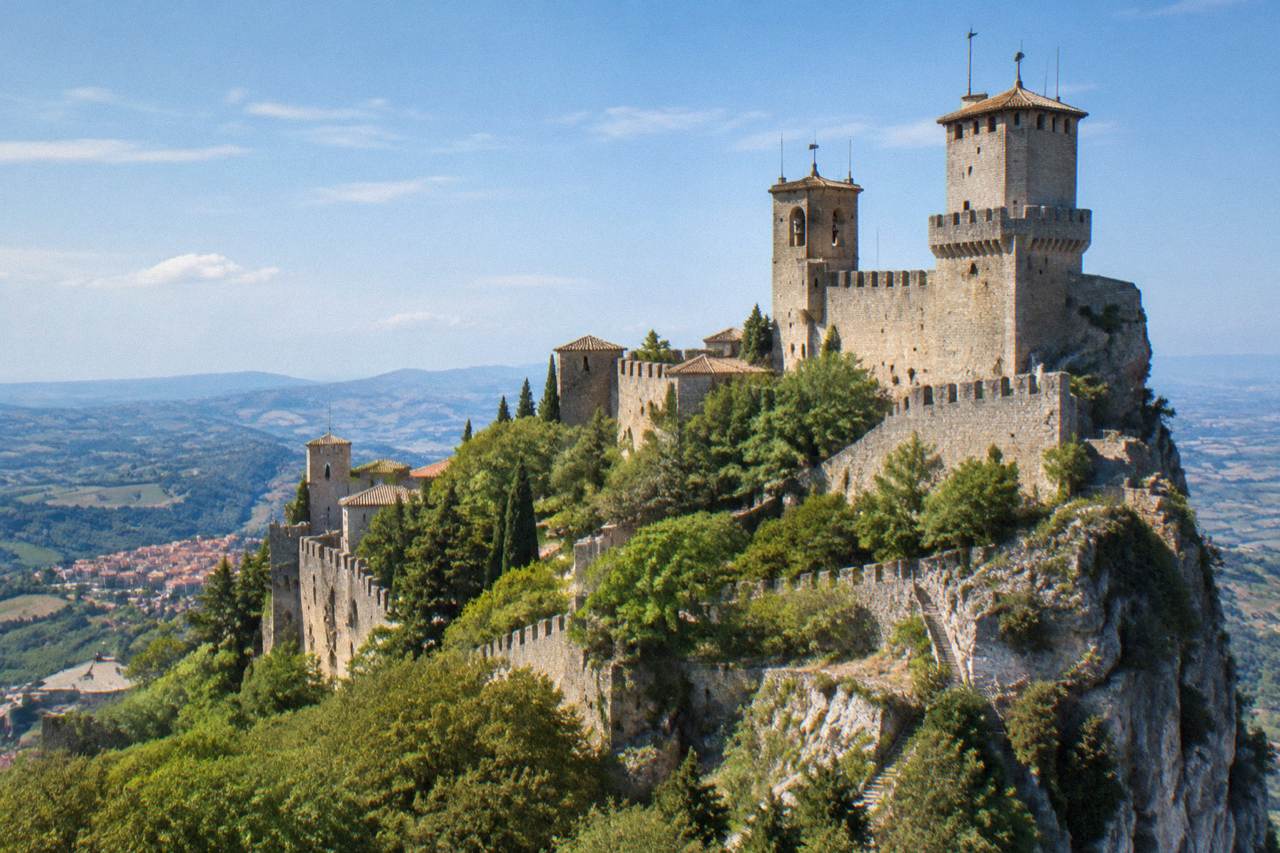
No, not inherently, but San Marino is touristy in a specific and predictable way: the crowds concentrate in the small historic centre on top of Mount Titano during summer weekends and holiday periods, while weekday mornings outside the peak season run far calmer. The republic depends on day-trip tourism, so souvenir shops and coach groups are part of the place rather than a distortion of it. Timing decides whether it feels crowded.
The practical distinction is between the destination and the atmosphere. San Marino's economy is built around visitors, and that shows in the density of shops selling coins, stamps and replica crossbows along the streets near the towers. This is not a hidden hill village surprised by tourism, and a visitor who arrives mid-afternoon on an August Saturday will find exactly what the guidebooks warn about.
The same streets on a weekday morning in the cooler months are a different experience, and this is the version that keeps the day trip worthwhile. The editorial desk's advice is simple: treat the crowding as a scheduling problem, not a verdict on the place. Check the calendar before committing, avoid Italian public holidays, and go early in the day when the coaches have not yet climbed the mountain.
There is a second, subtler point worth making. Touristy is not the same as bad, and a place can be popular for reasons that survive the crowds. The ridge and the three towers give San Marino a genuine panorama over the Adriatic coast on one side and the inland hills on the other, and that view does not shrink because a coach party is sharing it. What crowds actually damage is the atmosphere of the streets and the queueing at the cable car and the towers, both of which are avoidable with an early start. A fair reading is that San Marino rewards a visitor who plans around its rhythm and disappoints a visitor who treats it as a spontaneous afternoon stop.
When Is San Marino At Its Most And Least Crowded?
Crowding in San Marino follows the Adriatic coast season, because the day-trip traffic largely comes from the beach resorts of Rimini and the surrounding coast. July and August, weekends, Italian public holidays and the days around festival periods bring the peak load. Weekdays from late autumn through early spring, outside the holidays, are the calmest windows, though some facilities run shorter hours then.
The link between the coast and the mountain is the key. Ravenna's own climate table, modelled ERA5 normals for 1991 to 2020, shows July as both the warmest month, at a mean of 25.2 C, and the driest, at 38.1 mm of rain. That is precisely the weather that fills Marina di Ravenna, Rimini and the other resorts, and the same weather that fills the buses and cable car running up to San Marino. November, by contrast, is the wettest month in the table at 78.3 mm, and the cooler, damper months thin the coast, which thins the mountain with it.
For a visitor based in Ravenna, the shoulder logic works well. Ravenna itself is at its most pleasant in the months when the coast empties, and the monuments move to their winter schedule from 3 November 2026 to 6 March 2027, opening 10:00 to 17:00 daily with last admission at 16:30, or 16:45 at Galla Placidia and the Neonian Baptistery, per the Ravenna Mosaici page. A cool-season trip pairs quiet mosaics with a quiet mountain. The trade-off is that some services in San Marino, including shops and some visitor facilities, run reduced hours or close in the depth of winter, so the quietest weeks are also the weeks with the least open. Confirm locally before travelling in January or February.
| Timing factor | Peak crowding in San Marino | Quieter conditions |
|---|---|---|
| Season | July and August, when the coastal resorts are full | Late autumn to early spring, outside holidays |
| Day of week | Saturdays, Sundays and Italian public holidays | Weekdays, Tuesday to Friday |
| Time of day | Mid-morning to late afternoon, when coaches arrive | Early morning, shortly after opening |
| Weather | Clear, hot summer days that draw beach traffic inland | Cooler or overcast days, when the coast thins out |
What Does A Day Trip From Ravenna To San Marino Involve?
A day trip from Ravenna to San Marino involves a two-stage journey: you first travel to Rimini, then take the onward San Marino connection from there. The route logic is settled and straightforward, but before you set off, check current timetables for both legs so your timing lines up and your day runs smoothly.
The practical starting point is the guide on getting from Rimini to San Marino, which covers the connection the trip depends on, and the site's own San Marino day-trip guide lays out the full plan from Ravenna. Because the mountain republic is a separate state, remember passport or ID requirements differ in principle from travel within Italy, and cash points in San Marino dispense euros like anywhere else in the region.
One honest framing helps: San Marino is the kind of day trip that rewards a clear purpose. Visitors who enjoy panoramic ridge walks, stamp and coin collecting, or the simple novelty of a microstate tend to rate it; visitors who arrive without a plan and shuffle through the same three souvenir streets tend to leave disappointed. The towers and the ridge path are the substance, and the shops are the packaging around them.
If the plan is a guided experience rather than independent travel, the operator's live listing carries the current price and departure details, and the day-trip options below cover the guided route in both directions, from Ravenna itself or with a Bologna start.
For a traveller weighing the guided route against doing it alone, the deciding factor is usually the mosaic monuments rather than the mountain. A guided tour of Ravenna's mosaics covers the UNESCO interiors with a guide who can read the iconography, which is the part of the region's heritage that genuinely benefits from explanation, while San Marino is largely self-explanatory once you are standing on the ridge. That asymmetry is why this site leans toward guided time in Ravenna and independent time in San Marino.
Is San Marino Worth It Compared With Ravenna?
For a first-time visitor to the region, Ravenna's eight UNESCO Early Christian monuments are the stronger draw, and they absorb crowds far better because they are spread across a walkable city rather than stacked on one ridge. San Marino adds a panorama and a microstate novelty; Ravenna holds the mosaics, Dante's tomb and a historic centre that never depends on a single viewpoint. The two are complements, not rivals.
The UNESCO listing, inscribed in 1996, names exactly eight monuments: the Mausoleum of Galla Placidia, the Neonian Baptistery, Sant'Apollinare Nuovo, the Arian Baptistery, the Archiepiscopal Chapel, the Mausoleum of Theodoric, San Vitale and Sant'Apollinare in Classe. Reduced combined fares start at EUR 9.50 for two monuments on the Ravenna Mosaici prices page, rising to EUR 11.50 for four and EUR 13.50 for five, and the ticket is valid one week with one admission per monument. The reduced rate applies to students, non-accredited journalists and paying groups over 20, while children aged 0 to 10, Ravenna residents, ICOM members, licensed guides, and visitors with a disability plus companion enter free.
| Ravenna monument | Ticket status | Notes from the official pages |
|---|---|---|
| San Vitale | In the Ravenna Mosaici combo | Admission in scheduled slots, timed entry |
| Mausoleum of Galla Placidia | In the 4- and 5-monument combos | Mandatory booked entry time, a few minutes inside |
| Neonian Baptistery | In the 4- and 5-monument combos | Mandatory booked entry time, a few minutes inside |
| Sant'Apollinare Nuovo | In all combos from 2 monuments | Summer hours 9:00 to 19:00 until 2 November 2026 |
| Archiepiscopal Museum and Chapel | In the 5-monument combo | Same winter hours as the combo sites |
| Mausoleum of Theodoric | EUR 6, EUR 5 concession, EUR 2 ages 18 to 25 | Combined with the Arian Baptistery and Theodoric's Palace at EUR 7 |
| Sant'Apollinare in Classe | EUR 6, EUR 2 reduced | In the Classe area, outside the centre |
| Dante's tomb | Free | Open daily, 10:00 to 18:00 in the winter period |
The comparison also works in terms of crowd resilience. When San Marino's core is full, there is nowhere for the crowd to go, because the attraction is the ridge itself. When Ravenna is busy, the visitors disperse among monuments, cloisters, Piazza del Popolo and the quiet streets between, and the guide to the eight UNESCO sites shows how much ground that covers. The site's overview of what Ravenna is famous for makes the same point from the other direction.
There is also a seasonal argument. Ravenna's monuments stay open through the winter on the schedule quoted above, with only 25 December and 1 January as closure days, so the city gives a visitor something substantial in November or February, when the coast and the mountain are at their quietest and, in San Marino's case, partly asleep. A winter traveller who asks whether San Marino is too touristy in February is really asking the opposite question, and should be checking what is open rather than what is crowded.
A visitor who wants the mountain panorama should take it, and a visitor who wants depth should give Ravenna the extra day. The site's planning pages on how many days to spend in Ravenna and things to do in Ravenna cover how to split the time, and the picks below round out the options for guided and self-guided days in the city itself.
Common Questions About San Marino And Ravenna
Is San Marino too touristy?
San Marino is touristy in its small historic core at predictable times: summer, weekends and holidays. On weekday mornings outside the peak season the same streets are far calmer, so the honest answer is that timing, not the destination, decides the experience.
Can you visit San Marino as a day trip from Ravenna?
Yes, it is an established full-day outing from Ravenna, normally routed via the Rimini area before the climb to the republic. Check current timetables before travelling, as connections change with the season.
Do you need a passport to enter San Marino?
San Marino is a separate state, though it uses the euro and sits within the Schengen area's practical arrangements. Carry a recognised ID document, as the site's files hold no guidance beyond the general rule that border checks are possible in principle.
What is the quieter alternative to San Marino from Ravenna?
Ravenna's own eight UNESCO monuments spread visitors across a walkable inland city, and the combo ticket spreads visits across a full week, one admission per monument. Dante's tomb is free and the historic centre absorbs crowds well.
When are Ravenna's monuments open in winter?
The Ravenna Mosaici page lists winter hours from 3 November 2026 to 6 March 2027 as 10:00 to 17:00 daily, with last admission at 16:30, or 16:45 for Galla Placidia and the Neonian Baptistery, and closure on 25 December and 1 January.
The short version stands: San Marino is as touristy as the calendar you give it, and a Ravenna base lets you pick the quiet days for the mountain and keep the mosaics for the rest of the week.