Where Are The Best Mosaics In Ravenna?
The best mosaics in Ravenna sit inside its eight UNESCO Early Christian monuments. This guide ranks where to look, how the combo ticket works and what each site costs.
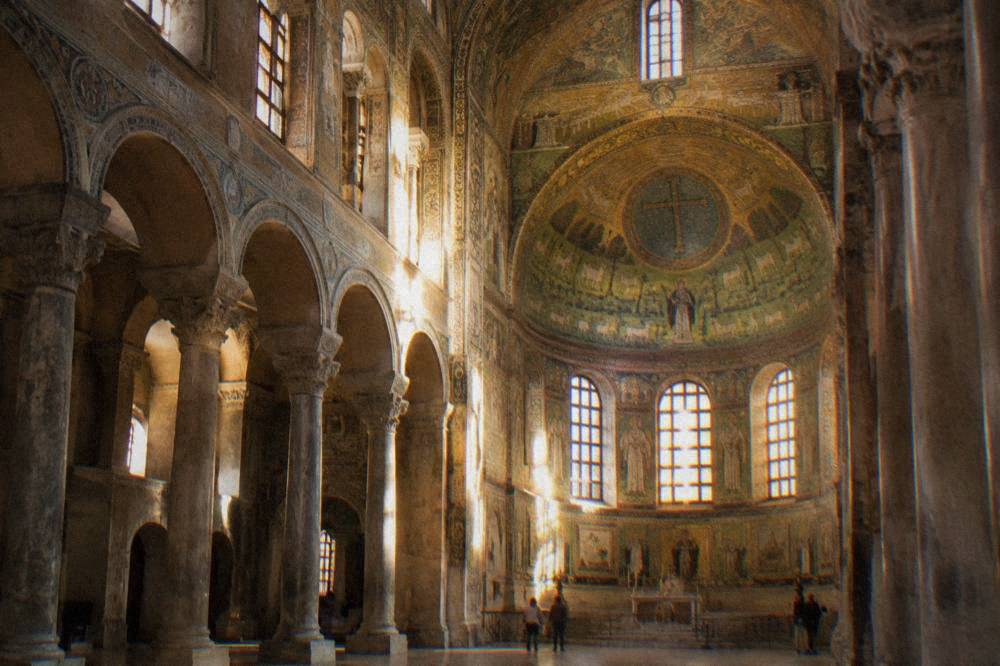
Ravenna, a flat inland city on the Po plain of Emilia-Romagna, holds the densest concentration of Early Christian Byzantine mosaics anywhere in western Europe, and UNESCO listed eight of its monuments together in 1996. The historic centre is small and walkable, so the question is never whether you can see them, only which ones to see first and in what order. The short answer: San Vitale and the Mausoleum of Galla Placidia in the centre, the Neonian Baptistery a few streets away, Sant'Apollinare Nuovo on the old processional street, and Sant'Apollinare in Classe a short trip out to the ancient port area. For the wider picture of the city's offerings, start with the things to do in Ravenna overview, then come back here for the mosaic detail.
Where Are The Best Mosaics In Ravenna?
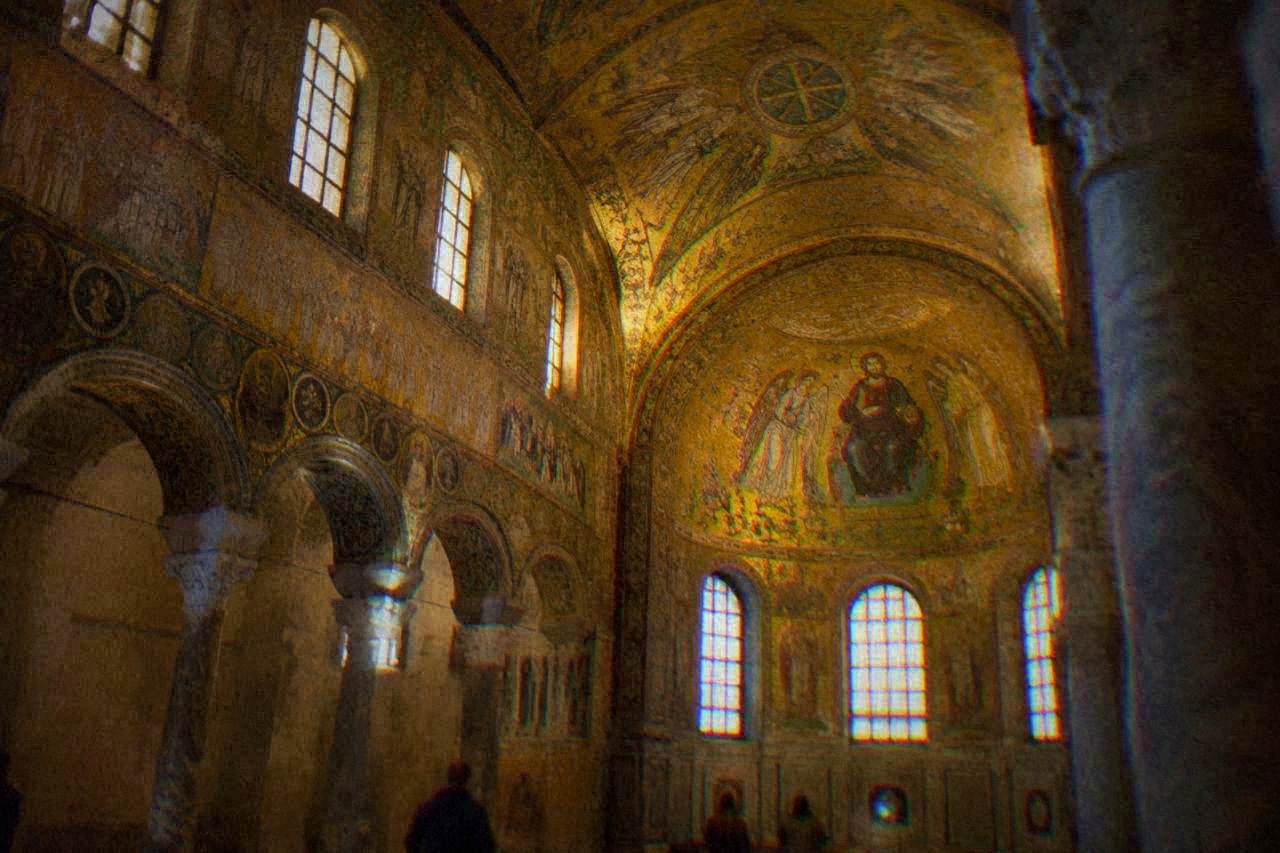
The best mosaics in Ravenna are in the Basilica of San Vitale and the Mausoleum of Galla Placidia, both covered by the same combo ticket in the historic centre, followed by the Neonian Baptistery's dome and the processional walls of Sant'Apollinare Nuovo. Sant'Apollinare in Classe, outside the centre, holds the green paradise apse. Together these five buildings carry the core of what UNESCO inscribed.
That ranking is a starting point rather than a verdict. San Vitale's apse and choir are the single densest display of gold-ground figural mosaic in the city, and Galla Placidia's little cross-vaulted chapel packs its starry ceiling into a space you view in only a few minutes, because the Ravenna Mosaici ticket page makes a timed entry and a short stay mandatory there. The Neonian Baptistery keeps its dome mosaic intact above a ring of empty arches, and Sant'Apollinare Nuovo lines one wall with a procession of figures against a gold ground. If you want the historical background of why this small city ended up with such treasure, read why Ravenna has so many mosaics, and for the individual artworks, see the rundown of some of the most famous mosaics in Ravenna.
One practical note shapes everything. The monuments are not spread across a metropolis. The centre is compact, the railway station is a short walk from the core, and the five central sites sit within an easy stroll of each other, which is why the mosaics in half a day itinerary exists at all.
Which Ravenna Buildings Hold The UNESCO Mosaics?
Eight monuments make up the UNESCO inscription: the Mausoleum of Galla Placidia, the Neonian Baptistery, Sant'Apollinare Nuovo, the Arian Baptistery, the Archiepiscopal Chapel, the Mausoleum of Theodoric, the Basilica of San Vitale and the Basilica of Sant'Apollinare in Classe. Only these eight carry the UNESCO name. Other museums in town hold mosaics too, but they are separate sites with separate tickets.
Five of the eight are inside the historic centre within a few minutes of each other. The Arian Baptistery, a plain brick drum from outside, keeps its own small dome mosaic and costs EUR 3 on the Visit Ravenna listing. The Archiepiscopal Chapel, reached through the Archiepiscopal Museum, is the smallest of the set and closes the five-monument combo ticket. The Mausoleum of Theodoric stands apart in its own park: a two-storey decagon of Istrian stone, listed at EUR 6 with a concession of EUR 5 and EUR 2 for ages 18 to 25 on the Visit Ravenna page, or EUR 7 combined with the Arian Baptistery and Theodoric's Palace. Sant'Apollinare in Classe lies outside the centre in the Classe area, where the basilica's green paradise apse and the Classis Ravenna museum share the former archaeological zone.
| Monument | Location | Ticket basis |
|---|---|---|
| San Vitale | Historic centre, Piazza San Vitale | Ravenna Mosaici combo |
| Mausoleum of Galla Placidia | Historic centre, beside San Vitale | Combo, mandatory timed entry |
| Neonian Baptistery | Historic centre, near Piazza del Popolo | Combo, mandatory timed entry |
| Sant'Apollinare Nuovo | Historic centre, Via di Roma | Combo |
| Archiepiscopal Chapel and Museum | Historic centre, near the cathedral | Combo, 5-monument tier |
| Arian Baptistery | Historic centre, Via degli Ariani | EUR 3 individual |
| Mausoleum of Theodoric | East of the centre, its own grounds | EUR 6, or EUR 7 combined |
| Sant'Apollinare in Classe | Classe area, outside the centre | EUR 6, EUR 2 reduced |
The combo ticket itself, sold through the Ravenna Mosaici site, is valid for one week with one admission per monument, and an entry time must be booked for each one. Reduced fares start at EUR 9.50 for the two-monument ticket covering Sant'Apollinare Nuovo and San Vitale, EUR 11.50 for the four-monument tier that adds Galla Placidia and the Neonian Baptistery, and EUR 13.50 for the five-monument tier that adds the Archiepiscopal Museum and Chapel of St Andrew; the full prices sit on the official ticket page. Reduced rates apply to students, non-accredited journalists and paying groups over 20, and entry is free for children 0 to 10, residents of Ravenna, ICOM members, licensed guides, and visitors with a disability plus one companion. The full guide to the Ravenna combo ticket walks through each tier in detail.
Ready to plan your visit to the monuments? Book a monument entry ticket here.
If you would rather have a guide decode the iconography than read wall panels, a guided walk is the efficient route, and the three options below cover the same monuments from different angles.
How Do Tickets And Opening Hours Work For The Ravenna Mosaics?
The Ravenna Mosaici ticket page runs a summer and a winter season for the five central monuments: from 8 March to 2 November 2026 the sites open 9:00 to 19:00, and from 3 November 2026 to 6 March 2027 they open 10:00 to 17:00, with last admissions 30 or 45 minutes before closing and the whole set closed on 25 December and 1 January. Each monument needs a booked entry time.
The two dates that matter for planning are the season switch on 3 November and the double closure over Christmas. Last admission is 16:30 in winter for San Vitale, Sant'Apollinare Nuovo and the Archiepiscopal Museum, and 16:45 for Galla Placidia and the Neonian Baptistery, so a winter afternoon visit has a hard edge to it. Galla Placidia and the Neonian Baptistery both require a booked time slot and allow only a few minutes inside, a rule the ticket page states plainly: the queue moves, the stays stay short. San Vitale admits in slots as well. Away from the combo set, the Mausoleum of Theodoric keeps hours of 8:30 to 17:30 per the Visit Ravenna page, and Sant'Apollinare in Classe opens Monday to Saturday 8:30 to 19:00 and Sunday from 13:30 to 19:00. More of these guides are collected on Ravenna Travel Guide.
| Site | Summer 2026 | Winter 2026 to 2027 | Closed |
|---|---|---|---|
| San Vitale, Sant'Apollinare Nuovo, Archiepiscopal Museum | 9:00 to 19:00 | 10:00 to 17:00, last entry 16:30 | 25 Dec, 1 Jan |
| Galla Placidia, Neonian Baptistery | 9:00 to 19:00 | 10:00 to 17:00, last entry 16:45 | 25 Dec, 1 Jan |
| Mausoleum of Theodoric | 8:30 to 17:30 | 8:30 to 17:30 | 25 Dec, 1 Jan |
| Sant'Apollinare in Classe | Mon to Sat 8:30 to 19:00 | Mon to Sat 8:30 to 19:00, Sun 13:30 | 25 Dec, 1 Jan |
Buying is simplest on the official Ravenna Mosaici site, which the page on where to buy tickets for the Ravenna mosaics covers step by step. State museums and monuments are free on the first Sunday of the month, which includes Sant'Apollinare in Classe and the Mausoleum of Theodoric, though the trade-off is crowds in the small spaces. For timing expectations, the answer to how long it takes to see the mosaics in Ravenna breaks the days down.
What Makes San Vitale And Galla Placidia The Standouts?
San Vitale holds the city's grandest mosaic programme, an apse and choir vault filled with gold-ground figures above coloured marble, while Galla Placidia, directly next door, is the intimate counterpart: a small cruciform chamber whose deep blue vault of golden stars is viewed in a few minutes on a timed slot. The two sites share one piazza and work as a single visit.
San Vitale's octagonal interior is the one room in Ravenna where the mosaics surround you entirely, figures lined across the apse arch and side walls, light moving across the gold tesserae as you circle the space. It is also the only central monument where you can linger, since admission runs in slots but the stay is open-ended. Galla Placidia flips that completely: the ticket page caps the visit at a few minutes, which sounds stingy until you realise how small the chapel is and how quickly the star vault reads. The famous window glow, where light through alabaster panes falls across the mosaic of a good shepherd, is visible from the moment you step in. The dedicated pages on the Basilica of San Vitale and the Mausoleum of Galla Placidia go deeper on both interiors.
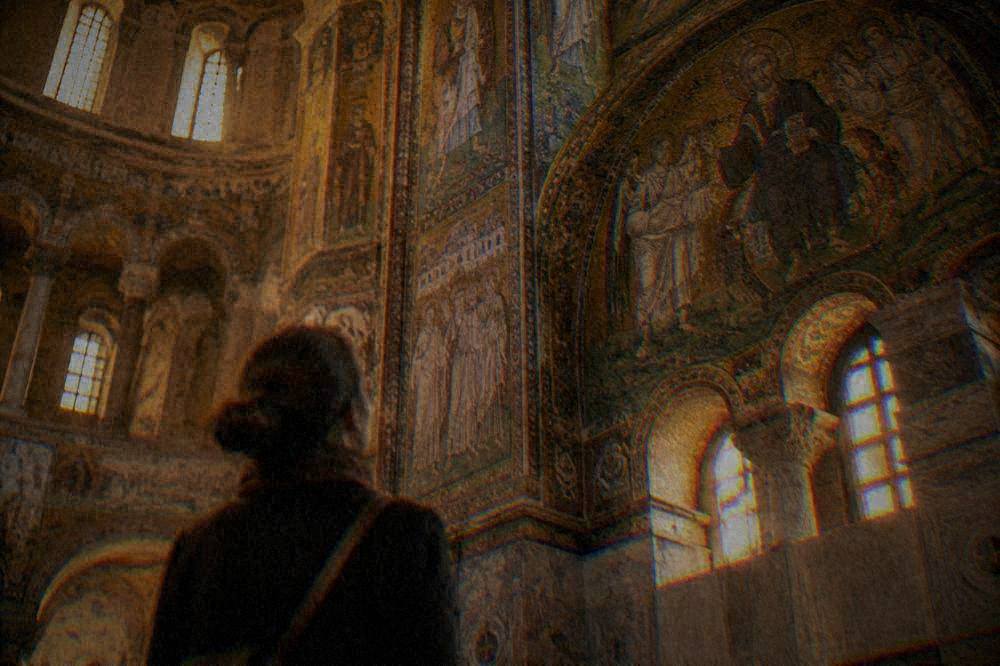
Between the two, and a short walk from Piazza del Popolo, the Neonian Baptistery supplies the third essential interior: a dome mosaic of the baptism of Christ above a ring of apostles, set into an octagonal brick building that the Neonian Baptistery guide details in full. Because the baptistery also runs on short timed entries, plan it in the same block as Galla Placidia and treat Sant'Apollinare Nuovo, with its long wall processions and open browsing time, as the place to slow down. For a focused walk through these interiors with a guide who unpacks the symbolism, Check availability on the Byzantine mosaics walk that concentrates exactly on this circuit.
Where Are The Best Mosaics Outside The Centre?
Sant'Apollinare in Classe holds Ravenna's most serene mosaic, a green paradise meadow facing the viewer from the apse with rows of trees and sheep, and the Mausoleum of Theodoric offers the strangest monument of the eight, a two-storey stone decagon with a single massive capstone. Both lie outside the historic centre and need a bus, a bike or a short drive to reach.
Classe, the ancient port settlement south of the city, pairs the basilica with the Classis Ravenna museum, ticketed at EUR 8 full and EUR 6 reduced, open daily 10:00 to 17:00 with the last entry 50 minutes before closing and closed on 25 December. The basilica's own entry is EUR 6, EUR 2 reduced. Together they make a half-day trip distinct in mood from the gold-heavy centre: the Classe apse is pastoral, wide and calm, and the museum's archaeology explains the port city the mosaics came from. The old TAMO museum in town closed in 2023 and its collection moved to Classis Ravenna, so anyone following an older guidebook should redirect there. Whether the detour is worth it depends on your available time, a question how many days you need in Ravenna answers directly.
For a wider sweep of the same heritage with everything from a private guide to a food-and-mosaics combination, these are the current options.
Common Questions About The Best Mosaics In Ravenna
Where are the best mosaics in Ravenna?
In the Basilica of San Vitale and the Mausoleum of Galla Placidia, both in the historic centre on one combo ticket, followed by the Neonian Baptistery dome, the walls of Sant'Apollinare Nuovo and the paradise apse of Sant'Apollinare in Classe.
Can you see Ravenna's mosaics in one day?
Yes. The five central monuments sit within a short walk of each other and share one combo ticket, and a focused half-day circuit is realistic. Sant'Apollinare in Classe adds an extra trip outside the centre.
How much do the Ravenna mosaic monuments cost?
Reduced combo fares start at EUR 9.50 for two monuments, EUR 11.50 for four and EUR 13.50 for five, valid one week with one admission per monument. Full prices are listed on the official Ravenna Mosaici ticket page.
Which Ravenna mosaics need a booked time slot?
The Mausoleum of Galla Placidia and the Neonian Baptistery require a booked entry time and allow only a few minutes inside, and San Vitale admits in slots. An entry time must be booked for every monument on the combo ticket.
Are the Ravenna mosaics open in winter?
Yes. From 3 November 2026 to 6 March 2027 the central monuments open 10:00 to 17:00 daily, and they close only on 25 December and 1 January.
Ravenna rewards the slow look. Book the time slots, walk between the monuments at the city's own pace, and let the green apse at Classe be the last thing you see before you leave.