What Is The Basilica Of San Vitale?
San Vitale in Ravenna is one of the eight UNESCO Early Christian monuments, famous for its Byzantine mosaics. This guide covers what it is, tickets, hours and how it fits the UNESCO set.
The Basilica of San Vitale is the church that anchors Ravenna's UNESCO World Heritage listing, an inland city in Emilia-Romagna, Italy, about 8 km from the Adriatic coast. UNESCO inscribed the Early Christian Monuments of Ravenna on the World Heritage List in 1996, and San Vitale is one of the eight monuments that make up the listing: the Mausoleum of Galla Placidia, the Neonian Baptistery, Sant'Apollinare Nuovo, the Arian Baptistery, the Archiepiscopal Chapel, the Mausoleum of Theodoric, San Vitale and Sant'Apollinare in Classe. The basilica is best known for its Byzantine mosaics, gold-ground glass work that covers the choir and apse, and for its unusual octagonal plan under a domed brick shape. It sits in the historic centre, a short walk from the other central monuments, and it is covered by the Ravenna Mosaici combined ticket rather than sold as a standalone church ticket. This page explains what the building is, what a visitor actually sees inside, how tickets and timed entry work, and how San Vitale fits into a day among the other UNESCO sites. The basics are laid out on Ravenna Travel Guide, and the fuller sightseeing context is in things to do in Ravenna.
What Is The Basilica Of San Vitale?
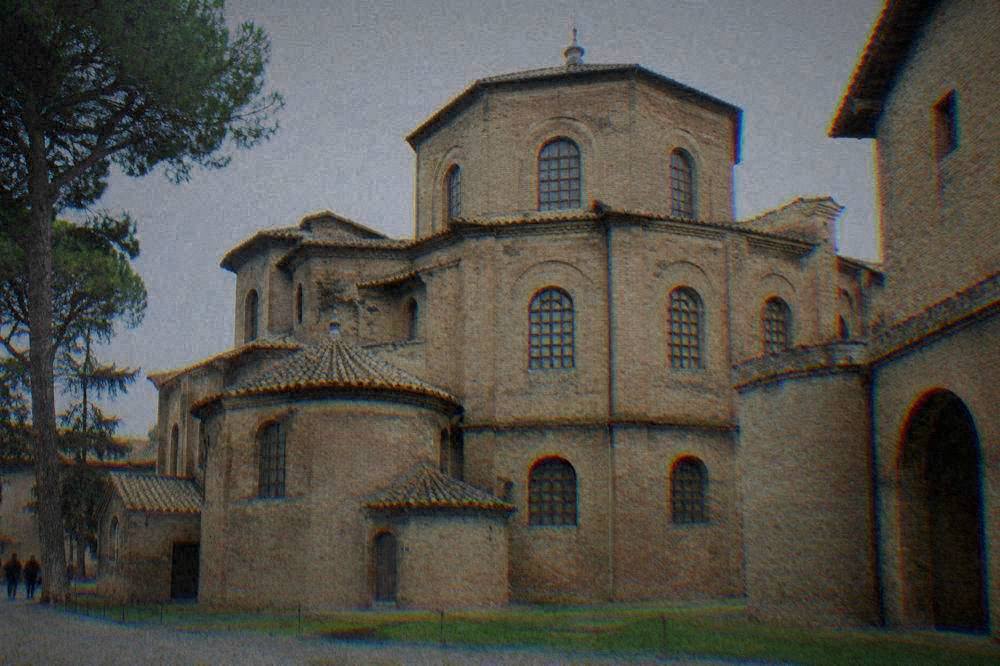
The Basilica of San Vitale is a Byzantine-style church in Ravenna, listed by UNESCO in 1996 as one of the eight Early Christian Monuments of Ravenna, and it is the city's principal showcase of gold-ground mosaic work. It is an octagonal domed building of brick, standing in the historic centre next to the Mausoleum of Galla Placidia and the National Museum, and it is visited on the Ravenna Mosaici combined ticket rather than a separate church ticket.
The UNESCO listing names the eight monuments together, and San Vitale sits at the centre of that set both geographically and in reputation. The listing's own wording describes the group as Early Christian monuments with Byzantine mosaics, and San Vitale is where that mosaic art is at its densest: the choir and apse carry figured mosaic panels on a gold ground, and the vault and upper walls carry decorative mosaic patterns that wrap the octagonal space. The plan itself is unusual for Ravenna. Where the other basilicas in the city are long columned halls, San Vitale is centralized, an octagon ringed by ambulatories and galleries, with light entering high into the dome so that the gold surfaces shift as the day moves.
The naming matters for visitors. The church is dedicated to Saint Vitalis, and the building is usually called simply San Vitale in Ravenna, not a cathedral: Ravenna's cathedral is a separate building elsewhere in the centre. San Vitale stands in its own piazza with the Mausoleum of Galla Placidia beside it, which is why the two are almost always visited one after the other. The dedicated attraction page has the full sight-by-sight detail, at the Basilica of San Vitale in Ravenna, and the story of why the city holds so much mosaic work is covered in why Ravenna has so many mosaics.
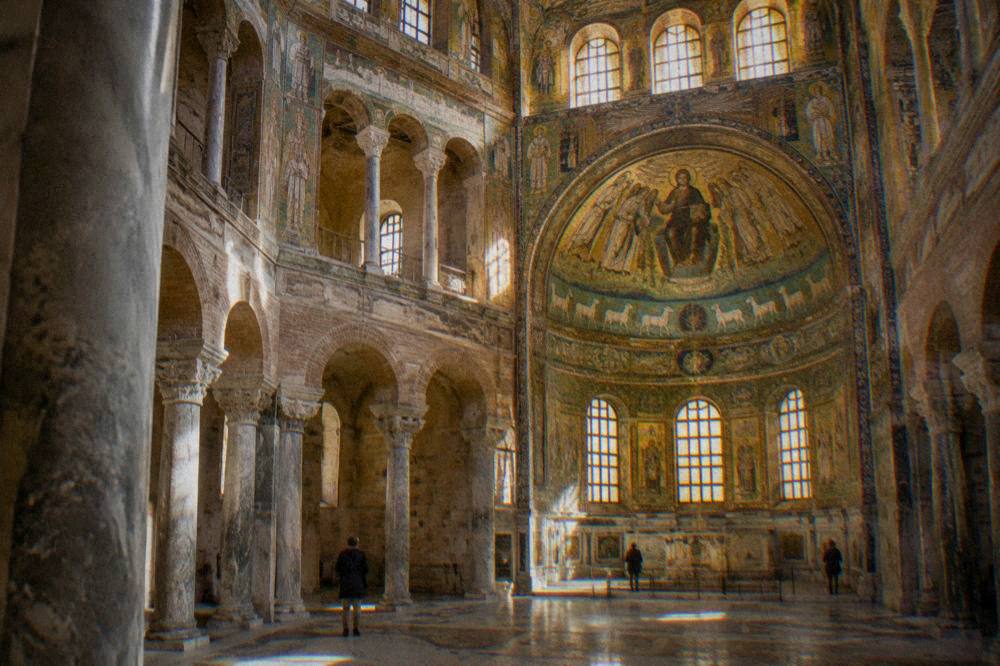
What a visitor sees has not changed in outline for a long time, and no restoration works affecting access are listed for the monument in the winter 2026 to 2027 period. The interior is dim at floor level and bright at the apse, where the gold ground does the work. The floor and lower walls carry marble veneer and carved stone, while the mosaic surfaces begin above the arcade and climb into the vault. Two panels flanking the apse show a imperial court scene, figures in purple and gold, and these are the images that appear in nearly every publication about Ravenna.
What Can You See Inside The Basilica Of San Vitale?
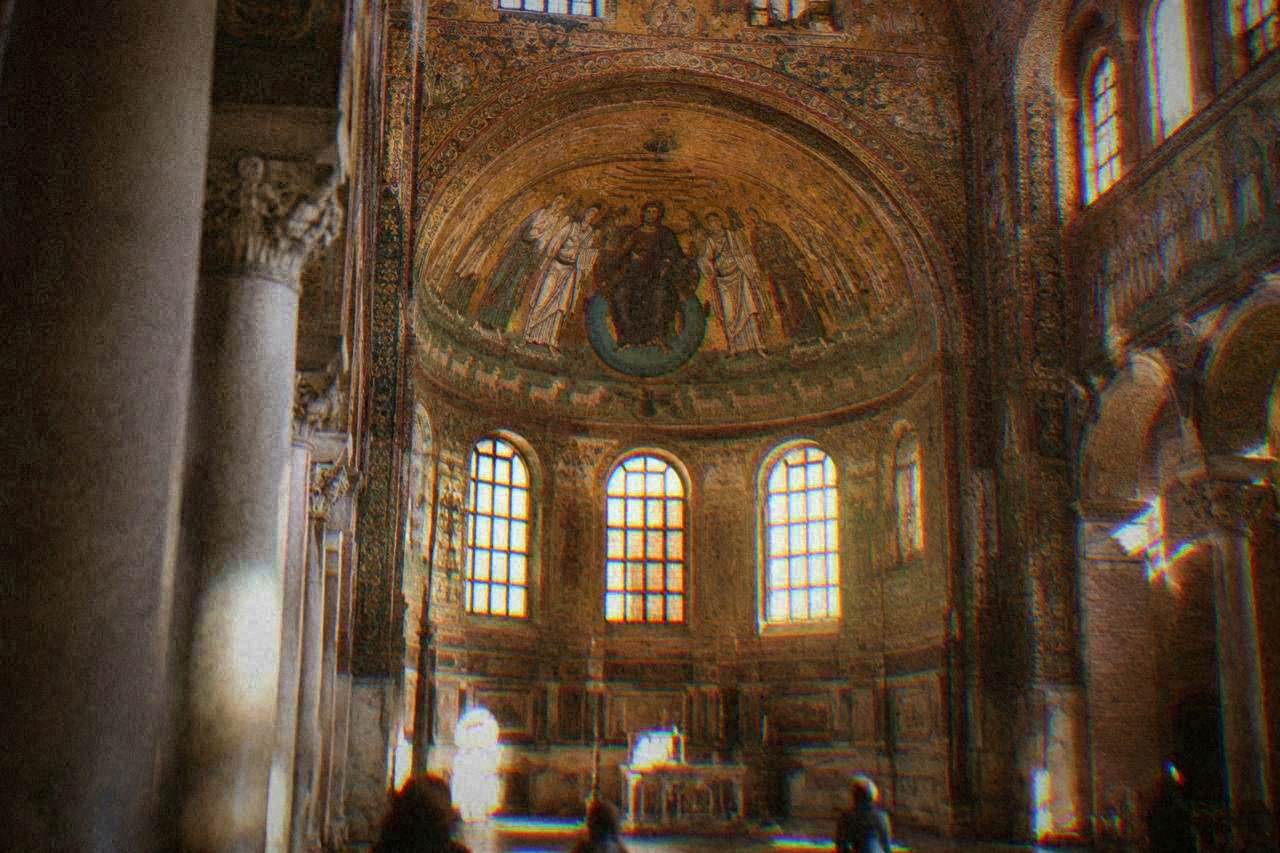
Inside San Vitale the visitor sees an octagonal nave ringed by two tiers of columns, a domed vault, marble flooring and, above all, the gold-ground Byzantine mosaics of the choir and apse, including the two imperial court panels that flank the altar and the decorative mosaics filling the vault and upper gallery. The effect is a single enclosed space built to be read upward, from plain stone at the bottom to gold at the top.
The mosaics are the reason the building is on the World Heritage List, and they divide into figured and decorative work. The figured panels sit in the choir: the two court scenes, each a formal procession of standing figures against gold, with names and titles worked into the tesserae. Above and around them, the decorative mosaics run across the vault, the arches and the gallery screens: acanthus scrolls, shells, peacocks, lambs, fruit and green meadow bands, all in glass tesserae set at angles so the gold catches moving light. The technique is the same gold-ground glass mosaic that defines Ravenna's UNESCO set, and it is at its most concentrated here.
The architecture frames the mosaics deliberately. The octagon rises through an ambulatory to a gallery level, and the dome sits on a drum pierced with windows, so the interior lighting changes through the day and the gold ground reads differently in morning and afternoon. The floor carries early marble paving and there are carved stone elements at the thresholds and capitals. Nothing in the interior requires a guide to appreciate at first glance, but the panels carry inscriptions and iconography that reward explanation, which is where guided and audio options come in.
A practical note on the visit itself: San Vitale admits visitors in scheduled slots under the Ravenna Mosaici ticketing system, so entry is staggered rather than a continuous flow, and the monument can be busy in the middle of the day in high season. The neighbouring Mausoleum of Galla Placidia, by contrast, uses mandatory timed entry with a stay of a few minutes per group, so the pairing works best when the Galla Placidia slot is booked for shortly after the San Vitale entry. The fuller monument-by-monument set is described in the eight UNESCO sites in Ravenna.
How Do Tickets And Timed Entry Work For San Vitale In Ravenna?
San Vitale is covered by the Ravenna Mosaici combined ticket, which is valid for one week with one admission per monument and requires an entry time to be booked for each monument; the two-monument combination covering Sant'Apollinare Nuovo and San Vitale starts from EUR 9.50 reduced, with the four-monument and five-monument combinations adding sites at higher reduced fares shown on the official ticket page.
Want your entry times arranged in advance? Book a mosaics entry ticket here.
The combined ticket is the practical route in. The two-monument combination covers Sant'Apollinare Nuovo and San Vitale. The four-monument combination adds the Mausoleum of Galla Placidia and the Neonian Baptistery. The five-monument combination adds the Archiepiscopal Museum and the Chapel of St Andrew. The ticket runs for seven days, allows one admission per monument, and an entry time must be booked for each monument individually. San Vitale admits in scheduled slots, while Galla Placidia and the Neonian Baptistery use mandatory timed entry with short stays of a few minutes per group. Reduced fares apply to students, non-accredited journalists and paying groups over 20, and free entry applies to children aged 0 to 10, residents of Ravenna, ICOM members, licensed guides, and visitors with a disability plus one companion. The full-price figures sit on the official Ravenna Mosaici ticket page, which is also where any one-off changes to hours or access are posted.
| Ticket combination | Monuments covered | Validity and rules | Reduced fare |
|---|---|---|---|
| 2 monuments | Sant'Apollinare Nuovo, San Vitale | 7 days, one admission per monument, entry time booked per monument | from EUR 9.50 |
| 4 monuments | Adds Mausoleum of Galla Placidia, Neonian Baptistery | Same validity, timed entry and short stays at Galla Placidia and the Neonian Baptistery | from EUR 11.50 |
| 5 monuments | Adds Archiepiscopal Museum and Chapel of St Andrew | Same validity, same booking rules | from EUR 13.50 |
For visitors who want interpretation rather than a bare entry, two structures exist. A combined entry-plus-guided-walk product bundles admission with a guided route, and a separate audio and written guide by a local walks the city at the visitor's own pace. The audio and written guide option is the site's featured pick for this page, and it can be checked via Check availability.
What Are The Basilica Of San Vitale Opening Hours?
San Vitale follows the Ravenna Mosaici seasonal schedule: from 8 March to 2 November 2026 it opens 9:00 to 19:00 with last admission at 18:30, and from 3 November 2026 to 6 March 2027 it opens 10:00 to 17:00 with last admission at 16:30, closing only on 25 December and 1 January. The same seasonal switch applies to the neighbouring Galla Placidia and the Neonian Baptistery, with a slightly later last admission of 16:45 in winter.
The seasonal split is the single most useful planning fact. Summer hours run to seven in the evening, which allows an after-dinner-light visit in the long days, while winter hours stop at five with last admission half an hour earlier. Because Galla Placidia stands a few steps away and the Neonian Baptistery is also within the historic centre, a morning in winter covering San Vitale, Galla Placidia and the Neonian Baptistery is realistic using the four-monument combination with booked slots. The official Ravenna Mosaici page posts any one-off changes, and it is the page to check the day before a visit, since special evenings such as the annual October Notte d'Oro, which opens monuments free in the evening, sit outside the standard timetable.
| Period | San Vitale hours | Last admission | Closures |
|---|---|---|---|
| 8 March to 2 November 2026 | 9:00 to 19:00 | 18:30 | 25 December, 1 January |
| 3 November 2026 to 6 March 2027 | 10:00 to 17:00 | 16:30 | 25 December, 1 January |
Two neighbouring sites run on related rhythms. The National Museum of Ravenna, next to San Vitale, is closed on Mondays and its hours shift across the season, so its current schedule should be confirmed on its official page. Dante's tomb, free to enter, runs 10:00 to 18:00 from November to March and 10:00 to 19:00 from April to October. Neither affects San Vitale's own schedule, but both sit inside the same walkable historic centre, which is compact and flat.
How Does San Vitale Fit Into The Eight UNESCO Sites Of Ravenna?
San Vitale is the central stop on a walking route through Ravenna's eight UNESCO monuments: from San Vitale and Galla Placidia in the heart of the centre, to the Neonian Baptistery, the cathedral complex with the Archiepiscopal Chapel, Sant'Apollinare Nuovo, the Arian Baptistery and the Mausoleum of Theodoric, and finally out to Sant'Apollinare in Classe, which lies in the Classe area outside the centre and needs a short bus or bike ride.
The eight-site structure shapes every Ravenna itinerary. Six of the eight monuments plus the Archiepiscopal Museum sit within the historic centre, all reachable on foot along flat streets, and the combined ticket's seven-day validity means the set can be split across more than one day without rushing. Sant'Apollinare in Classe and the Mausoleum of Theodoric are the two that need transport: Classe is a short ride from the centre, and the Mausoleum of Theodoric, ticketed separately at EUR 6 with a EUR 7 combination that adds the Arian Baptistery and Theodoric's Palace, stands on its own ground at the edge of the centre. The full count and the individual monument descriptions are in the eight UNESCO sites in Ravenna, which is the companion page to this one.
For a single day, the natural sequence pairs San Vitale with Galla Placidia first, then the Neonian Baptistery and Sant'Apollinare Nuovo, leaving Classe for the afternoon. For visitors with two days, Classe and the Classis Ravenna museum, which holds the collection of the former TAMO museum that closed in 2023, fill a second morning. Guided products cover the same ground with interpretation included, and the private and small-group options below are the ones that include the mosaic circuit.
Common Questions About The Basilica Of San Vitale
What is the Basilica of San Vitale?
The Basilica of San Vitale is an octagonal, domed Byzantine-style church in the historic centre of Ravenna, listed by UNESCO in 1996 as one of the eight Early Christian Monuments of Ravenna. It is best known for its gold-ground Byzantine mosaics in the choir and apse, and it is visited on the Ravenna Mosaici combined ticket.
Is San Vitale the cathedral of Ravenna?
No. San Vitale is a basilica within the UNESCO listing, but Ravenna's cathedral is a separate building elsewhere in the historic centre. San Vitale stands in its own square next to the Mausoleum of Galla Placidia and the National Museum of Ravenna.
Do I need a timed entry slot for San Vitale?
Yes. Under the Ravenna Mosaici system, San Vitale admits visitors in scheduled slots, and an entry time must be booked for each monument on the combined ticket. The ticket is valid for one week with one admission per monument.
Can I visit San Vitale and the Mausoleum of Galla Placidia together?
Yes, and they stand a few steps apart. Both are covered by the four-monument and five-monument combined tickets. Galla Placidia uses mandatory timed entry with a stay of a few minutes per group, so it works best booked for shortly after the San Vitale slot.
What are the San Vitale opening hours?
From 8 March to 2 November 2026 the monument opens 9:00 to 19:00, last admission 18:30. From 3 November 2026 to 6 March 2027 it opens 10:00 to 17:00, last admission 16:30. It closes on 25 December and 1 January, and the official Ravenna Mosaici page posts any one-off changes.