When Was Sant'apollinare Nuovo Built?
The construction date of Sant'Apollinare Nuovo in Ravenna, what the UNESCO listing actually records, and what a visitor sees inside the basilica today.
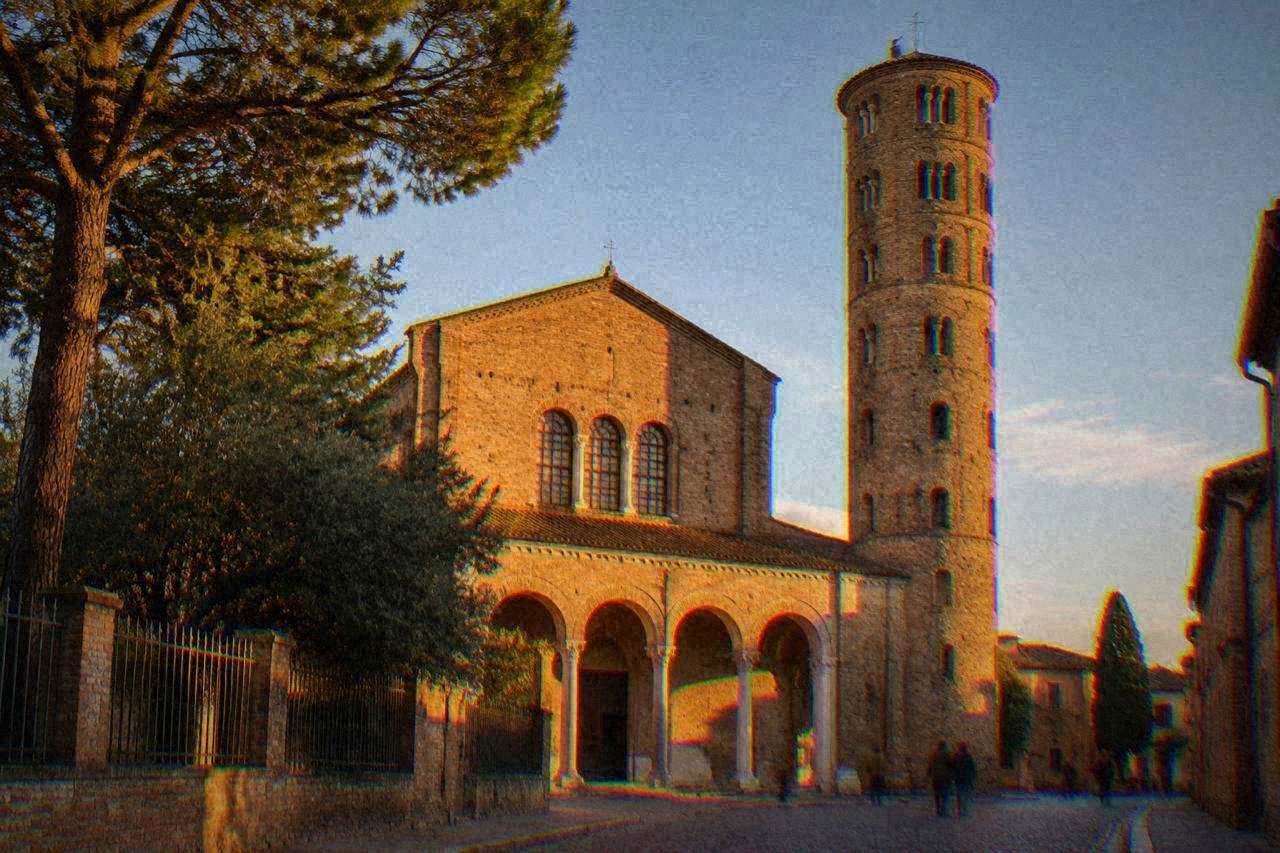
Sant'Apollinare Nuovo stands on Via di Roma in Ravenna, the inland Po-valley city in Emilia-Romagna whose eight Early Christian monuments were inscribed together on the UNESCO World Heritage List in 1996, and the question of when it was built is the one thing the official listing does not answer with a number. The UNESCO entry names the basilica among the eight monuments, alongside San Vitale, the Mausoleum of Galla Placidia, the Neonian Baptistery, the Arian Baptistery, Sant'Apollinare in Classe, the Archiepiscopal Chapel and the Mausoleum of Theodoric, and describes their Byzantine mosaics, but it carries no construction year for any of them. What a visitor can verify is what the basilica shows: a nave lined with gold-ground glass mosaics on both walls, a brick drum and apse, and a marble sarcophagus row along the aisles. This page from the Ravenna Travel Guide editorial desk sets out what the official sources state, what they leave to art historians, and how to plan a visit around it.
When Was Sant'apollinare Nuovo Built?
The UNESCO World Heritage listing for the Early Christian Monuments of Ravenna names Sant'Apollinare Nuovo as one of eight inscribed monuments and describes its mosaics, but it states no construction date, no architect and no founding patron. For a year, a ruler or a building campaign, the reader needs art-historical literature beyond the official listing, and any date given in a guidebook should be checked against that scholarship rather than against the UNESCO text.
The basilica appears in the UNESCO inscription text as part of the serial site inscribed in 1996. The listing's own vocabulary, "Early Christian" and "Byzantine mosaics", is the wording the site uses, and this guide keeps to it. What the listing does record is the monument's role within the group: eight buildings across the city and at Classe that together document the mosaic art Ravenna is known for. The full guide to the eight UNESCO sites in Ravenna lists all eight with their locations.
Visitors who want the dating question answered in person have a practical option. The basilica's mosaics are the primary evidence scholars use, and a guided walk that explains the walls panel by panel covers exactly that material. The Ravenna and its Treasures private half-day walking tour visits the basilica together with the other centre monuments, and its live listing shows what is included.
What Do The Official Ravenna Pages Say About The Basilica?
The municipal and tourism pages describe Sant'Apollinare Nuovo through its mosaics and its place in the UNESCO group, and neither page prints a construction year. The Visit Ravenna entries for the monument give the visitor facts that can be checked on the spot: the nave mosaic cycle, the procession of martyrs and virgins, the port and palace scenes, and the basilica's inclusion in the combined ticket. A date is simply not part of what those pages promise.
The basilica is on the Ravenna Mosaici combined ticket. The two-monument combination covers Sant'Apollinare Nuovo and San Vitale, the four-monument combination adds the Mausoleum of Galla Placidia and the Neonian Baptistery, and the five-monument combination adds the Archiepiscopal Museum and the Chapel of St Andrew. The ticket is valid for one week, allows one admission per monument, and an entry time must be booked for each monument. Reduced fares start at EUR 9.50 for two monuments, EUR 11.50 for four and EUR 13.50 for five, and the full prices sit on the Ravenna Mosaici entrance page. Children aged 0 to 10, residents of Ravenna, ICOM members, licensed guides, and visitors with a disability plus one companion enter free.
Want to see the mosaic walls for yourself? Book a monument entry ticket here.
| Combination ticket | Monuments covered | Reduced fare |
|---|---|---|
| 2 monuments | Sant'Apollinare Nuovo, San Vitale | EUR 9.50 |
| 4 monuments | Adds Galla Placidia, Neonian Baptistery | EUR 11.50 |
| 5 monuments | Adds Archiepiscopal Museum, Chapel of St Andrew | EUR 13.50 |
The basilica has its own attraction page on this site, with the mosaic walls described in visiting order: the basilica of Sant'Apollinare Nuovo guide. For the other great basilica in the group, the San Vitale builder question page works the same way: it reports what the official record holds and what it does not.
What Can You See Inside Sant'Apollinare Nuovo Today?
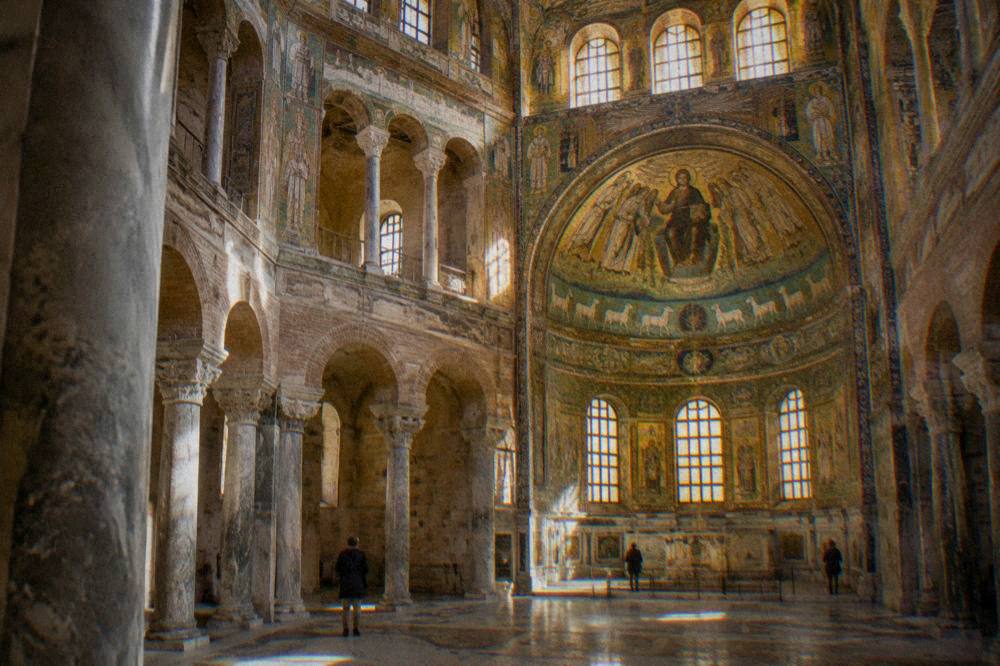
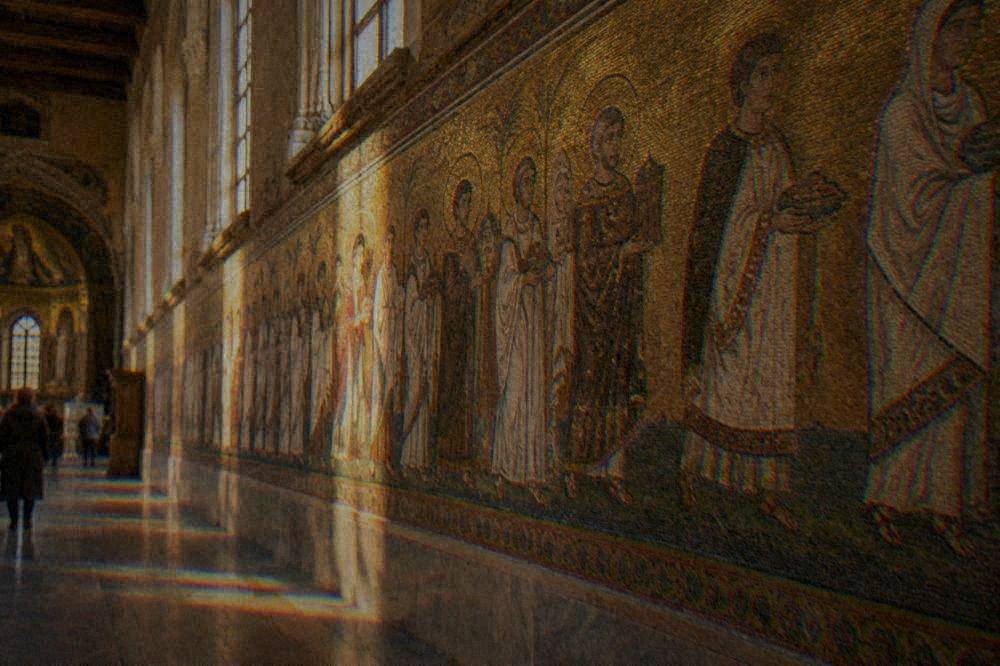
The interior shows two long mosaic walls above the colonnades, with a procession of female virgins on one side and male martyrs on the other, walking toward the apse and the figure of Christ, plus palace and port scenes near the west end, all in gold-ground glass tesserae. The UNESCO listing describes these as Byzantine mosaics within its Early Christian framing. Marble sarcophagi stand along the aisles, and the floor and arcades carry later restorations the on-site panels document.
The basilica rewards slow looking. The two processions are the reason art historians argue about the building's phases: the walls carry visible changes in style and in the figures' hands, and those changes are the evidence behind every dating argument. Nothing in the visitor experience depends on resolving it. A private guide can point out where the mosaic styles shift along the nave, which is the closest a visitor gets to seeing the chronology question with their own eyes.
The counterpoint to this basilica is its twin name at Classe. Sant'Apollinare in Classe stands outside the centre in the Classe area, holds its own mosaic apse, and charges EUR 6 full and EUR 2 reduced, open Monday to Saturday 8:30 to 19:00 and Sunday 13:30 to 19:00. The Classis Ravenna museum sits in the same area, and the TAMO museum closed in 2023 with its collection moved there.
What Are The Opening Hours For Ravenna's Mosaic Monuments?
The Ravenna Mosaici entrance page gives summer hours of 9:00 to 19:00 from 8 March to 2 November 2026, with last admission at 18:30 for Sant'Apollinare Nuovo, San Vitale and the Archiepiscopal Museum, and winter hours of 10:00 to 17:00 from 3 November 2026 to 6 March 2027, with last admission at 16:30. The monuments close on 25 December and 1 January, and no weekly closure applies to the basilica.
| Period | Hours | Last admission |
|---|---|---|
| 8 March to 2 November 2026 | 9:00 to 19:00 daily | 18:30 |
| 3 November 2026 to 6 March 2027 | 10:00 to 17:00 daily | 16:30 |
| Closed days | 25 December and 1 January |
One booking rule matters at the other monuments more than here: Galla Placidia and the Neonian Baptistery require a booked entry time and allow a stay of a few minutes, and San Vitale admits in slots. The basilica itself is a standing visit. The same page notes that timed entry applies to the Archiepiscopal Museum and Chapel of St Andrew as well, so the five-monument itinerary needs a little planning at booking. For a full narrative of the city's rise, the page on why Ravenna was the capital of the Western Roman Empire covers the political background that brought the mosaic workshops to the city in the first place.
How Does A Visit To The Basilica Fit Into A Day In Ravenna?
The basilica sits inside the historic centre, a short walk from Piazza del Popolo and from San Vitale, so it fits into a morning or afternoon without transport, and the combined ticket is designed for exactly that circuit. A one-day plan can cover Sant'Apollinare Nuovo, the Neonian Baptistery, Galla Placidia and San Vitale on foot, with Dante's tomb, which is free and open 10:00 to 18:00 from November to March and 10:00 to 19:00 from April to October, as a stop between them.
The centre is flat and compact, and the railway station is a short walk from it, so arriving by train and leaving the same evening works without a car. The state museums and monuments are free on the first Sunday of the month, which changes the arithmetic for budget planning. Visitors with more time can pair the city with the coast: the beach resorts of Marina di Ravenna, Punta Marina and the lidos are 8 km or more from the centre and are reached by Start Romagna bus from the station, so the beach is a separate half-day rather than a stroll after the mosaics. The does Ravenna have a beach page covers that route in detail.
For travellers who prefer a guide to the mosaic walls, the private options below cover the basilica within a centre walk, and one goes further afield into the wetlands of the Po Delta, where a birdwatching outing with a species guarantee runs year-round. Each listing shows its own price, rating and cancellation terms at booking.
Common Questions About Sant'Apollinare Nuovo In Ravenna
When was Sant'Apollinare Nuovo built?
The UNESCO listing names the basilica among the eight Early Christian monuments of Ravenna but gives no construction date, and neither do the municipal monument pages. Any specific year comes from art-historical scholarship, which bases its arguments on visible changes in the mosaic style along the nave walls.
Is Sant'Apollinare Nuovo one of the UNESCO sites?
Yes. It is one of the eight monuments in the serial inscription of the Early Christian Monuments of Ravenna, inscribed in 1996, together with San Vitale, the Mausoleum of Galla Placidia, the Neonian Baptistery, the Arian Baptistery, the Archiepiscopal Chapel, the Mausoleum of Theodoric and Sant'Apollinare in Classe.
Do I need a timed entry for Sant'Apollinare Nuovo?
No timed stay applies at the basilica itself. Timed entry is mandatory at the Mausoleum of Galla Placidia and the Neonian Baptistery, where visits last a few minutes, and San Vitale admits in slots. An entry time must still be booked for each monument covered by the combined ticket.
What does the combined ticket cost?
Reduced fares start at EUR 9.50 for the two-monument ticket covering Sant'Apollinare Nuovo and San Vitale, EUR 11.50 for four monuments and EUR 13.50 for five. Full prices and current conditions are on the Ravenna Mosaici entrance page, and the ticket is valid for one week with one admission per monument.
What is the difference between Sant'Apollinare Nuovo and Sant'Apollinare in Classe?
Sant'Apollinare Nuovo is in the historic centre and is covered by the Ravenna Mosaici combined ticket. Sant'Apollinare in Classe stands in the Classe area outside the centre, is also UNESCO-listed, and sells its own ticket at EUR 6 full and EUR 2 reduced.
The dating question will keep filling guidebooks, but the visit does not wait on it: the mosaics are on the walls, the ticket is on the official page, and the basilica is open every day of the week except 25 December and 1 January.