Sant Apollinare Nuovo
The Basilica of Sant'Apollinare Nuovo in Ravenna carries two long mosaic walls that run the length of the nave, and it sits on the Ravenna Mosaici combo ticket together with San Vitale and, on the larger tickets, Galla Placidia and the Neonian Baptistery. This page covers what the mosaics show, what the ticket includes, the hours, and how to plan the visit.
Short answer
Sant'Apollinare Nuovo is one of the eight UNESCO Early Christian monuments of Ravenna. It is covered by the Ravenna Mosaici combo ticket, from EUR 9.50 reduced for two monuments, and it opens 9:00 to 19:00 in summer and 10:00 to 17:00 in winter, closed 25 December and 1 January.
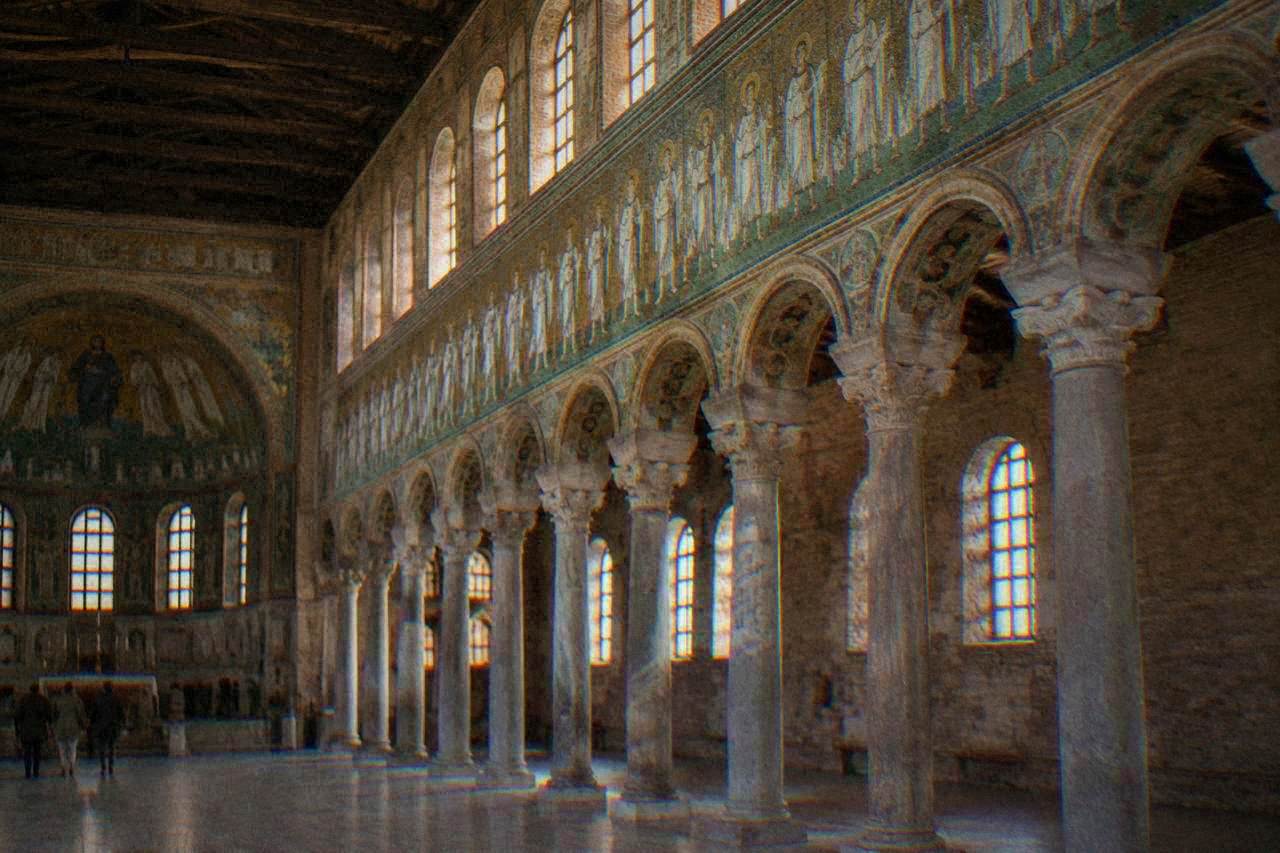
The Basilica of Sant'Apollinare Nuovo stands on Via di Roma in Ravenna, a short walk from the railway station and inside the historic centre of this inland city on the Po plain, about 8 km from the Adriatic coast. It is one of the eight UNESCO Early Christian monuments of Ravenna, inscribed by UNESCO in 1996, and its interior holds the element no other monument in the city offers in the same way: two uninterrupted mosaic bands, one per side, that run the whole length of the nave above the colonnade. The basilica is part of the Ravenna Mosaici combined ticket, which is the practical way nearly everyone visits it, and this Ravenna Travel Guide page sets out what the mosaics show, what the ticket covers, the opening hours, and how to place the basilica inside a day among the other monuments.
What Is Sant'Apollinare Nuovo In Ravenna?
Sant'Apollinare Nuovo is a basilica in the historic centre of Ravenna, one of the eight UNESCO Early Christian monuments inscribed in 1996, and the monument whose nave walls carry two long processional mosaic bands that run above the colonnades from end to end. The Ravenna Mosaici combined ticket covers it, from EUR 9.50 reduced for the two-monument itinerary with San Vitale.
The UNESCO listing names the eight monuments together: the Mausoleum of Galla Placidia, the Neonian Baptistery, Sant'Apollinare Nuovo, the Arian Baptistery, the Archiepiscopal Chapel, the Mausoleum of Theodoric, San Vitale and Sant'Apollinare in Classe. UNESCO's own wording describes the group as Early Christian monuments with Byzantine mosaics, and those two labels, "Byzantine mosaics" and "Early Christian", are the listing's own terms rather than an art-historical claim made by this page. Sant'Apollinare Nuovo is the only one of the eight inside the historic centre that functions as a full-length basilica you walk through rather than a chapel or a baptistery you step into, and that shape is what makes the interior read the way it does.
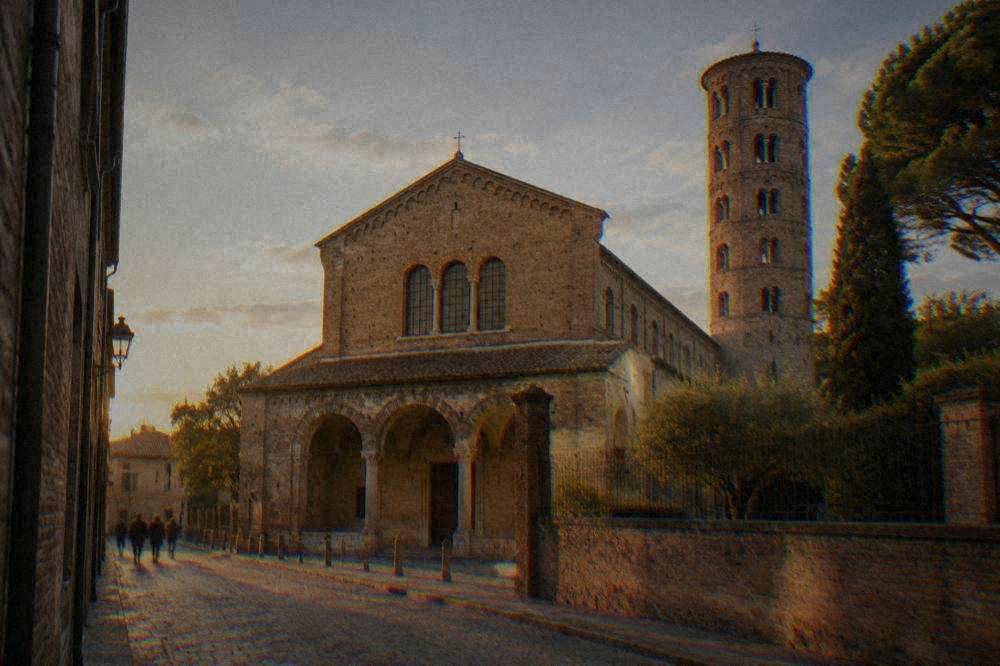
The building faces onto Via di Roma, the straight street that links the railway station side of the city with Piazza del Popolo, so the basilica sits directly on the route between the station, the mosaic circuit and the centre. The name distinguishes it from Sant'Apollinare in Classe, the larger basilica of the same dedication in the Classe area outside the centre, and the two are frequently confused by visitors planning a first trip. The two monuments share an entry system run by the same ticketing body but are not interchangeable: Classe is a separate trip, reached by car, bike or bus, while Sant'Apollinare Nuovo is walked to.
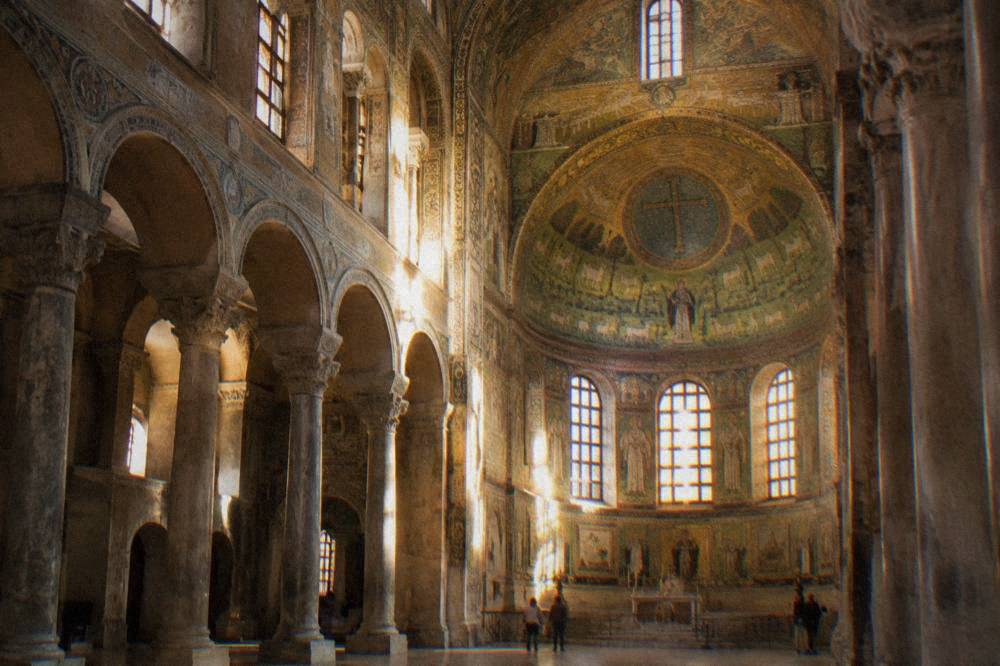
The marble colonnade, the bare brick exterior and the raised mosaic bands give the interior its rhythm. Nothing in the sources this site reports from attaches an architect or a construction date to the building, and none is needed for a visit: what the page can describe is what stands there, the two mosaic walls, the colonnade, the timber roof line and the apse rebuilt in later centuries, which is visible as a change in material at the east end.
What Do The Mosaics Of Sant'Apollinare Nuovo Show?
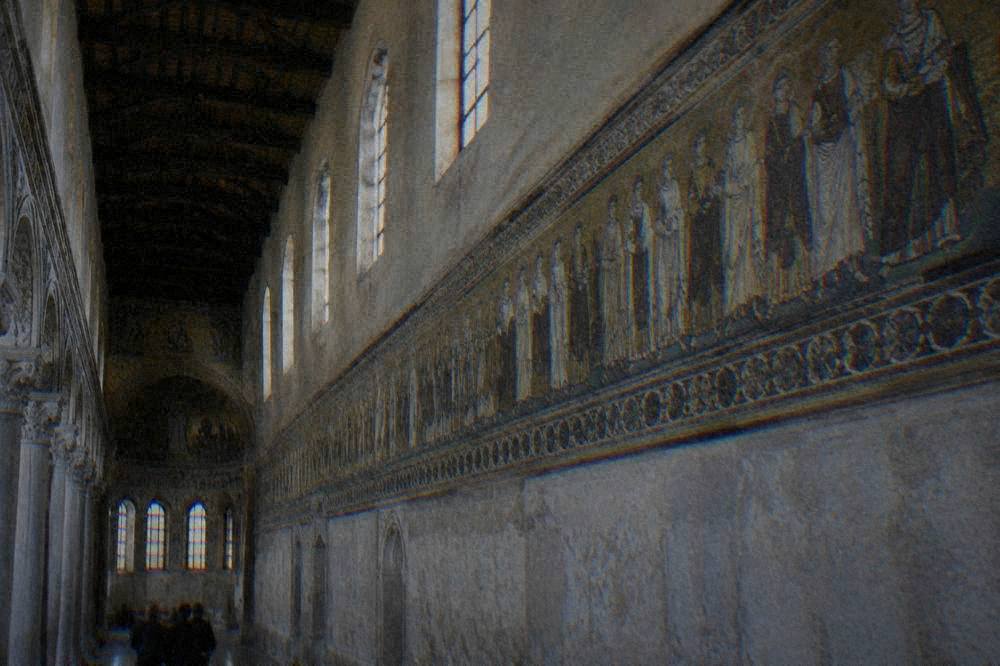
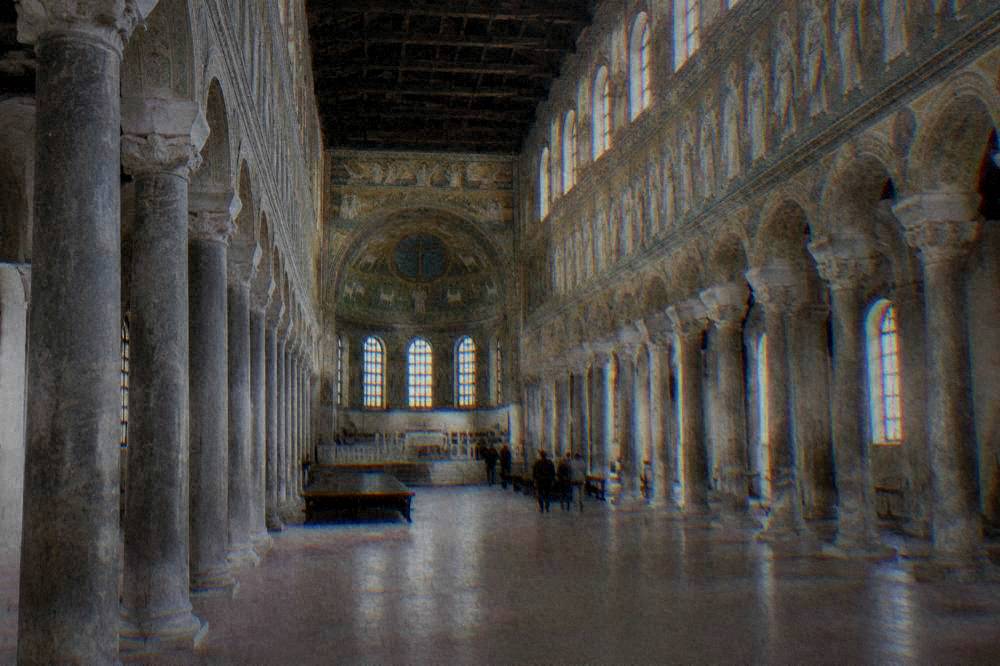
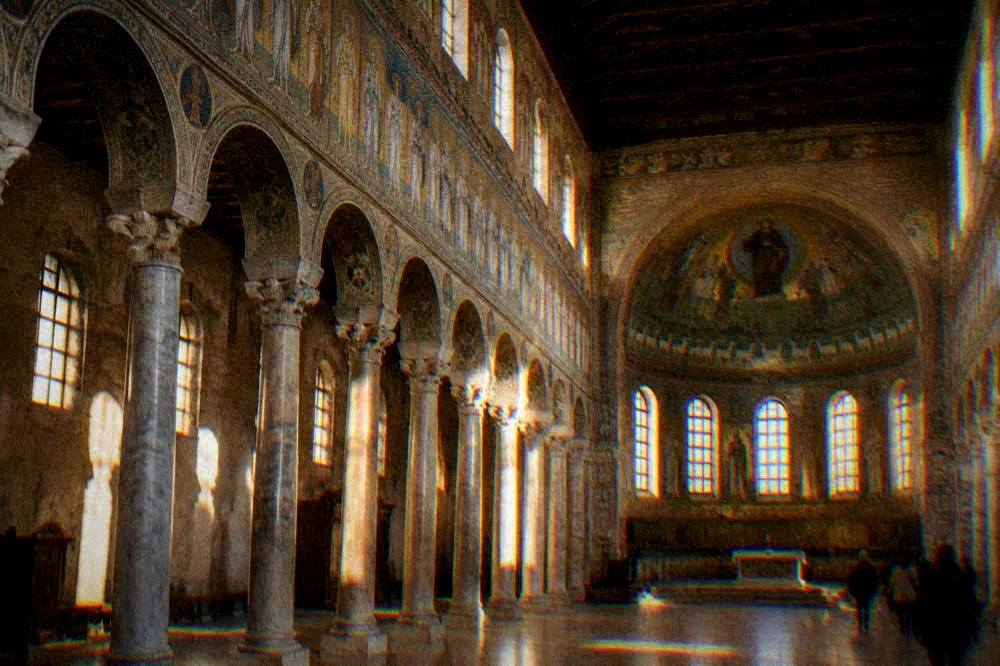
The two nave walls of Sant'Apollinare Nuovo carry processional mosaics: a line of female figures moving toward the Virgin and Child on one side, a line of male figures moving toward Christ on the other, with palaces and porticoed courtyards set between the procession and the windows, and a further strip of small scenes from the life of Christ above. The walls read left to right as one continuous story.
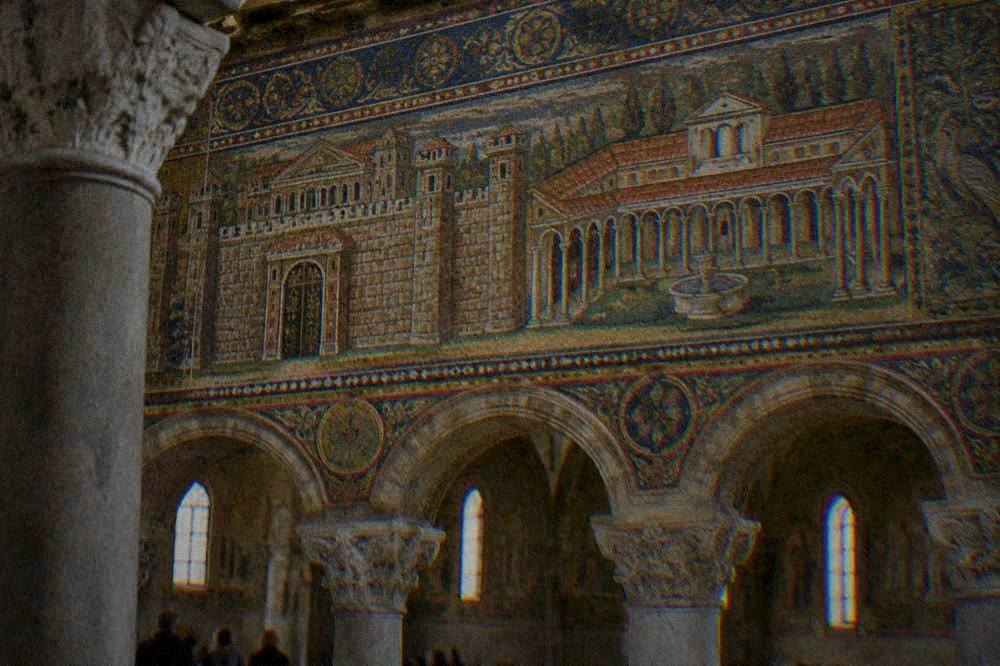
The lower band on the north side shows a procession of virgins approaching the Virgin enthroned with the Child, led by the Three Magi in patterned trousers, named in Latin lettering beside each figure. Opposite, on the south wall, male martyrs process toward a seated Christ, led by Saint Martin. Between the processions and the clerestory windows runs a second register with a walled palace front on one side and a colonnaded courtyard on the other, and above that, closest to the roof, a third band of small framed panels showing moments from the life of Christ, arranged in two rows. The lettering beside the Magi and beside several of the figures is one of the details visitors can read from the floor without any aid.
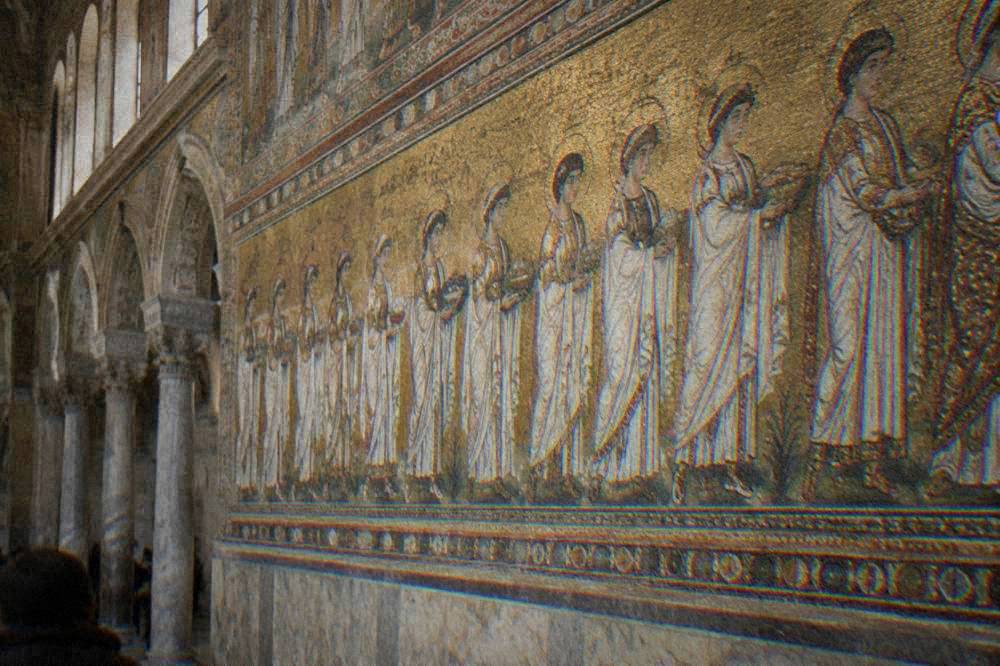
Two features reward standing still rather than walking. The first is the scale: because the bands run the full length of the nave, the eye follows a procession that only ends at the apse, and the floor of the nave is the viewing position for all of it. The second is the presence of two palaces, the one labelled as a royal palace on the south side and the porticoed court on the north, which the mosaics show as city architecture rather than as narrative scenery. The gold ground is glass tesserae, the same material used at Galla Placidia and San Vitale, set at slightly varied angles so the surface catches light unevenly as you move.
The apse itself is not part of the early mosaic programme: the sources describe it as rebuilt, and its decoration belongs to a later phase, so a visitor comparing the nave bands with the apse is looking at two different periods of the same building. A practical viewing order is to walk the nave once at normal pace, then return to the west end and read each wall slowly from the processional start, because the processions are oriented toward the apse and make sense walked in that direction.
A guided walk places the basilica in the sequence the mosaics were made for, and several of the city's guided products include it with the other monuments; a private walk such as the one below lets the sequence be tailored.
How Much Does A Ticket To Sant'Apollinare Nuovo Cost?
Sant'Apollinare Nuovo is not sold as a standalone ticket: the Ravenna Mosaici combined ticket covers it, and reduced fares start at EUR 9.50 for the two-monument itinerary with San Vitale, EUR 11.50 for four monuments and EUR 13.50 for five. The ticket is valid one week, one admission per monument, with a booked entry time for each.
To lock in your entry for the basilica and its neighbours, book a mosaics entry ticket here.
The Ravenna Mosaici ticket page structures the combined ticket in three itineraries, and the table below shows how the basilica sits inside them.
| Itinerary | Monuments covered | Reduced fare |
|---|---|---|
| 2 monuments | Sant'Apollinare Nuovo, San Vitale | EUR 9.50 |
| 4 monuments | The two above, plus the Mausoleum of Galla Placidia and the Neonian Baptistery | EUR 11.50 |
| 5 monuments | The four above, plus the Archiepiscopal Museum and Chapel of St Andrew | EUR 13.50 |
Reduced fares apply to students, non-accredited journalists and paying groups over 20, and entry is free for children aged 0 to 10, residents of Ravenna, ICOM members, licensed guides, and visitors with a disability plus one companion. The full-price fares are on the Ravenna Mosaici ticket page, which also lists the terms of purchase: the ticket is valid one week, allows one admission per monument, and requires an entry time to be booked for each monument on the itinerary. Galla Placidia and the Neonian Baptistery require a booked entry time and allow a stay of a few minutes each, and San Vitale admits visitors in slots, so the scheduling constraint sits with those monuments rather than with Sant'Apollinare Nuovo, which has no timed stay.
Three monuments outside the circuit are worth naming so nobody buys the wrong ticket expecting them. The Mausoleum of Theodoric is ticketed separately at EUR 6, with a concession of EUR 5 and EUR 2 for ages 18 to 25, or EUR 7 combined with the Arian Baptistery and Theodoric's Palace. The Arian Baptistery alone is EUR 3, and Sant'Apollinare in Classe is EUR 6 full and EUR 2 reduced. The state museums and monuments are free on the first Sunday of the month, a detail worth checking against your travel dates.
If you prefer the monuments with a guide and the entries arranged, the walks below cover the mosaic circuit including this basilica.
What Are The Opening Hours Of Sant'Apollinare Nuovo?
Sant'Apollinare Nuovo follows the Ravenna Mosaici seasonal hours: 9:00 to 19:00 from 8 March to 2 November 2026 with last admission at 18:30, and 10:00 to 17:00 from 3 November 2026 to 6 March 2027 with last admission at 16:30. The monument is closed on 25 December and 1 January.
The same seasonal pattern applies across the Ravenna Mosaici circuit, with one difference in last-admission times between the larger basilicas and the two small timed monuments, as the table shows.
| Period | Sant'Apollinare Nuovo, San Vitale, Archiepiscopal Museum | Galla Placidia, Neonian Baptistery | Closed |
|---|---|---|---|
| Summer, 8 March to 2 November 2026 | 9:00 to 19:00, last admission 18:30 | 9:00 to 19:00, last admission 18:45 | 25 December, 1 January |
| Winter, 3 November 2026 to 6 March 2027 | 10:00 to 17:00, last admission 16:30 | 10:00 to 17:00, last admission 16:45 | 25 December, 1 January |
There is no weekly closing day, which distinguishes the mosaic circuit from several of the city's museums: the National Museum of Ravenna closes Mondays, the MAR closes Mondays and 25 December, and the Museo Dante closes Mondays. If your itinerary mixes basilicas and museums, a Monday in Ravenna is a day for the mosaic circuit rather than the museums. One-off changes are announced on the official Ravenna Mosaici page, and the free evening openings that the city runs at events such as the October Notte d'Oro are published on the event pages rather than the monument pages, so the last entry time to check before travelling is always the official one.
How Long Does A Visit To Sant'Apollinare Nuovo Take?
A visit to Sant'Apollinare Nuovo takes roughly 20 to 30 minutes at an unhurried pace, because the interior is one nave read from the floor in both directions, with no crypt, no museum rooms and no timed exit. Reading the three mosaic registers slowly on both walls takes longer, so a visitor who wants to study the panels rather than walk them can budget close to an hour.
The basilica's shape is the reason the visit is short: unlike San Vitale, which concentrates its mosaics in a presbytery and apse you circle, or the Archiepiscopal Chapel, which is a single small room, Sant'Apollinare Nuovo is a linear interior. You enter at the west end, the processions run toward you or away from you depending on the wall, and there is no furniture or barrier between you and the reading of the walls. The companion pieces on the same ticket differ sharply in pace, and the table below compares them so a half-day or full-day plan can be sequenced.
| Monument on the combo ticket | Type of space | Timed stay or slot |
|---|---|---|
| Sant'Apollinare Nuovo | Full-length basilica, mosaic walls read from the nave | No timed stay |
| San Vitale | Central-plan basilica, mosaics in the presbytery and apse | Admissions in slots |
| Mausoleum of Galla Placidia | Small cruciform chapel | Booked entry time, stay of a few minutes |
| Neonian Baptistery | Small octagonal baptistery | Booked entry time, stay of a few minutes |
| Archiepiscopal Museum and Chapel of St Andrew | Museum plus chapel | Booked entry time |
Because Galla Placidia and the Neonian Baptistery require booked entry times with stays of a few minutes, the practical way to build a day is to anchor the timed entries first and place the untimed monuments, Sant'Apollinare Nuovo among them, around them. The basilica's position on Via di Roma makes it a natural first or last stop for anyone arriving from the station, and the site's one day in Ravenna itinerary uses it in exactly that role. For a fuller plan, the things to do in Ravenna page sequences all the monuments together.
A guided product that includes tickets removes the entry-time booking from your side of the table, which matters most in the high season when the timed monuments fill first.
How Do You Get To Sant'Apollinare Nuovo?
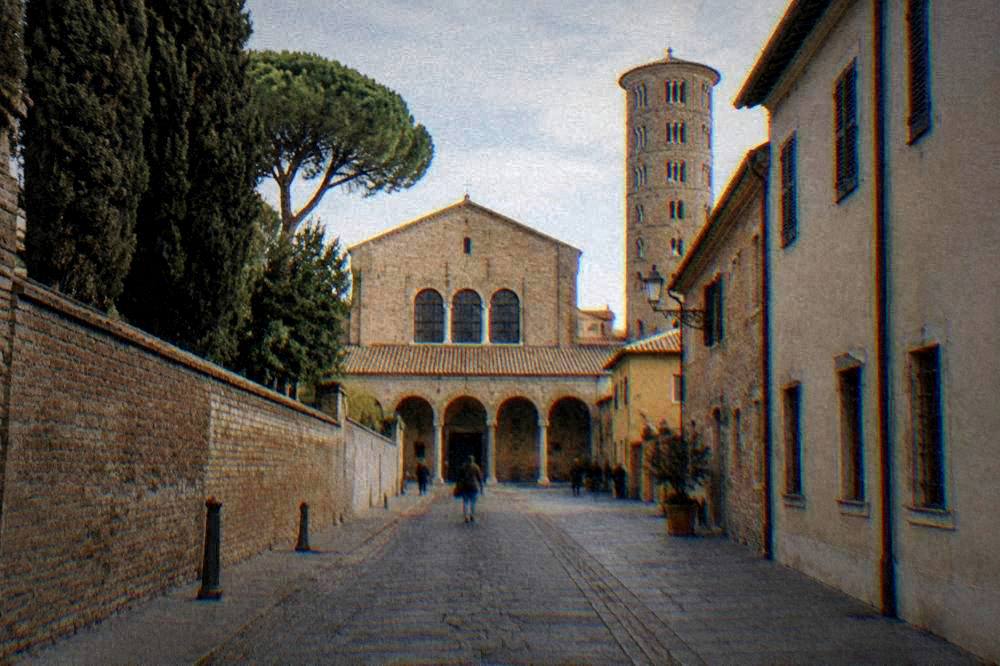
Sant'Apollinare Nuovo is on Via di Roma in the historic centre of Ravenna, a short walk from the railway station and on the walking route between the station and Piazza del Popolo. The centre is compact and flat, and the basilica needs no transport once you are inside it: it is reached on foot from the station, from any central accommodation, or as a stop on a walking route through the other monuments.
The railway station sits a short walk from the historic centre, and Via di Roma runs from that side of the city toward the heart of it, so the basilica is passed by anyone walking the obvious route. Drivers should note two things before setting out. First, the historic centre's limited traffic zone, the ZTL, is camera-enforced, with some gates active 7:30 to 20:30 and others 24 hours; a daily permit of about EUR 8 is bought at the 24-hour parcometers, and hotels can issue a guest authorisation, so the correct move is to arrange access with your accommodation before driving in. Second, parking tariffs are posted at the car parks themselves, so the figure to trust is the one at the machine. The details are on the site's parking and ZTL guide.
Cruise passengers arrive at the Porto Corsini terminal, about 15 km from the centre, and the Visit Ravenna shuttle runs between the centre, the station area and the terminal in about 30 minutes on the 2026 schedule, which the shuttle page gives as 3 May to 26 October. From the shuttle drop-off the basilica is inside the walkable centre. The site's Ravenna cruise port guide covers the transfer in full, and the historic centre page maps the walking distances between the monuments. Regional trains connect Ravenna with Bologna in about 1 hour to 1 hour 20 over about 84 km by direct regional train, so a day trip from Bologna also lands you a short walk from this basilica.
For visitors combining the city with Venice, a Venice shore excursion from the Ravenna port area handles the long transfer in one booking; the listing below is that product.
Sant'Apollinare Nuovo Or Sant'Apollinare In Classe: Which Should You See?
Sant'Apollinare Nuovo is the one to see if your time is short: it is in the historic centre, on the combo ticket, and its two processional mosaic walls are unique in the city. Sant'Apollinare in Classe is worth the separate trip if you have a second day or a spare half-day, for its vast nave, its mosaic apse showing the Transfiguration, and its setting among the pinewoods of the Classe area.
The two basilicas share a name and a saint but almost nothing else about the visiting experience. The table below sets out the differences that matter when planning.
| Sant'Apollinare Nuovo | Sant'Apollinare In Classe | |
|---|---|---|
| Location | Historic centre, on Via di Roma | Classe area, outside the centre |
| Ticket | Ravenna Mosaici combo, from EUR 9.50 reduced | EUR 6 full, EUR 2 reduced |
| Hours | 9:00 to 19:00 summer, 10:00 to 17:00 winter | Monday to Saturday 8:30 to 19:00, Sunday 13:30 to 19:00 |
| Getting there | On foot from the station or the centre | Car, bus or bike from Ravenna |
| Signature mosaics | Twin processional walls the length of the nave | Apse mosaic of the Transfiguration and the green meadow cross |
Sant'Apollinare in Classe stands beside the Classis Ravenna museum, which the site covers in its own Classis Ravenna page, and the museum holds the collection of the former TAMO mosaic museum, which closed in 2023. A visit to Classe therefore pairs the basilica with a museum in one trip, while Sant'Apollinare Nuovo pairs with everything in the centre. Sunday visitors should note the Classe hours: the basilica there opens only in the afternoon on Sundays, at 13:30.
What Is Near Sant'Apollinare Nuovo In Ravenna?
Within a short walk of Sant'Apollinare Nuovo are the Basilica of San Francesco with Dante's tomb beside it, Piazza del Popolo with the city's civic buildings, the Arian Baptistery a street away, and the rest of the Ravenna Mosaici circuit including San Vitale and the Archiepiscopal Museum. The whole set sits inside the flat, walkable historic centre.
The basilica's position on the main axis makes it the hinge of a walking circuit rather than an outlier. The Arian Baptistery, EUR 3 entry, lies a street away and its small dome is a direct comparison with the Neonian Baptistery on the combo ticket. Continuing toward the centre brings Piazza del Popolo, the Ravenna Cathedral site and the Archiepiscopal Museum, and then San Vitale and Galla Placidia, which stand together on one side of the centre. Toward the other side, past the basilica toward the station, sits the Basilica of San Francesco, and beside its cloister is Dante's tomb, free to enter and open 10:00 to 18:00 from November to March and 10:00 to 19:00 from April to October, closed 25 December.
| Site | Relation to Sant'Apollinare Nuovo | Entry |
|---|---|---|
| Arian Baptistery | A street away on the same side of the centre | EUR 3 |
| Basilica of San Francesco and Dante's tomb | Toward the station, plain walking route | Tomb free |
| Piazza del Popolo | Central square on the walking route | Open space |
| Archiepiscopal Museum and Chapel of St Andrew | On the 5-monument combo ticket | From EUR 13.50 reduced combo |
| San Vitale and Galla Placidia | Same combo ticket, slots and timed entry | Combo |
| National Museum of Ravenna | Near San Vitale, closed Mondays | EUR 7, EUR 2 reduced |
A walking day that starts at the station can therefore run in one line: Sant'Apollinare Nuovo, the Arian Baptistery, San Francesco and Dante's tomb, Piazza del Popolo, the Archiepiscopal Museum, San Vitale and Galla Placidia, with the National Museum added on any day but a Monday. The climate table for Ravenna, modelled ERA5 normals for 1991 to 2020, shows November as the wettest month at 78.3 mm and July as the driest at 38.1 mm, with about 674 mm across the year, which matters less here than anywhere in Italy: almost the entire circuit is indoors, and the site's Ravenna in the rain page is built around exactly that fact.
Guided products vary in shape, from a private best-of walk to a mosaics walk with food tastings, and the selection below places the basilica in the company of the other monuments.
Common Questions About Sant'Apollinare Nuovo In Ravenna
Is Sant'Apollinare Nuovo included in the Ravenna Mosaico ticket?
Yes. Sant'Apollinare Nuovo is part of the Ravenna Mosaici combined ticket, on the two-monument itinerary with San Vitale, from EUR 9.50 reduced, and on the four-monument and five-monument itineraries at higher reduced fares. The ticket is valid one week with one admission per monument.
When was Sant Apollinare Nuovo built?
The site does not print a construction date or an architect for the basilica, and a visit does not depend on one. What the monument shows is the two processional mosaic walls, the colonnade and a rebuilt apse, and the UNESCO listing inscribes it among the eight Early Christian monuments of Ravenna in 1996. More on the building's background is on the site's dedicated answer page.
Do you need to book an entry time for Sant'Apollinare Nuovo?
The timed-entry requirement sits with the small monuments on the combo ticket: Galla Placidia and the Neonian Baptistery need a booked entry time and allow a stay of a few minutes, and San Vitale admits in slots. Sant'Apollinare Nuovo itself has no timed stay, but the ticket requires an entry time to be booked for each monument on the itinerary.
Is Sant'Apollinare Nuovo the same as Sant'Apollinare in Classe?
No. Sant'Apollinare Nuovo is in the historic centre of Ravenna on the combo ticket, while Sant'Apollinare in Classe stands in the Classe area outside the centre, ticketed separately at EUR 6 full and EUR 2 reduced, and opens Sunday afternoons only, from 13:30.
Is Sant'Apollinare Nuovo open on Mondays?
Yes. The Ravenna Mosaici circuit, Sant'Apollinare Nuovo included, has no weekly closing day and opens daily except 25 December and 1 January, 9:00 to 19:00 in the summer season and 10:00 to 17:00 in the winter season. It is the city's museums, among them the National Museum and the MAR, that close on Mondays.
How much time should you allow for Sant'Apollinare Nuovo?
Roughly 20 to 30 minutes at an unhurried pace, since the interior is one nave read from the floor, with longer for a slow study of the three mosaic registers on both walls. On a combined itinerary the timed monuments, not this basilica, set the pace of the day.
Sant'Apollinare Nuovo rewards the slow walk more than any other monument on Ravenna's ticket: stand at the west end, let the two processions run away from you toward the apse, and the basilica explains itself one wall at a time.
Before you go, the pick for this guide:
Mosaic Highlights, Tickets Included
★ 4.8 176 reviews · From $66
Check availability →