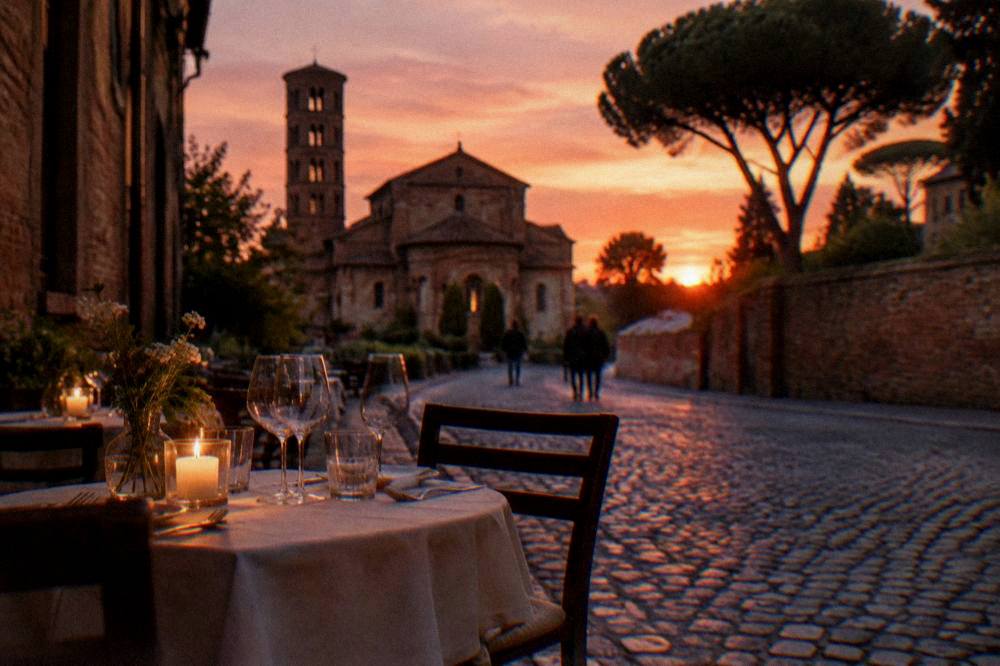
Ravenna Restaurants
Ravenna's restaurants serve the plain-cooking tradition of Romagna: fresh pasta, piadina, grilled meat and local Sangiovese, all within a compact inland centre a short walk from the mosaic monuments.
Short answer
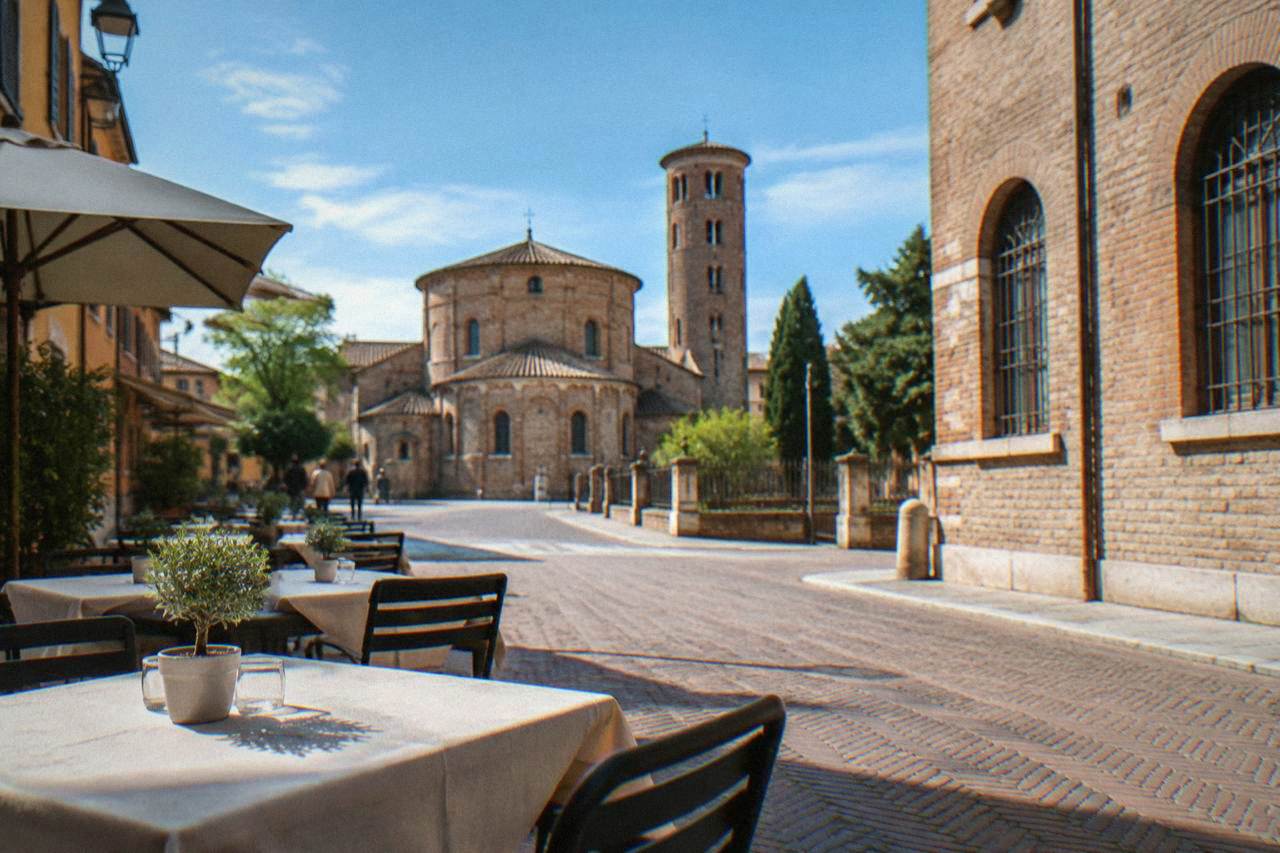
Eating in Ravenna means Romagna home cooking: cappelletti, tagliatelle, piadina and passatelli, served in a small walkable centre where the restaurants cluster around Piazza del Popolo and the streets behind it. A cover charge (coperto) is legal when printed on the menu, tipping is not obligatory, and food tours and cooking classes cover the same tradition with a guide.
Ravenna, an inland city on the flat Po plain of Emilia-Romagna about 8 km from the Adriatic coast, eats the way the rest of Romagna eats: fresh egg pasta rolled in the morning, flatbread cooked on a terracotta plate, grilled meat, and Sangiovese from the hills inland. The restaurants sit inside a compact, walkable historic centre, so a day built around the mosaic monuments, which this site covers in the guide to the eight UNESCO sites, leaves room for long lunches without any real transport planning. This page explains the dishes, the streets, the menu conventions and the food experiences available, in the order a visitor actually meets them.
What Food Is Ravenna Known For?
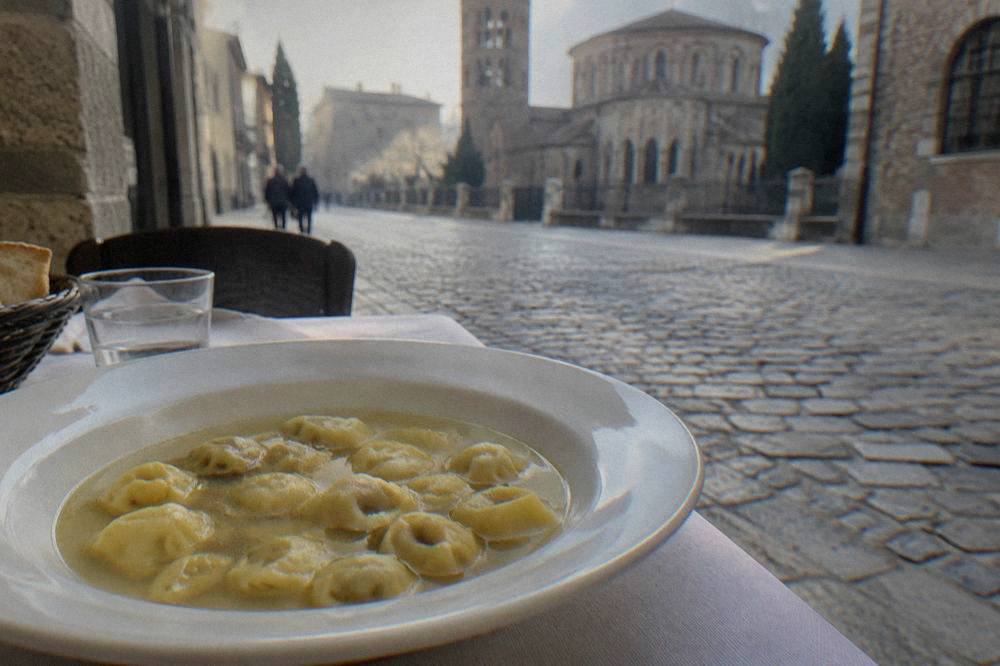
The tables of Ravenna are set with the home cooking of Romagna: cappelletti in brodo, tagliatelle al ragù, passatelli, strozzapreti, grilled meats, and piadina, the flatbread that accompanies almost every meal. Ravenna's own pages describe cappelletti as the symbolic dish of the region, and the city's food identity sits with these pastas and breads rather than with seafood, despite the coast lying a bus ride away.
Cappelletti are small hand-folded pasta parcels, traditionally served floating in a clear capon or chicken broth, and they are the dish a Romagna nonna would put at the centre of a Sunday lunch. Tagliatelle al ragù is the same egg-pasta tradition in another shape, with a slow meat sauce. Passatelli are breadcrumbs, egg and Parmesan pushed through a die to make short rough strands, cooked in broth. Strozzapreti, "priest-stranglers" in the local dialect, are hand-rolled twists that hold a ragù or simple olive oil and garlic.
The Visit Ravenna food pages list these dishes as the core of the local table, together with grilled sausages and lamb, and the Romagna flatbread piadina sold in bakeries and specialist kiosks across the centre. Squacquerone, a soft, mild, spreadable cheese, appears with piadina and rocket as the classic quick lunch. For the flatbread's own story, the site carries a dedicated piadina guide covering how it is made and where it fits the day.
Desserts follow the same plain tradition: ciambella, a ring-shaped cake meant for soaking in sweet wine, and zabaglione-style creams. The point to hold onto is that Ravenna restaurants are not chasing novelty. The menus repeat, from trattoria to osteria, because the repertoire is the region's identity.
| Dish | What It Is | How It Is Served |
|---|---|---|
| Cappelletti | Small hand-folded egg pasta parcels with cheese and meat filling | In capon or chicken broth |
| Tagliatelle al ragù | Flat egg ribbons with slow meat sauce | As a first course |
| Passatelli | Short rough strands of breadcrumb, egg and Parmesan | In broth |
| Strozzapreti | Hand-rolled twisted pasta | With ragù or olive oil and garlic |
| Piadina | Thin unleavened flatbread cooked on a terracotta plate | Filled with squacquerone, rocket, cold meats |
| Grilled lamb and sausage | Romagna griglia, charcoal-grilled meats | As a main course |
| Ciambella | Ring-shaped sponge cake | With sweet wine for dunking |
Where Do You Eat In Ravenna: Streets, Squares And Areas?
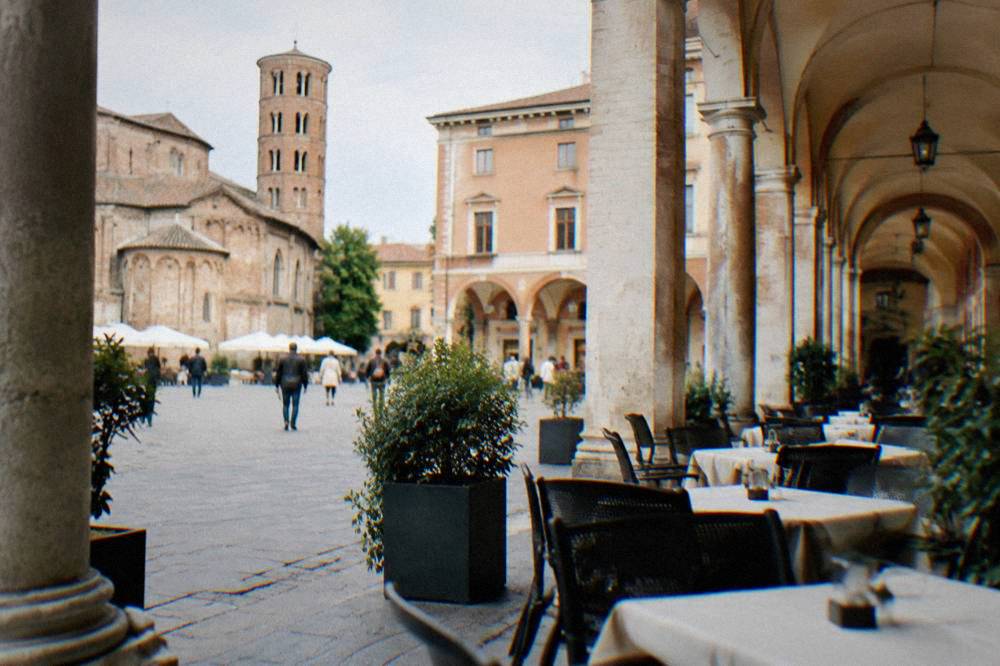
The restaurants of Ravenna cluster in and around the historic centre: Piazza del Popolo, the city's main square, the streets running off it toward the Dante area and Via Cairoli, and the lanes around the basilicas, with everything inside a walkable core. The municipal tourism pages describe the centre as compact, and no restaurant district of the city requires a bus: the tables begin a short walk from the railway station.
Piazza del Popolo is the historic heart, a grand square with cafes under arcades where the coffee-and-piadina rhythm of the day runs from morning to evening. From the square, the streets north toward Dante's tomb and the Quadrarco di Braccioforte hold small trattorias and osterias in brick and stone buildings. This is the zone to aim for when a day of mosaic-viewing, described in the mosaics guide, needs a lunch within sight of the monuments.
Further out, the area around the market and the residential streets east of the centre holds the everyday bakeries and piadina kiosks where lunch costs less and the menu is shorter. The coast is a different affair: the lidos, Marina di Ravenna and its neighbours, are beach resorts reached by Start Romagna bus from the station, and their restaurants lean harder on Adriatic fish. The Comune's press pages note a winter market operating in Marina di Ravenna on Piazza Dora Markus on the sea side, on Wednesdays and Saturdays until 31 May, which is worth knowing for an off-season beach-lunch plan.
A private tour on this site's roster pairs a morning of Ravenna history with lunch on the beach, running from Ravenna itself out to the coast: Check availability. It suits visitors who want the seaside leg handled rather than reading the bus timetable on a full stomach.
How Does Eating Out In Ravenna Work: Menus, Coperto And Tipping?
Eating out in Ravenna follows standard Italian menu convention: a coperto, a per-person cover charge for bread and table setting, is legal when it is printed on the menu, and it appears as a separate line on the bill. Tipping is not obligatory. Courses run antipasto, primo, secondo with contorni, then dolce, and nobody is expected to order every course.
The coperto is the item that catches visitors off guard. It is a legitimate charge across Italy, not a scam, but it must be printed on the menu; if a bill carries a charge that was never printed, the reader can query it, and the itemised bill, the scontrino, is the document to check. Service, when listed separately as servizio, is different again from coperto, and a menu that prints neither adds neither.
Course logic matters for pacing. The primo is the pasta course, cappelletti or tagliatelle, and the secondo is meat or fish with vegetables ordered separately as contorni. A common and completely acceptable Ravenna lunch is a single primo plus piadina, or antipasto and primo, skipping the secondo entirely. Portions are generous because the tradition is a full afternoon table, not a quick refuel.
Wine by the carafe, vino della casa, is standard and inexpensive in trattorias, and asking for it is normal. Water is ordered as still or sparkling, and it is bottled and charged, not free tap service. Reservations matter less at lunch than for weekend dinner in the small dining rooms of the centre, where a handful of tables can fill from one booking.
| Menu Item | What It Means | What To Check |
|---|---|---|
| Coperto | Per-person cover charge for bread and table | Must be printed on the menu |
| Servizio | Service charge, separate from coperto | Only if printed |
| Primo | Pasta course: cappelletti, tagliatelle, passatelli | A full lunch on its own |
| Secondo | Meat or fish main | Contorni ordered separately |
| Contorno | Side vegetable or salad | Priced individually |
| Vino della casa | House wine, often by the carafe | Ask for mezzo or quarto litro |
For eating that comes with a guide rather than a menu, a food walking tour covers mosaics and tastings in one outing:
What Is Piadina And Where Do You Find It In Ravenna?
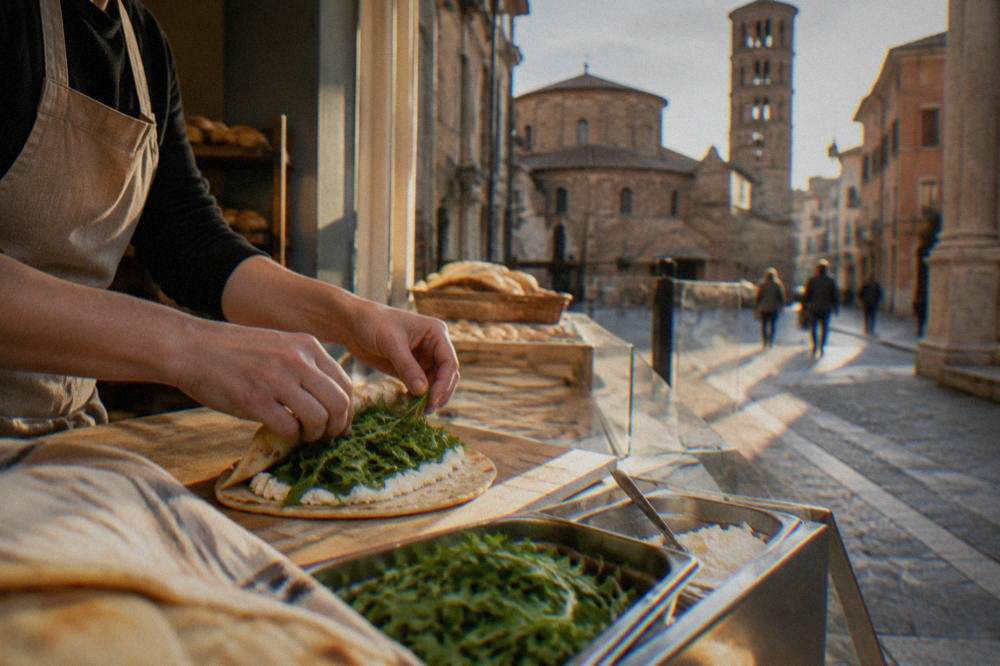
Piadina is the thin unleavened flatbread of Romagna, cooked dry on a hot terracotta or metal plate and folded around fillings such as squacquerone cheese, rocket, prosciutto and grilled vegetables. In Ravenna it is sold in bakeries, piadinerie and market stalls across the centre, and it functions as the city's standing lunch, its street food and its bread basket all at once.
The Visit Ravenna pages treat piadina as the region's signature bread, and the tradition is protected and codified in Romagna, where the thickness of the bread varies subtly from town to town. The Ravenna style sits mid-way: thin enough to fold, thick enough to hold a wet filling like squacquerone without tearing. A piadina with squacquerone and rocket is the classic order, and a porchetta or mortadella filling makes it a fuller meal.
Where to find it requires no research: any street with a bakery will have a piadina counter by mid-morning, and the kiosks around Piazza del Popolo and near the station serve the commuter crowd at lunch. The bread is made to order, cooked while the filling is assembled, so the wait is the length of the cooking, not a queue of pre-made rolls.
For visitors who want to make it rather than buy it, a cooking class on the roster teaches the dough and the plate:
Want to make piadina yourself instead of buying it? Book a piadina cooking class here.
The class format suits families and anyone whose ideal souvenir is a recipe. Free cancellation terms are shown at booking.
| Filling | What Goes In | Best Time Of Day |
|---|---|---|
| Squacquerone and rocket | Soft fresh cheese, bitter greens | Lunch |
| Prosciutto crudo | Dry-cured ham, optional squacquerone | Any time |
| Porchetta | Slow-roast herbed pork | Lunch, heartier |
| Grilled vegetables | Courgette, aubergine, peppers | Lunch, meatless |
| Nutella | The sweet version, for children and dessert | Afternoon |
Which Wines And Drinks Go With A Ravenna Meal?
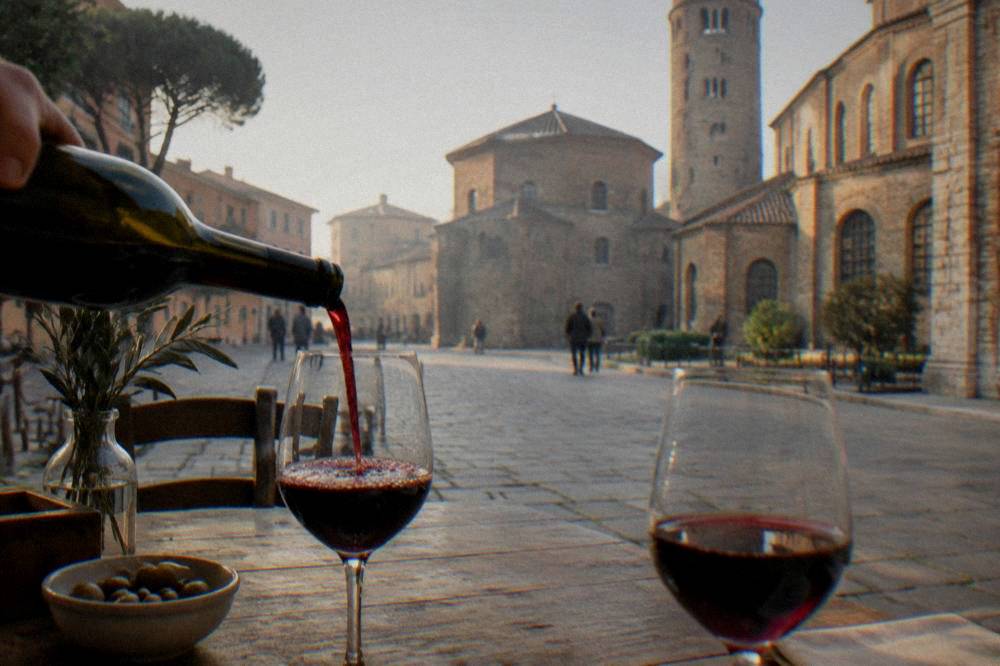
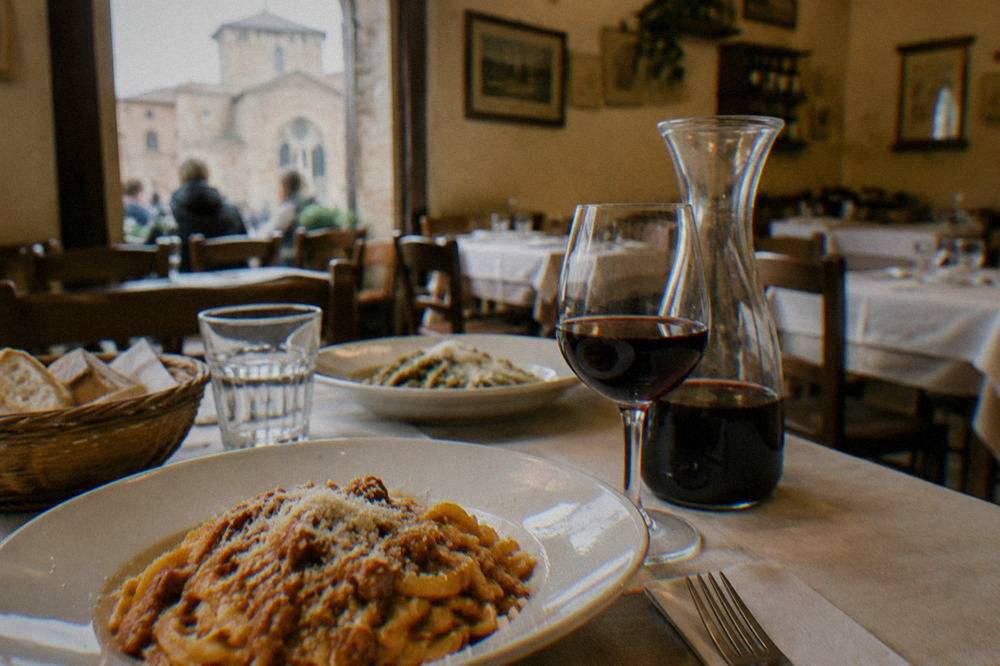
The wine list of a Ravenna restaurant is a Romagna list: Sangiovese di Romagna as the red, Albana and Trebbiano as the whites, all from the hills immediately inland, with bubbly Romagnola and local dessert wines filling the margins. House wine by the carafe is the everyday choice in trattorias, and the region's own pages present these grapes as the local answer to everything on the menu.
Sangiovese di Romagna is the structural red: the same grape as Tuscan Sangiovese, grown on the Romagna side of the Apennines, and it is the standard pairing for tagliatelle al ragù and grilled lamb. Albana, a white with its own classified status, carries enough body for the antipasto course and the seafood plates of the coast. Trebbiano is the lighter everyday white. For diners who want to visit the source, wineries in the Romagna hills inland of Ravenna run tastings, and one is bookable on this site's roster.
After dinner, the tradition is a sweet local wine with ciambella, dunked rather than sipped. Coffee is espresso, taken standing at the bar or seated at the table, and a cappuccino after a meal marks a visitor as foreign faster than any accent, since milk coffee belongs to the morning in Romagna as across Italy.
| Drink | Style | Pairs With |
|---|---|---|
| Sangiovese di Romagna | Dry red | Tagliatelle al ragù, grilled lamb |
| Albana | Full-bodied white | Antipasti, Adriatic fish |
| Trebbiano | Light dry white | Piadina, vegetables |
| Vino della casa | House wine by the carafe | Everything, everyday |
| Sweet local wine | Dessert wine | Ciambella, dunked |
How Do You Plan Meals Around The Mosaic Monuments?
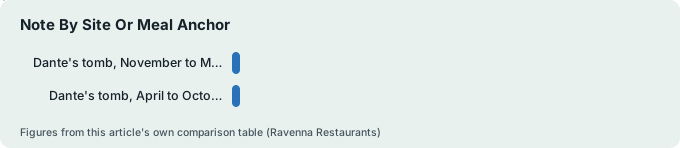
A food day in Ravenna plans itself around the monuments' clock: the Ravenna Mosaici sites run 9:00 to 19:00 in summer and 10:00 to 17:00 in winter, Dante's tomb is free and opens 10:00 to 18:00 from November to March and to 19:00 from April to October, and everything sits within walking distance of the restaurants, so lunch can be dropped into the middle of a sightseeing day without a detour.
The practical sequence is to book the mosaic monuments for the morning, when the timed entries at Galla Placidia and the Neonian Baptistery run on short stays, then eat a proper lunch, then continue with the afternoon sites. The combo ticket, which the site explains in the combo ticket guide, is valid one week with one admission per monument, so the sightseeing can even be split across two days with a restaurant-heavy day in between.
Winter shortens the window: from 3 November 2026 to 6 March 2027 the mosaic sites close at 17:00, so the last sitting of a long lunch pushes against the final admissions. The trade is that the cold months bring the city's concert and theatre season, and an evening performance at Teatro Alighieri, next to Dante's tomb, ends within a few streets of the dinner tables.
| Site Or Meal Anchor | Hours | Note |
|---|---|---|
| Ravenna Mosaici sites, 8 Mar to 2 Nov 2026 | 9:00 to 19:00 | Timed entry at Galla Placidia and Neonian Baptistery |
| Ravenna Mosaici sites, 3 Nov 2026 to 6 Mar 2027 | 10:00 to 17:00 | Closed 25 December and 1 January |
| Dante's tomb, November to March | 10:00 to 18:00 | Free entry |
| Dante's tomb, April to October | 10:00 to 19:00 | Free entry |
| Lunch in the centre | Midday onward | A short walk from all central monuments |
The seasonal angle is worth a sentence more. The climate table, modelled ERA5 normals for 1991 to 2020, puts July as the driest month at 38.1 mm and November as the wettest at 78.3 mm, with about 674 mm across the year, so terrace eating is a summer-to-early-autumn pleasure and the indoor osterias carry the winter. The site's best time to visit guide works through the same trade-offs for the trip as a whole.
Are Food Tours And Cooking Classes In Ravenna Worth Booking?
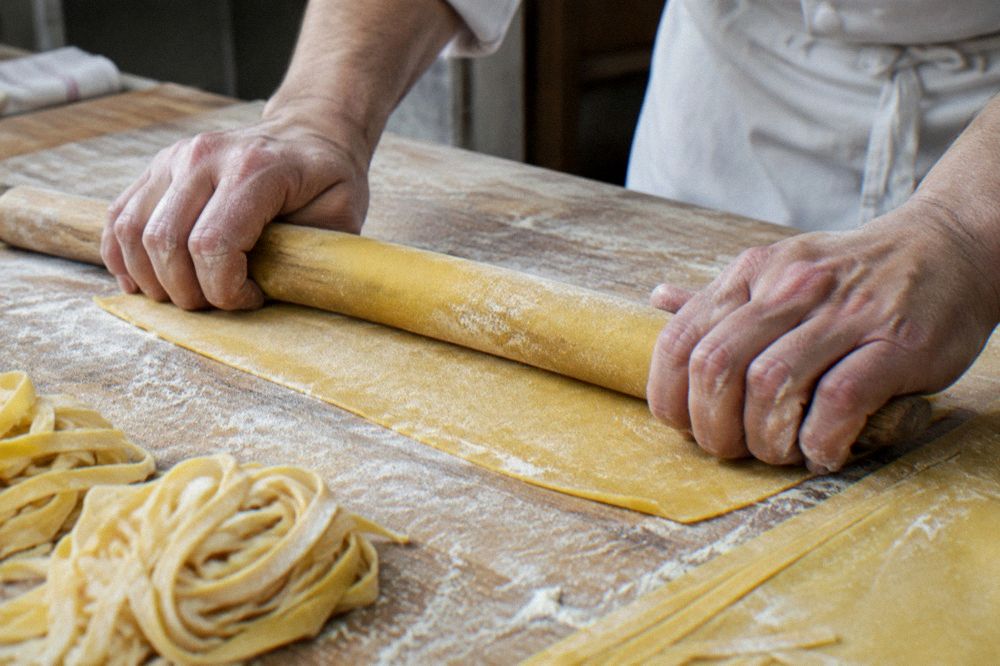
Food tours and cooking classes in Ravenna are worth booking for the access they provide rather than the food alone: a guided walk links mosaic-viewing with tastings of piadina, cheese and local wine in a single outing, and a cooking class teaches cappelletti or piadina hands-on, with the roster on this site covering both, from market-and-cooking formats to gelato classes. The deciding factor is time, since a class takes half a day.
The formats divide cleanly. Walking food tours move through the centre with stops at producers and counters, and some pair the tastings with the monuments themselves, which suits a first day in the city. Cooking classes sit still: a market tour and class begins with shopping and ends at the table, a piadina class covers the flatbread from dough to plate, and gelato classes cover churning and flavouring. The private options on the roster, including the tour that combines Ravenna's history with a beach lunch, add flexibility for families and short stays.
Booking matters for capacity reasons. Class sizes are small by design, and the walking tours that include monument tickets tie the participant to fixed entry times, so booking ahead is the practical route. Every product page on this site shows the live price, rating and availability, and cancellation terms are stated at booking.
For travellers weighing Ravenna against its neighbours, the food here is Romagna plain-cooking, closer to Bologna's tradition than to Rimini's beach menus, a comparison the site's is Ravenna worth visiting page covers alongside the mosaics.
Where Should You Stay To Be Near The Restaurants?
The best base for eating in Ravenna is the historic centre itself, the zone between the railway station, Piazza del Popolo and the basilicas, where every restaurant street in this guide sits within a short walk and no evening meal requires transport. The station-side edge of the centre is the fallback, still walkable, and the lidos only make sense for a beach-first stay.
The centre's advantage is the evening. Romagna dining runs late by northern European habit, and a table booked for the second sitting ends within a few brick-paved streets of the bed. The trade-offs are the usual ones of an old Italian core: the ZTL, the camera-enforced traffic zone, restricts driving into the centre, with some gates active 7:30 to 20:30 and others around the clock, and hotels can issue a guest authorisation for access, which the site details in its parking and access coverage under getting to Ravenna. A daily permit costs about EUR 8 at the 24-hour parcometers.
For the lodging options street by street, the site's where to stay guide does that work, and the hotels guide covers the properties themselves. What matters for this page is only the food geography: the centre wins it outright, and a stay near the station loses nothing but a few minutes' walk.
Common Questions About Ravenna Restaurants
What food is Ravenna famous for?
Ravenna is famous for the home cooking of Romagna: cappelletti in broth, tagliatelle al ragù, passatelli, strozzapreti, grilled lamb and sausage, and piadina filled with squacquerone cheese and rocket, with Sangiovese di Romagna as the standard red wine.
Is there a cover charge in Ravenna restaurants?
Yes, a cover charge, the coperto, is normal and legal, provided it is printed on the menu. It appears as a per-person line on the bill. Tipping is not obligatory in Ravenna or anywhere in Italy.
Can you eat seafood in Ravenna?
Seafood is on the menu, but the stronger tradition inland is Romagna meat and pasta cooking. Adriatic fish dishes dominate the restaurants of the lidos, Marina di Ravenna and the other beach resorts, which are reached by Start Romagna bus from the station.
What is piadina?
Piadina is the thin unleavened flatbread of Romagna, cooked dry on a hot terracotta or metal plate and folded around fillings such as squacquerone, a soft fresh cheese, plus rocket, prosciutto or grilled vegetables. It is sold across Ravenna's centre in bakeries and piadinerie.
Do you need to book restaurants in Ravenna?
Lunch rarely needs booking on weekdays. Weekend dinners in the small dining rooms of the historic centre can fill from a handful of tables, so a reservation is the safe choice for a Saturday evening in the streets around Piazza del Popolo.
Are there food tours in Ravenna?
Yes. Guided walking tours pair the city's monuments with tastings, cooking classes cover piadina, pasta and gelato, and private day tours combine Ravenna sightseeing with a beach lunch on the Romagna coast. Live prices and availability are shown on each product page.
Ravenna rewards the unhurried table: order the cappelletti, take the piadina for the road, and let the mosaic hours and the meal hours share one walkable centre, as the planning pages on Ravenna Travel Guide lay out for every season.