Ravenna Food
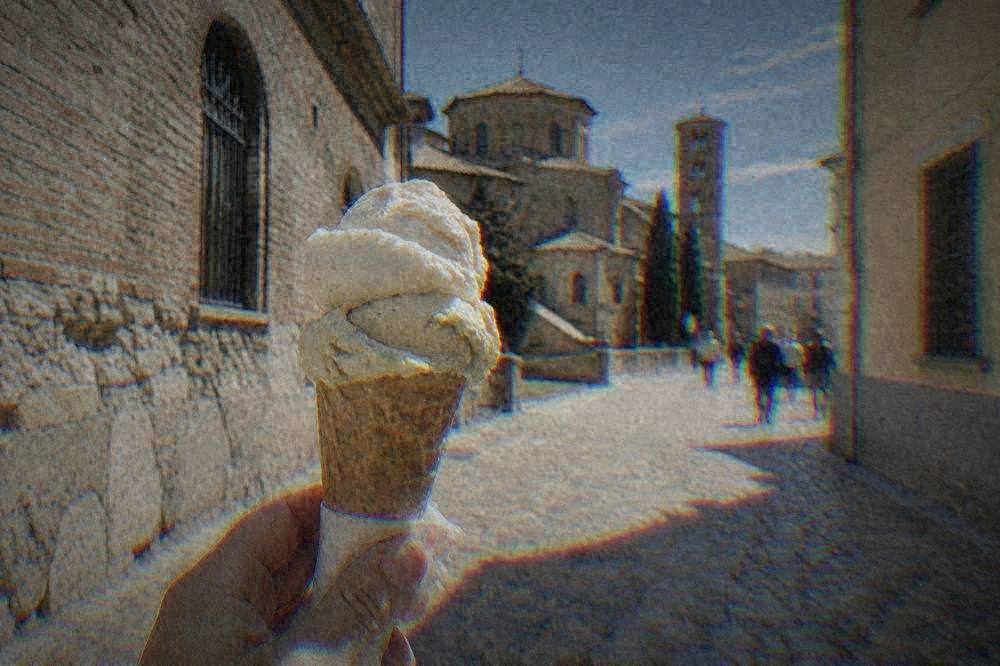
Ravenna, an inland Po-valley city in Emilia-Romagna a few kilometres from the Adriatic coast, eats the way the rest of Romagna eats: flatbread rolled thin, filled pasta in broth, sparkling red wine, and meals that stretch long past the coperto. This guide covers what the city's food actually is, where it sits in the region, what a food tour or cooking class covers, and the dining customs that catch visitors out.
Short answer
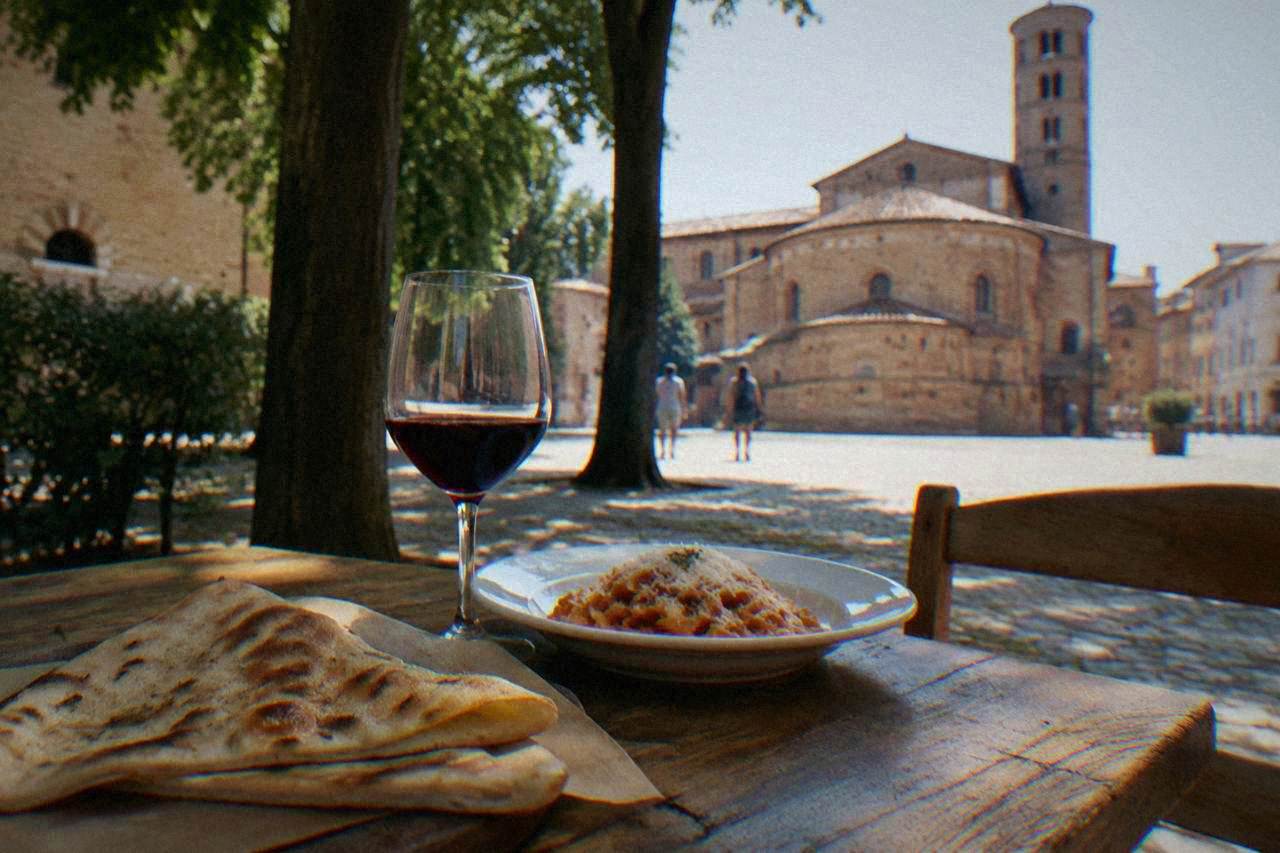
Ravenna food is Romagna food: piadina flatbread, cappelletti in broth, passatelli, grilled meat, squacquerone cheese and Sangiovese-based Romagna wines, with Adriatic fish at the coast resorts 8 km or more from the centre.
Ravenna sits on the flat Po plain of Emilia-Romagna, an inland city about 8 km from the Adriatic coast, and its table is the table of Romagna. That means piadina rolled thin and folded around squacquerone cheese, cappelletti served floating in capon broth, passatelli pulled from breadcrumbs and Parmigiano, and Lambrusco or Sangiovese di Romagna beside the plate. The mosaic monuments pull the visitors, but the food is the reason dinner runs long. This guide lays out what the city actually eats, how the dining customs work, what a food tour or cooking class covers, and how a food-focused trip slots around the mosaic monuments' hours and tickets. For the wider sightseeing picture, start with the Ravenna Travel Guide homepage and the things to do in Ravenna overview.
What Food Is Ravenna Famous For?
Ravenna's food is Romagna's food: piadina romagnola as the everyday flatbread, cappelletti as the festive filled pasta, passatelli and strozzapreti as the everyday shapes, squacquerone as the soft local cheese, and Sangiovese di Romagna as the poured red. The Adriatic adds grilled fish and eel, eaten at the coast resorts rather than in the inland centre. Ravenna has no single signature dish of its own; it is the Romagna repertoire in full.
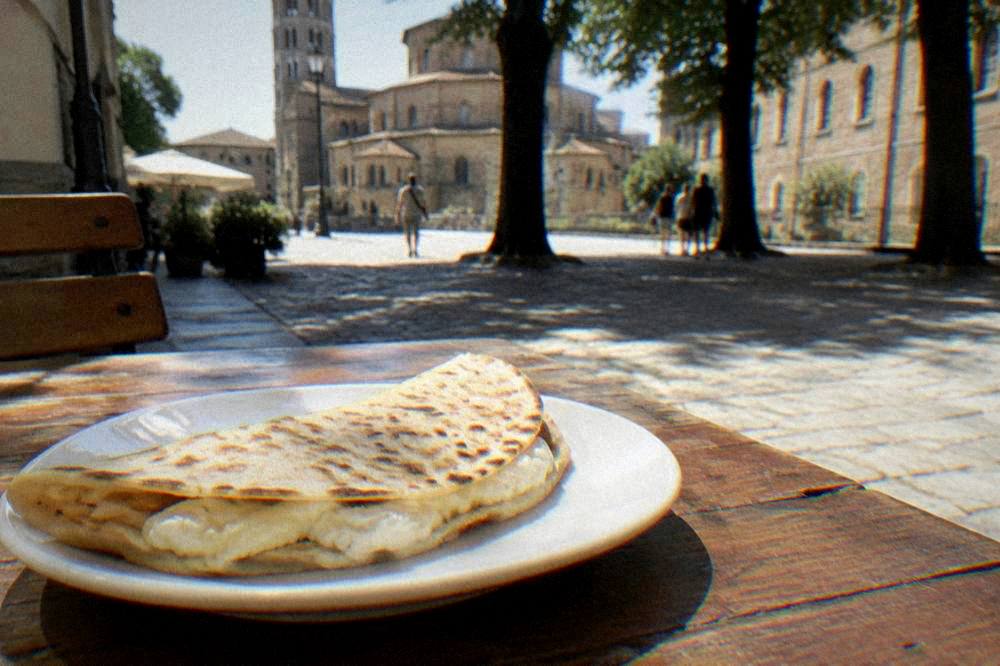
The piadina is the constant. It is a flatbread of flour, lard or olive oil, salt and water, cooked on a terracotta or cast-iron plate and folded around cheese, cured meats or vegetables. The Romagna version made around Ravenna is thicker and softer than the Rimini version, which is thinner and crunchier, and that difference is a genuine local talking point. Bakeries and piadinerie sell it all day, and the Visit Ravenna food pages treat it as the region's staple street food. The full story of the bread itself is on the piadina romagnola page, and the narrower question of what the city is known for at the table has its own answer page at what food is Ravenna famous for.
Cappelletti are the ceremonial pasta: small closed hats of egg pasta filled with cheese, or cheese and meat depending on the household, served in capon broth on feast days. Strozzapreti, the hand-rolled "priest-strangler" shape, and passatelli, thick breadcrumbs-and-cheese strands cooked in broth, are the workaday alternatives. Meat comes as grilled cuts, and Romagna's cured pork, salama da sugo included, appears on antipasti boards. Squacquerone, a runny fresh cheese, goes into piadina with rocket. On the sweet side, restaurants bring torta di riso, a dense rice cake from neighbouring Ferrara's orbit, and the " Ravenna" style is simply the Romagna one.
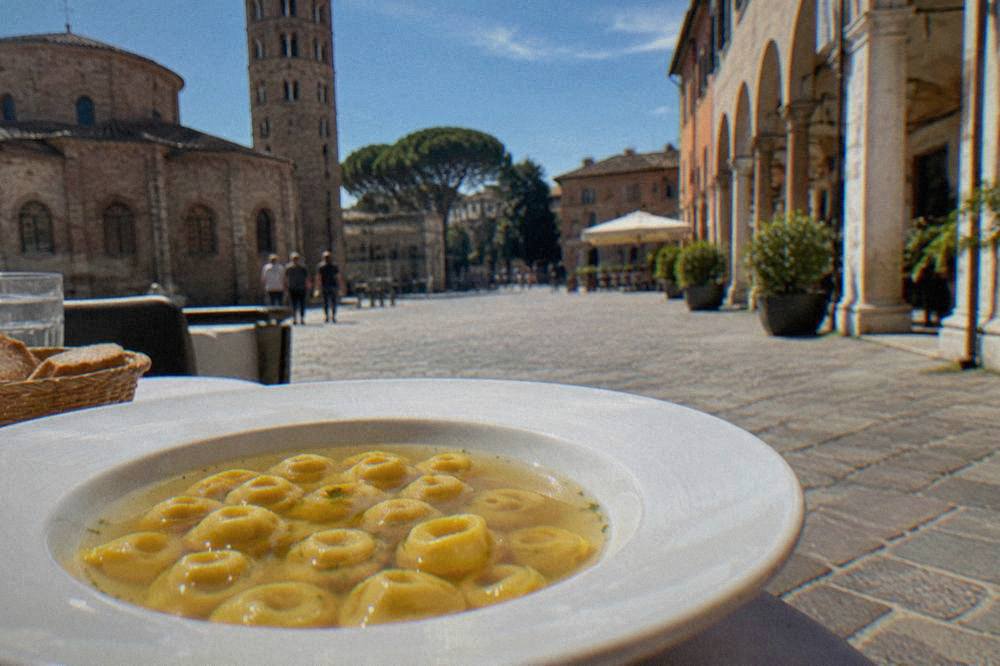
The wine list is short and local. Sangiovese di Romagna is the still red, Albana di Romagna the white with a DOCG classification in the region, and Lambrusco the frothing red poured with everyday meals. The regional detail is on the Romagna wines page. Fish belongs to the coast: Marina di Ravenna and the other resorts, reached by Start Romagna bus from the station, grill Adriatic catch and serve eel and clams, which is why a fish dinner in Ravenna usually means a bus or bike ride of 8 km or more. The beach side of that trip is covered in the Ravenna beaches guide.
Here is the core repertoire at a glance:
| Dish | What It Is | When It Is Eaten |
|---|---|---|
| Piadina romagnola | Thick soft flatbread folded around squacquerone, cured meats or vegetables | All day, everyday |
| Cappelletti | Small filled pasta hats served in capon broth | Feast days, Sunday lunch |
| Passatelli | Strands of breadcrumb and Parmigiano cooked in broth | Everyday first course |
| Strozzapreti | Hand-rolled short pasta with sauce | Everyday first course |
| Squacquerone | Soft, runny fresh cow's milk cheese | Inside piadina, with rocket |
| Grilled meat and cured pork | Grillon and charcuterie boards, salama da sugo | Antipasti and secondi |
Where Do Locals Eat In Ravenna?
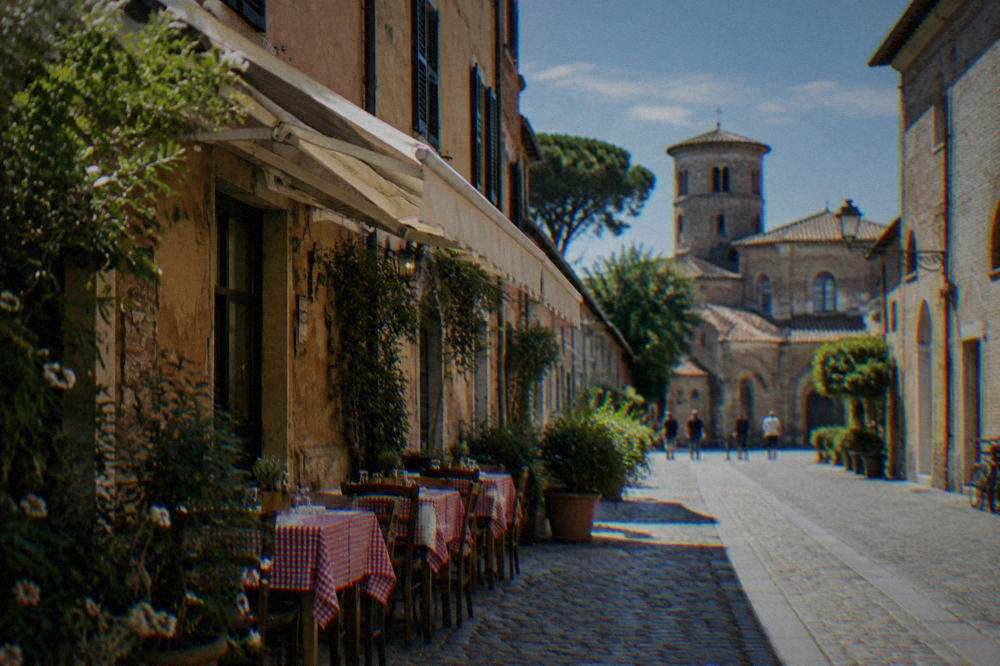
Ravenna's eating is concentrated in the compact historic centre: the lanes around Piazza del Popolo, the streets off Via Cavour, and the area between the railway station and the mosaics, all within a short walk of each other. The Visit Ravenna pages point to traditional trattorie serving the Romagna repertoire and to piadinerie for quick lunches, while the fish restaurants cluster at the coast resorts rather than in the centre.
The centre is small and flat, so a food walk between meals is effortless. Lunch tends to be the cheaper, quicker meal, with piadina the standard grab-and-hold option, and dinner starts late by northern European habits, with kitchens opening around 19:30. Menus are posted at the door by law, and reading the posted menu before sitting down is the reliable check. The city's restaurant landscape, area by area, is mapped in the Ravenna restaurants guide, and the question of where residents themselves eat has its own treatment on the where do locals eat in Ravenna page.
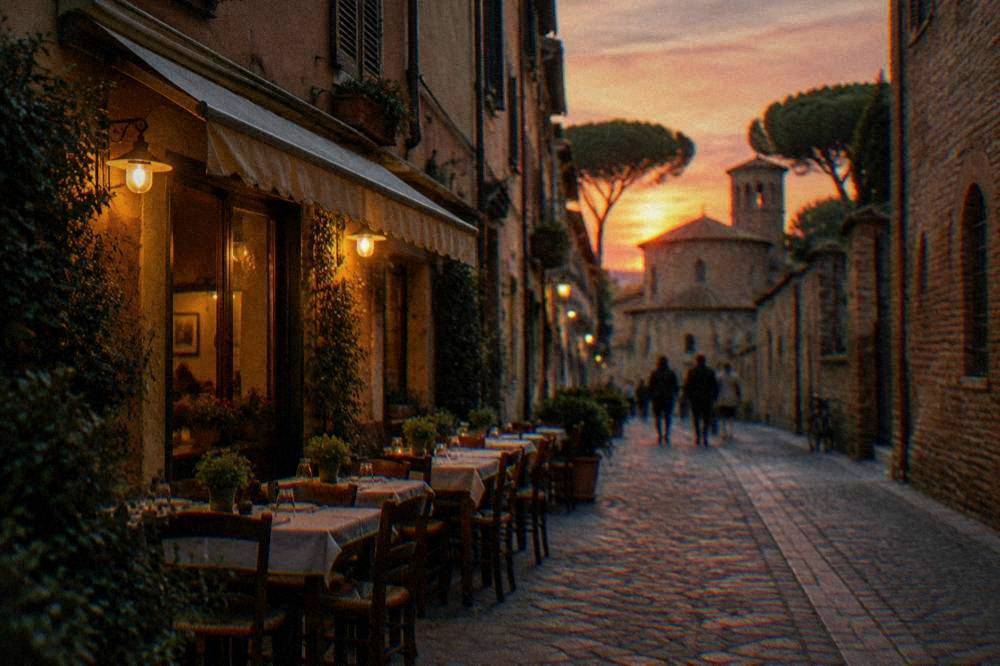
One habit worth knowing before the first bill arrives: the coperto. A cover charge is legal in Italy when it is printed on the menu, and in Romagna it typically appears as a fixed amount per person covering bread and table service. It is not a scam; it is a line item. Check the menu for the coperto line before ordering, and look for it on the itemised bill. Tipping is not obligatory, and there is no percentage convention this site prints: rounding up or leaving coins is normal, and nothing more is expected. Petty crime in Ravenna is of the pickpocketing kind, around tourist sites and on public transport, so the usual checks apply: a bag zipped and held in front on a crowded bus.
For visitors matching meals to sightseeing, the geography helps. The mosaic monuments cluster in the centre, Dante's tomb sits a short walk from Piazza del Popolo, and Sant'Apollinare in Classe and the Classis Ravenna museum sit out at Classe, where eating options thin out and a packed piadina before the bus is a reasonable plan. If the trip is short, the how many days in Ravenna guide shows how food stops slot between monuments.
Which Ravenna Food Tours And Cooking Classes Cover The Most?
The food experiences on this site's roster split into three kinds: guided walks that pair the UNESCO monuments with tastings, cooking classes that teach piadina, pasta or gelato by hand, and private tours that bolt a Romagna food stop onto a mosaic itinerary. Prices, ratings and durations for each render from the live listings rather than being typed here, and every product can be checked before the trip with free cancellation up to 24 hours before on the listings that state it.
The walk-plus-tastings format suits a first visit, because the mosaics and the food get covered in one block. A guided option that includes both the monuments and tastings is the Mosaics and Food Guided Walking Tour, which moves through the city's sights with food stops built in; check current availability through the operator's live listing.
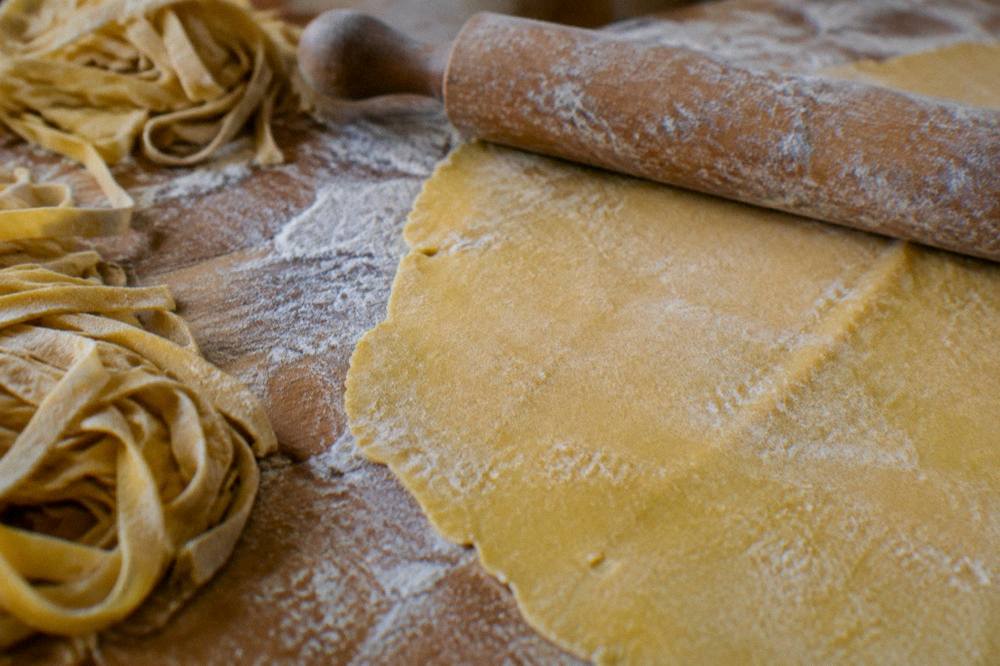
Cooking classes go deeper on one technique. The piadina class walks through the dough, the rolling and the filling, and it is the class that maps most directly onto what Ravenna eats daily; the gelato classes suit families; and a market-and-cooking class builds the shopping trip into the morning. The full range, with what each class actually covers, is compared in the Ravenna food tours and cooking classes guide.
Want to try rolling the dough yourself? Book a piadina cooking class here.
For a day that leads with the mosaics and lets the food follow, the featured pick below is a guided tour of Ravenna's mosaics that also runs from Bologna, which matters for visitors sleeping in the regional capital and eating in Ravenna by day. Alongside it sit a private walk with a local expert and a private Byzantine mosaics tour, the two most-booked private options on the roster.
What Should A Food-Focused Day Around The Mosaics Look Like?
A workable shape is monuments in the morning, piadina or a trattoria lunch in the centre, and a long dinner with Romagna wine, because the Ravenna Mosaici sites run 9:00 to 19:00 in summer and 10:00 to 17:00 in winter, which leaves the evenings free. The combo ticket lasts one week with one admission per monument, so the food stops do not have to squeeze into a single frantic day.
The ticket structure rewards a slow trip. Reduced combo fares start at EUR 9.50 for two monuments (Sant'Apollinare Nuovo and San Vitale), EUR 11.50 for four (adding Galla Placidia and the Neonian Baptistery) and EUR 13.50 for five (adding the Archiepiscopal Museum and Chapel of St Andrew), per the Ravenna Mosaici prices page. Galla Placidia and the Neonian Baptistery require a booked entry time and allow only a few minutes inside, which is why splitting them across two mornings works better than rushing. The mechanics are unpacked in the Ravenna combo ticket guide, and the monuments themselves in Ravenna mosaics.
| Ravenna Mosaici Combo | Monuments Covered | Reduced Fare | Validity |
|---|---|---|---|
| 2 monuments | Sant'Apollinare Nuovo, San Vitale | EUR 9.50 | 7 days, 1 admission each |
| 4 monuments | Adds Galla Placidia, Neonian Baptistery | EUR 11.50 | 7 days, 1 admission each |
| 5 monuments | Adds Archiepiscopal Museum, Chapel of St Andrew | EUR 13.50 | 7 days, 1 admission each |
The state sites outside the combo follow their own price list, useful when a food day drifts out to Classe for the basilica and back for dinner:
| Monument Or Museum | Ticket | Notes |
|---|---|---|
| Mausoleum of Theodoric | EUR 6, concession EUR 5, EUR 2 ages 18 to 25 | Combined with Arian Baptistery and Theodoric's Palace EUR 7 |
| Sant'Apollinare in Classe | EUR 6, EUR 2 reduced | Mon to Sat 8:30 to 19:00, Sun 13:30 to 19:00 |
| Arian Baptistery | EUR 3 | Smaller interior, quick visit |
| MAR art museum | EUR 8, EUR 6 reduced, EUR 3 students | Closed Mondays |
| Museo Dante | EUR 5, EUR 3.50 reduced | Tue to Sun, closed Mondays |
| Dante's tomb | Free | 10:00 to 18:00 November to March |
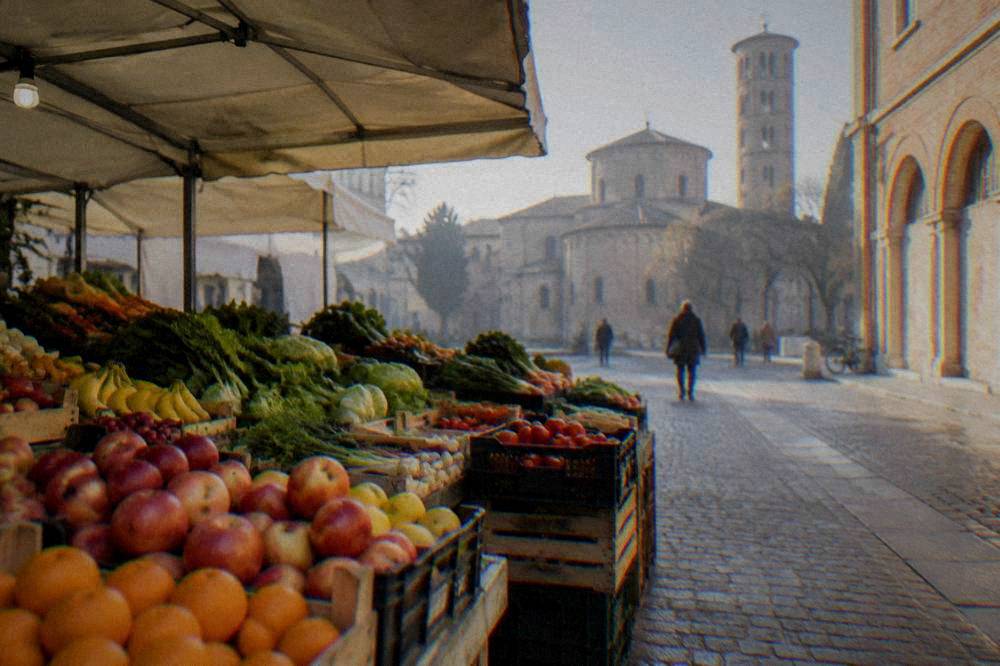
Pair the monuments with the market rhythm. The winter market at Marina di Ravenna runs Wednesdays and Saturdays on the sea side of Piazza Dora Markus until 31 May, per the Comune's notice, which turns a coast food trip into a two-stop morning: the market at the resort, then the bus back for the afternoon mosaics. The state museums and monuments are free on the first Sunday of the month, which frees a budget line for a longer lunch.
When Is The Best Season For A Ravenna Food Trip?
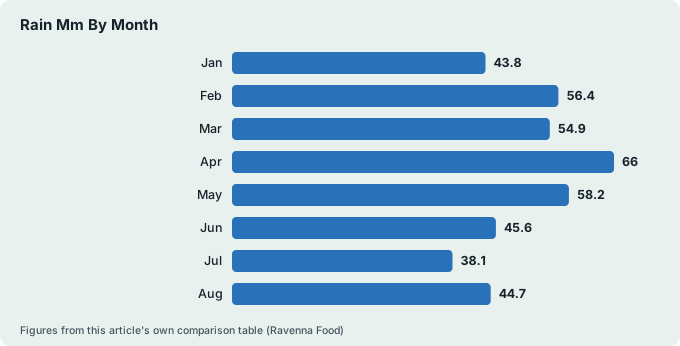
The best food-trip windows are spring and autumn, because the climate table gives May a mean of 17.9 C and October 15.7 C with moderate rain, while July and August average 25.2 C and 25.0 C and November is the wettest month at 78.3 mm. Ravenna's eating happens year-round regardless, and the indoor trattorie make winter dining entirely workable.
The table below is the modelled ERA5 monthly normals for 1991 to 2020, the only climate data this site holds. What it shows is a classic Po-valley pattern: cold flat winters, warm summers, and rainfall spread across the year with a July minimum.
| Month | Mean Temp C | Rain mm |
|---|---|---|
| Jan | 5.1 | 43.8 |
| Feb | 5.8 | 56.4 |
| Mar | 9.4 | 54.9 |
| Apr | 13.1 | 66.0 |
| May | 17.9 | 58.2 |
| Jun | 22.6 | 45.6 |
| Jul | 25.2 | 38.1 |
| Aug | 25.0 | 44.7 |
| Sep | 20.3 | 57.9 |
| Oct | 15.7 | 66.0 |
| Nov | 10.6 | 78.3 |
| Dec | 6.1 | 63.7 |
Two calendar anchors matter for a food-and-culture trip. The Ravenna Festival autumn trilogy "Mozart 1791" runs 13 to 17 November 2026 at Teatro Alighieri, which sits a short walk from the central restaurants and makes a November weekend of dinner plus opera straightforward. And each October the Notte d'Oro evening opens monuments for free, a one-night format that pairs well with a long Saturday dinner. The full seasonal picture, including winter draw- backs, is in the best time to visit Ravenna guide.
What Dining Costs And Tourist Taxes Should You Expect In Ravenna?
Posted menus are the authority on food prices, and a cover charge (coperto) is legal when it is printed on them. The fixed extra that can be stated is the overnight tourist tax, about EUR 1 per night at 1 to 2 star hotels, EUR 2 at 3 star, EUR 3 at 4 star and EUR 4 at 5 star, with EUR 1.20 at hostels and EUR 1.50 at B&B and rooms, from a tariff in force since 1 January 2023, always to be confirmed at booking.
That tariff may have changed since it took force, which is why every per-night figure carries "about" and a pointer to the accommodation's confirmation. The rest of the dining-cost picture is behavioural rather than numeric: lunch is the cheaper service, piadina from a bakery counter is the cheapest hot meal in the city, and dinner with wine in a trattoria costs what the posted menu says it costs. The checks that work everywhere in Italy work here: read the menu at the door, confirm the coperto line, check the itemised bill, and ask the price of the daily special before ordering it.
| Accommodation Type | Tourist Tax Per Night |
|---|---|
| Hotel 1 to 2 stars | About EUR 1 |
| Hotel 3 stars | About EUR 2 |
| Hotel 4 stars | About EUR 3 |
| Hotel 5 stars | About EUR 4 |
| Hostel | About EUR 1.20 |
| B&B and rooms | About EUR 1.50 |
Budget travellers have a realistic path: the Ravenna on a budget and free things to do in Ravenna guides list what costs nothing, including Dante's tomb, and a piadina-and-fountain lunch keeps the day's spend low without skipping the region's defining food. Whether the city justifies the trip at all is answered, with the usual honesty, in is Ravenna worth visiting.
How Does Ravenna's Food Compare With The Rest Of Emilia-Romagna?
Ravenna eats the Romagna half of Emilia-Romagna, not the Emilia half: piadina and squacquerone rather than Bologna's tagliatelle al ragu, Sangiovese di Romagna rather than Lambrusco as the default pour, and Adriatic fish at the coast, which places it closer to Rimini's table than to Parma's. The comparators are all day-trip distance: Bologna, Ferrara, Faenza and Rimini.
Bologna, about 84 km away by direct regional train with a journey of roughly 1 hour to 1 hour 20, is the region's food capital and the natural contrast: egg pasta with meat ragu, mortadella, and a heavier restaurant culture. Faenza, closer and on the same rail line's orbit, is the ceramics town with its own trattorie. Rimini, roughly 42 to 58 minutes by direct regional train, shares the piadina tradition in its thinner Rimini style and eats more fish, being on the sea. The head-to-head is worked through in Ravenna vs Bologna and Ravenna vs Rimini, and the day-trip logistics sit in the Bologna to Ravenna guide.
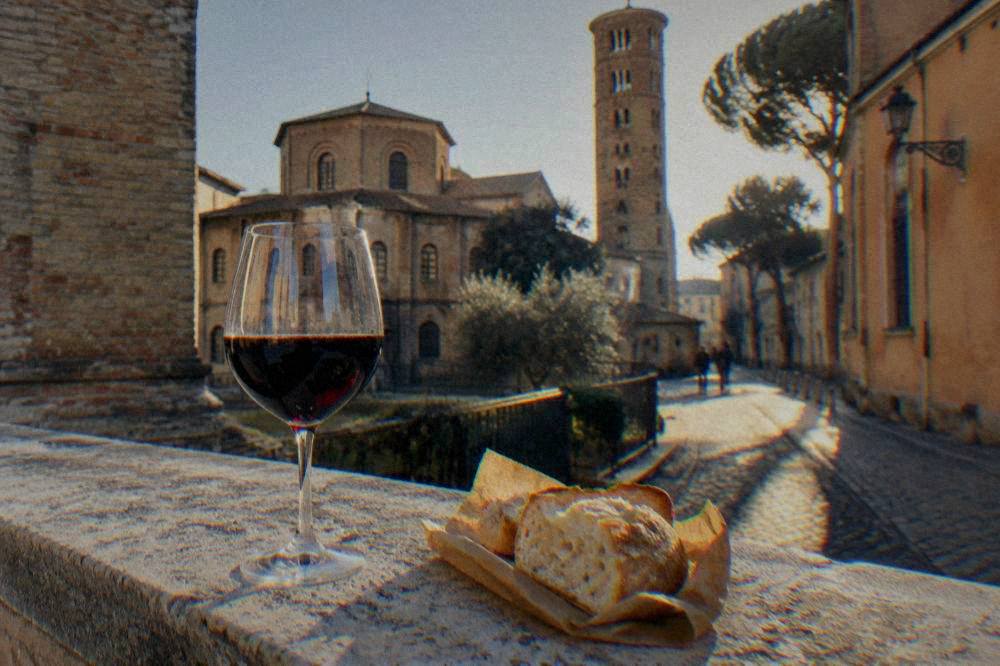
Within that map, Ravenna's advantage is compactness: the restaurants, the mosaics and the station sit in one walkable centre, so a food trip does not need transport until the coast is added. Visitors flying into Bologna's airport should read the Bologna airport to Ravenna guide for the connection, since there is no direct airport bus and the route runs via the Marconi Express and a regional train.
For travellers who want a guided thread through all of it, the trio below repeats the mosaic-led options that pair best with a food-focused stay, from the Bologna-or-Ravenna mosaic day trip to the two private walks.
Common Questions About Ravenna Food
These are the questions that arrive most often about eating in Ravenna: what piadina is, what cappelletti contain, how the coperto works, and which tours combine food with the mosaics.
What food is Ravenna famous for?
Ravenna is famous for the Romagna repertoire: piadina romagnola flatbread, cappelletti in capon broth, passatelli, strozzapreti, squacquerone cheese and Sangiovese di Romagna wine, with Adriatic fish at the coast resorts rather than in the inland centre.
What is piadina and how is it served in Ravenna?
Piadina is a flatbread of flour, lard or oil, salt and water, cooked on a hot plate and folded around a filling. Around Ravenna it is made thicker and softer than the Rimini style, and it is typically filled with squacquerone and rocket or cured meats.
What is cappelletti made of?
Cappelletti are small closed shapes of egg pasta filled with cheese, or cheese and meat depending on the household tradition, and they are served in capon broth as a festive first course.
Is the coperto a scam in Ravenna?
No. A cover charge is legal in Italy when it is printed on the menu. Check the menu for the coperto line before ordering and confirm it appears once per person on the itemised bill. Tipping is not obligatory.
Can you eat fish in Ravenna's centre?
Fish belongs to the coast. The historic centre is inland, about 8 km from the sea, and the fish restaurants cluster at Marina di Ravenna and the other beach resorts, reached by Start Romagna bus from the station.
Are there food tours in Ravenna that include the mosaics?
Yes. Guided walking tours combine the UNESCO monuments with food tastings, and private tours add a Romagna food stop to a mosaic itinerary. Prices and ratings render from the operators' live listings, and the options are compared in the Ravenna food tours and cooking classes guide.
The short version: eat the piadina at a counter at lunch, book the cappelletti for dinner, read the posted menu before sitting down, and use the one-week mosaic ticket to spread the monuments around the meals rather than the other way round. That is the whole Ravenna food trip in one sentence, and it holds in every season the climate table shows.