Rocca Di Brancaleone Ravenna
The Rocca di Brancaleone is a brick fortress set in public gardens in Ravenna, an inland city in Emilia-Romagna whose eight UNESCO Early Christian monuments sit a short walk away. This page covers what the fortress is, how to reach it and how to plan a visit around it.
Short answer
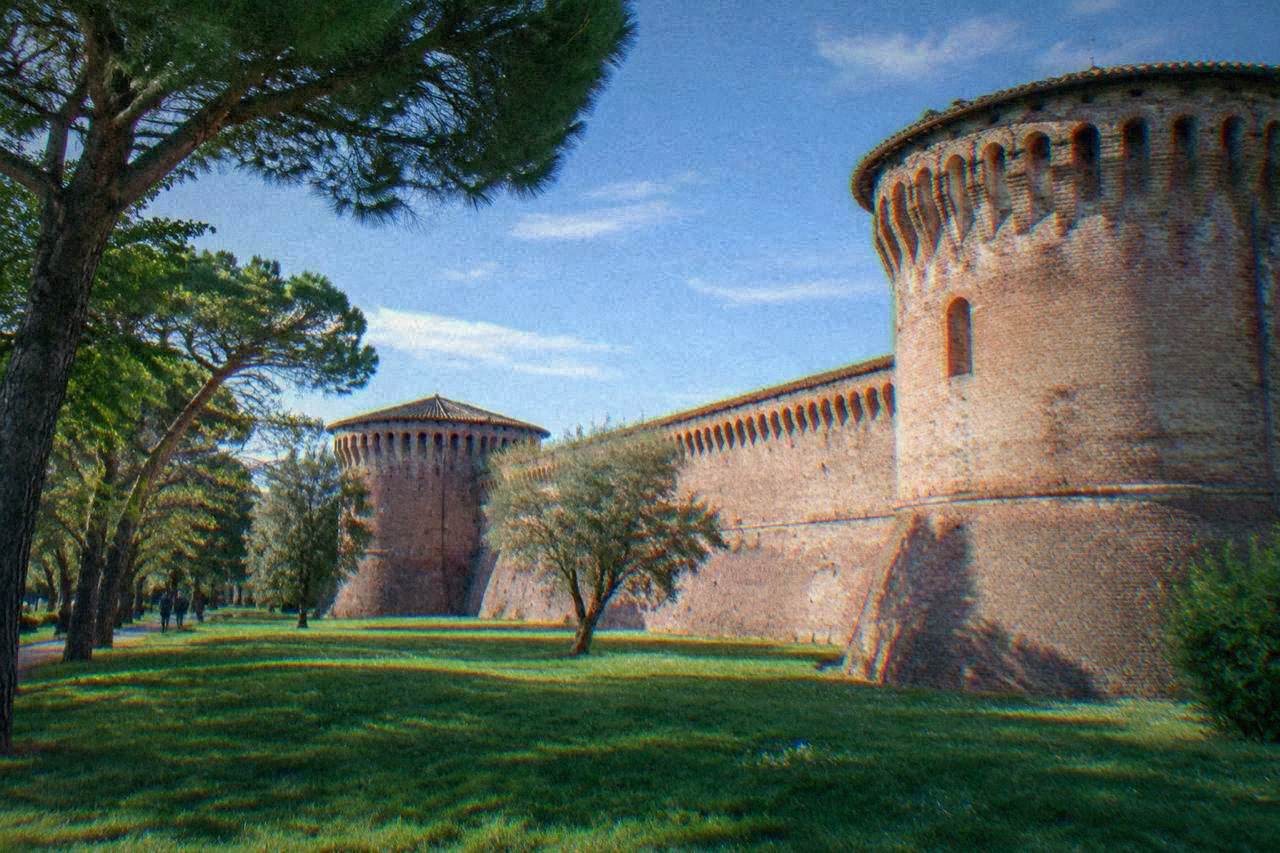
The Rocca di Brancaleone is a brick fortress with round towers and a wide moat, standing in a public park on the edge of Ravenna's historic centre. The grounds are open green space close to the city's UNESCO mosaic monuments, and a visit pairs naturally with San Vitale, the Mausoleum of Galla Placidia and Dante's tomb.
The Rocca di Brancaleone is a brick fortress in Ravenna, the inland Po-valley city in Emilia-Romagna, Italy, whose historic centre stands about 8 km from the Adriatic coast. The fortress occupies a corner of public gardens near the edge of the centre, a short walk from the railway station side of town, and it is one of the few places in the city where the skyline is dominated by defensive walls and round towers rather than bell towers and domes. Ravenna is known above all for its eight UNESCO Early Christian monuments with Byzantine mosaics and for Dante's tomb, and the Rocca belongs to a second layer of the city: the quiet green spaces, gardens and brick landmarks that sit between the mosaic churches. This guide from the Ravenna Travel Guide editorial desk covers what the fortress is, how to reach it, what a visit involves, and how to build a day around it using the verified monument prices and hours the official pages publish.
What Is The Rocca Di Brancaleone In Ravenna?
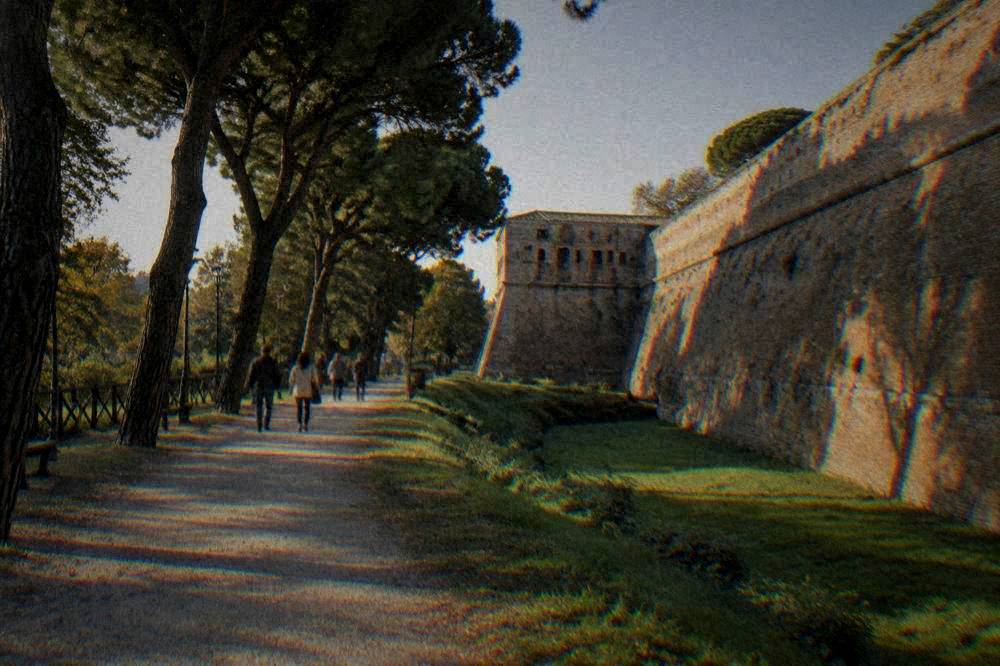
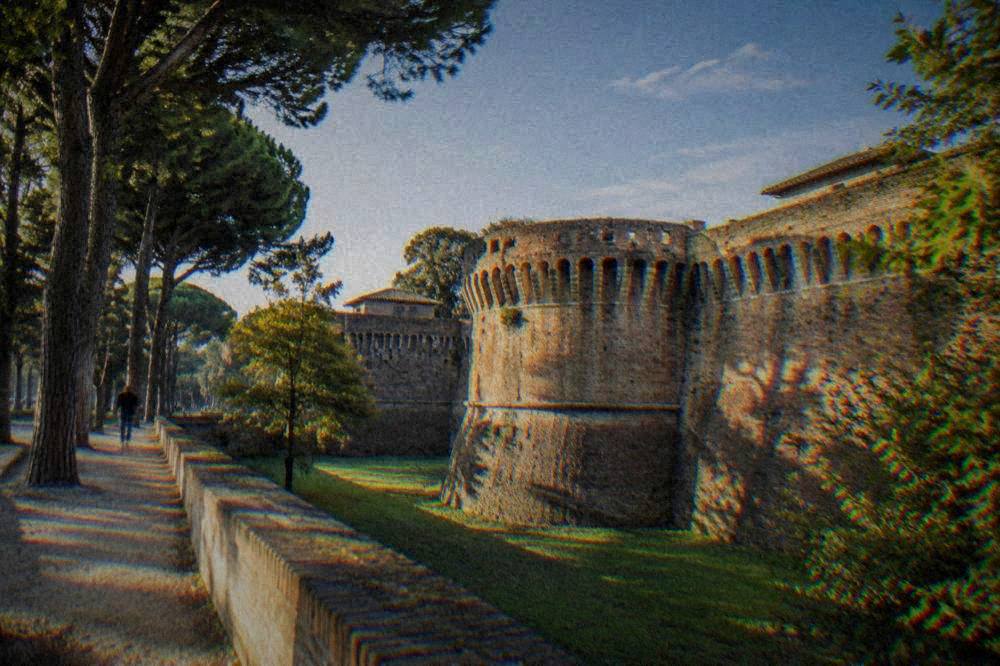
The Rocca di Brancaleone is a brick fortress with massive round towers and a wide surrounding moat, set inside a public park at the edge of Ravenna's historic centre. It is a defensive structure rather than a mosaic monument, so it is not one of the city's eight UNESCO sites, and its value for a visitor lies in the walls, the towers, the lawns and the open space rather than in interior decoration.
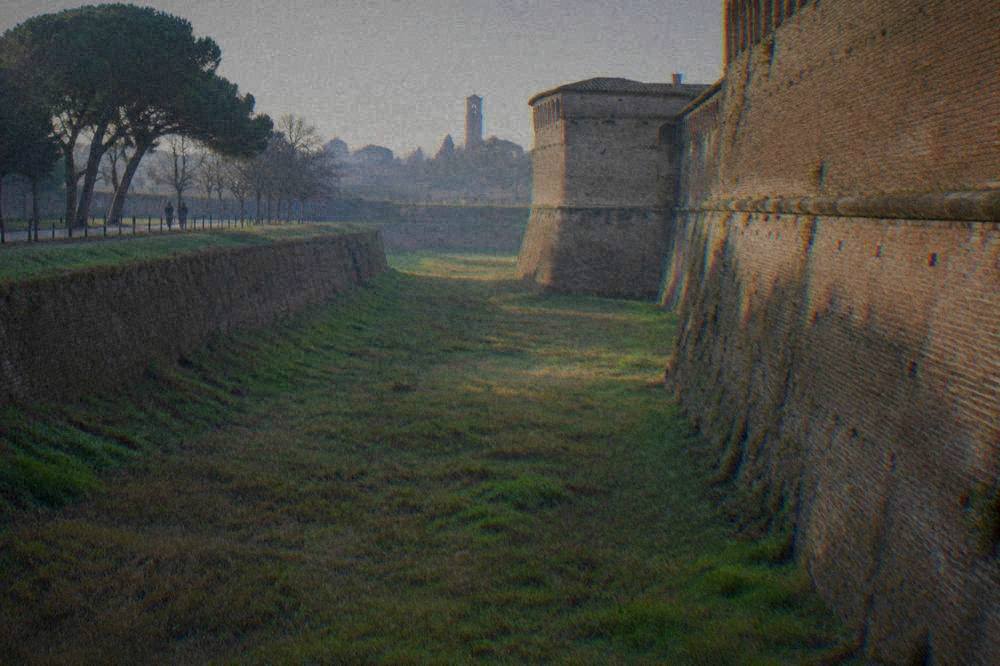
Ravenna's UNESCO listing, inscribed in 1996 under the name Early Christian Monuments of Ravenna, covers exactly eight buildings: the Mausoleum of Galla Placidia, the Neonian Baptistery, Sant'Apollinare Nuovo, the Arian Baptistery, the Archiepiscopal Chapel, the Mausoleum of Theodoric, San Vitale and Sant'Apollinare in Classe. The UNESCO listing text names those eight and no others. The Rocca di Brancaleone does not appear on that list, and that distinction is worth stating plainly, because several shorter guides to the city blur the two categories. The fortress is a military building, and what a visitor sees today is a fortified perimeter: high brick curtain walls, corner towers, the broad dry moat that encircles the whole complex, and the gardens that now fill the space around it.
The interior courtyard of the Rocca functions as an open-air venue for the city, and the municipal tourism page lists the fortress among Ravenna's public event spaces. Because the calendar changes from season to season, the practical advice is to check the municipal tourism page for the dates of anything scheduled during a visit. The Ravenna Festival's autumn trilogy "Mozart 1791" runs 13 to 17 November 2026 at the Teatro Alighieri, and the festival organisation stages work at multiple venues across the city, so the tourism office's current listings are the reliable way to learn whether the fortress courtyard is in use on a given day.
What the fortress never requires is a ticket for the grounds themselves. The park around the walls is public green space, and it is one of the roomiest places in a city whose centre is otherwise a dense grid of narrow streets and small piazzas. For anyone touring Ravenna with children, or anyone who needs a pause between the mosaic churches, the gardens around the Rocca are the obvious place for it.
Where Is Rocca Di Brancaleone And How Do You Reach It?
The Rocca di Brancaleone stands in public gardens just outside the ring of Ravenna's historic centre, within a short walk of the railway station and of Via di Roma, one of the streets that carries the camera-enforced ZTL boundary. The historic centre itself is small, flat and walkable, so the fortress is reached on foot from the station and from every major monument without a bus or a taxi.
Ravenna's railway station sits a short walk from the centre, and regional trains connect the city with Bologna Centrale in about 1 hour to 1 hour 20 over about 84 km, with Rimini roughly 42 to 58 minutes away by direct regional service. From the station forecourt, the route into town passes within sight of the gardens, and the municipal tourism page for the fortress marks it at the north-western edge of the centre. Nothing about the walk is demanding: Ravenna is a flat Po-plain city, and the whole UNESCO cluster, from the Neonian Baptistery to San Vitale, fits inside an easy stroll.
Drivers should note two things before aiming a car at the centre. First, the ZTL, the limited traffic zone, is camera-enforced, with some gates active 7:30 to 20:30 and others 24 hours; a daily permit of about EUR 8 is bought at the 24-hour parcometers, and hotels can issue a guest authorisation, so ask at your accommodation before bringing a car inside the ring.
Cruise passengers arrive differently. The Porto Corsini terminal is about 15 km from the centre, and the Visit Ravenna shuttle runs the distance in about 30 minutes, with the 2026 service operating 3 May to 26 October and picking up near the station. The port expects 111 calls and about 390,000 passengers in the 2026 season, and a new terminal is reported for inauguration in spring 2027. A shuttle arrival lands a visitor within a short walk of both the station district and the fortress gardens.
For orientation, the table below places the fortress against the landmarks a visitor uses to navigate Ravenna.
| Landmark | Position relative to the Rocca | Notes |
|---|---|---|
| Ravenna railway station | Short walk north-west of the centre | Regional trains to Bologna and Rimini |
| Piazza del Popolo | Inside the historic centre, a short walk away | The city's main square |
| San Vitale and Galla Placidia | Eastern side of the centre | Core of the UNESCO cluster |
| Dante's tomb | Central, near San Francesco | Free entry |
| Marina di Ravenna | About 8 km from the centre | Reached by Start Romagna bus |
| Porto Corsini cruise terminal | About 15 km from the centre | Shuttle about 30 minutes |
A guided walk is the other way to fold the fortress into a first day, and two of the options below between them cover the UNESCO monuments with a food tasting and a low-cost self-guided format.
What Can You See Inside The Rocca Di Brancaleone?
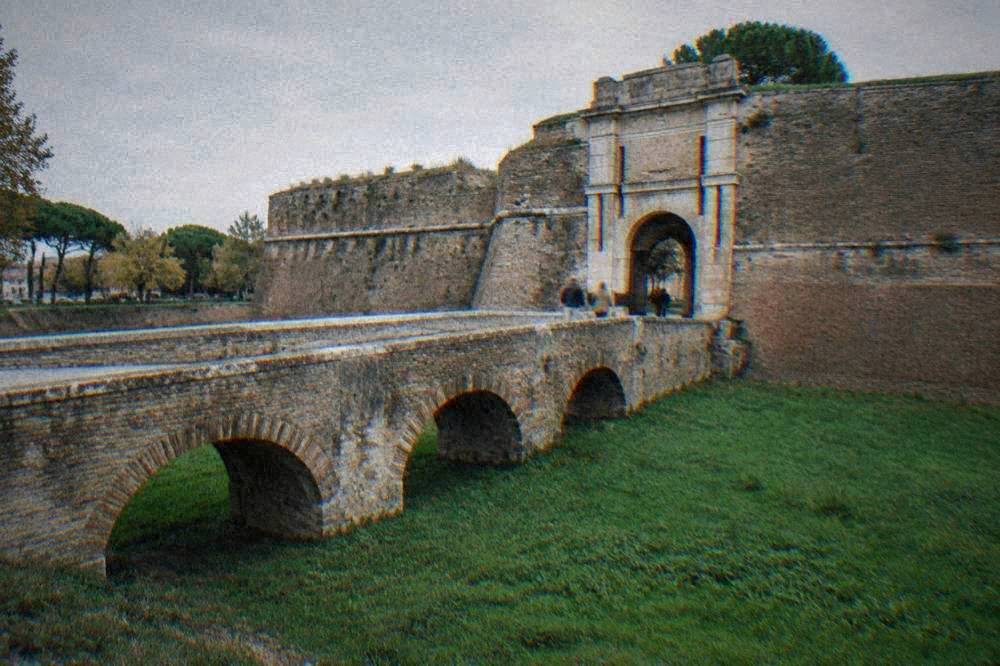
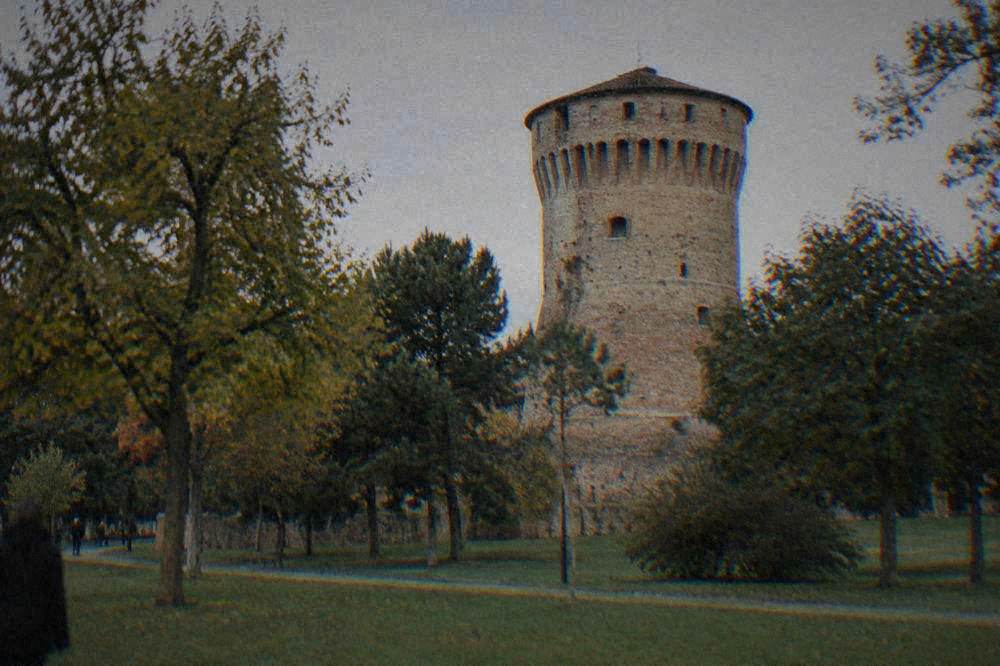
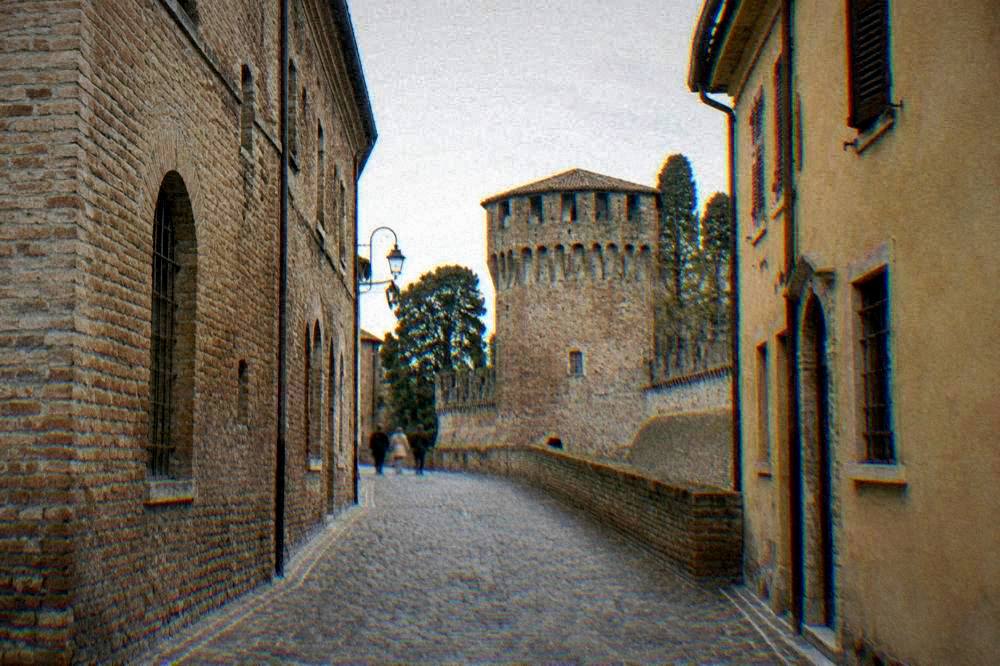
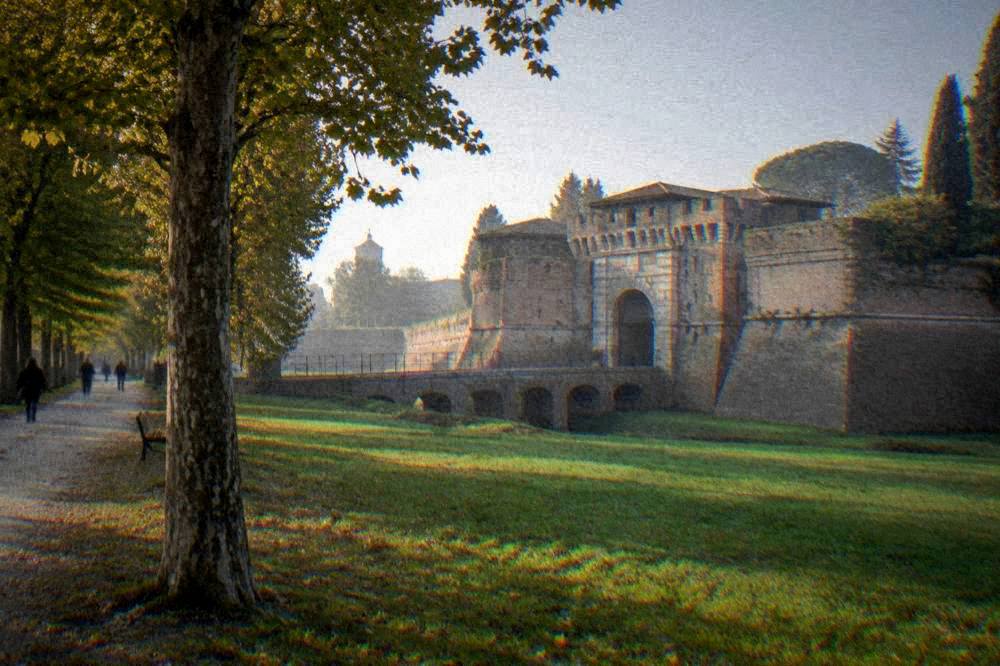
What a visitor sees at the Rocca di Brancaleone is the fortress exterior and its grounds: high brick curtain walls, round corner towers, the wide dry moat, the bridge and gateway, and the public gardens laid out around the whole complex. There are no mosaics inside, and no museum collection is listed there, because the city's mosaic holdings sit in the monuments and museums described on the Ravenna Mosaici and Classis Ravenna pages.
The visual rhythm of the place is defensive and monochrome. Where San Vitale rewards a slow upward gaze at gold-ground glass mosaic, the Rocca rewards distance: the best views of the walls come from across the moat, where the full height of the brickwork and the mass of the towers read clearly. The municipal tourism page describes the site as a fortress with its moat and gardens, and the gardens themselves carry mature trees, lawns and paths, which makes the site the greenest corner of the centre.
Inside the walls, the courtyard works as an open-air space, and that is the honest description to plan around. Anyone hoping for an interior circuit of furnished rooms should calibrate expectations: the listing material for the site presents the courtyard and the grounds, and any interior programme that exists runs only on event days, so the municipal tourism page is the place to check what is open on a specific date. A visit therefore costs time rather than money: the grounds suit anything from a ten-minute walk around the perimeter to a leisurely hour with a picnic, and there is no printed ticket price to consider.
The practical mistake to avoid is treating the Rocca as a substitute for the mosaics. Ravenna's reputation rests on the UNESCO monuments, and a day that spends its morning inside San Vitale and its afternoon under the fortress walls is better balanced than one that does only half of that. The pages on the Basilica of San Vitale and the Mausoleum of Galla Placidia cover those two anchor monuments in detail.
For visitors who want the fortress walls and the mosaic vaults in a single organised outing, the tour below links the UNESCO monuments with pasta, piadina and gelato tastings, a combination that suits a first day in the city.
Is Rocca Di Brancaleone Free To Visit?
The gardens and the exterior of the Rocca di Brancaleone are public green space with no ticket, and no admission price for the grounds appears on the municipal tourism page. Any charge that arises is tied to specific ticketed events in the courtyard, whose prices are set per event and published by the organisers, so the reliable method is to check the current events listing before assuming either a free or a paid visit.
That makes the fortress one of the genuinely free pleasures in a city whose headline monuments are cheap but not free. Ravenna does have free anchors: Dante's tomb is free, open 10:00 to 18:00 from November to March and 10:00 to 19:00 from April to October, closed 25 December, and the state museums and monuments are free on the first Sunday of the month. The UNESCO churches themselves carry the Ravenna Mosaici combo prices, with reduced fares starting at EUR 9.50 for two monuments, EUR 11.50 for four and EUR 13.50 for five, and the full-price figures are shown on the official Ravenna Mosaici ticket page, which is where to buy or check them. The combo is valid one week, one admission per monument, and an entry time must be booked for each monument.
Budget visitors can string together a day that is almost entirely free: the park at the Rocca, Piazza del Popolo, the exterior of the UNESCO churches, Dante's tomb and a first-Sunday monument visit. The page on free things to do in Ravenna rounds up the full list, and the fortress grounds belong near the top of it.
The table below sets out the verified entry prices for the monuments a visitor is most likely to combine with a walk to the fortress.
| Site | Ticket | Concession or reduced | Notes |
|---|---|---|---|
| Ravenna Mosaici combo, 2 monuments | from EUR 9.50 reduced | Sant'Apollinare Nuovo and San Vitale | Full price on the official page |
| Ravenna Mosaici combo, 4 monuments | from EUR 11.50 reduced | Adds Galla Placidia and Neonian Baptistery | Timed entry at both added sites |
| Ravenna Mosaici combo, 5 monuments | from EUR 13.50 reduced | Adds Archiepiscopal Museum and Chapel | Valid one week, one entry per monument |
| Mausoleum of Theodoric | EUR 6 | EUR 5 concession, EUR 2 ages 18 to 25 | Combined with Arian Baptistery and palace EUR 7 |
| Sant'Apollinare in Classe | EUR 6 | EUR 2 reduced | In the Classe area outside the centre |
| Arian Baptistery | EUR 3 | no reduced price listed | 9:00 to 17:00 |
| MAR art museum | EUR 8 | EUR 6 reduced, EUR 3 students | Closed Mondays |
| Dante's tomb | Free | none | 10:00 to 18:00 November to March |
Two habits keep the spending honest. A cover charge, the coperto, is legal when printed on the menu, and tipping is not obligatory. The tourist tax is charged per night at hotels, about EUR 1 at 1 to 2 star properties up to about EUR 4 at 5 star ones, and it should be confirmed at booking.
What Else Is Within A Short Walk Of The Rocca?
Everything in Ravenna's historic centre is within walking range of the Rocca di Brancaleone, because the centre is small and flat: Dante's tomb, the Neonian Baptistery, San Vitale, the Mausoleum of Galla Placidia, Piazza del Popolo and the Archiepiscopal Museum all sit a short walk from the fortress gardens. The only major UNESCO monument outside the centre is Sant'Apollinare in Classe, in the Classe area to the south.
A sensible walking order starts at the fortress and the station district, cuts into the centre toward Piazza del Popolo, then follows the quiet streets to Dante's tomb beside the Basilica of San Francesco, and finishes in the UNESCO cluster around San Vitale and Galla Placidia. Along the way, the Neonian Baptistery and the Archiepiscopal Chapel add two more of the eight UNESCO monuments without lengthening the route. Galla Placidia and the Neonian Baptistery both require a booked entry time and allow only a few minutes inside, so book those slots when buying the combo rather than arriving and hoping.
The museums fill the gaps on a rainy or a Monday-anchored day. The National Museum of Ravenna is closed Mondays and charges EUR 7 with a EUR 2 reduced rate; the MAR city art museum charges EUR 8, is open Tuesday to Saturday 9:00 to 18:00 and Sundays 15:00 to 19:00, and is currently showing a Nicola Samori solo exhibition from 17 October 2026 to 17 January 2027. The Classis Ravenna museum sits out in the Classe area beside Sant'Apollinare in Classe, open daily 10:00 to 17:00, and it absorbed the collection of the former TAMO mosaic museum, which closed in 2023. The Domus dei Tappeti di Pietra is a Byzantine-floor site in the centre whose hours vary by season, so check the official page for both the current schedule and prices.
For visitors building a longer stay, the distances worth knowing are few, and the table below holds the ones the transport sources verify.
| Journey | Figure | Source basis |
|---|---|---|
| Ravenna centre to the Adriatic coast | About 8 km | Beach resorts are separate towns |
| Ravenna to Bologna Centrale by regional train | About 84 km, about 1 hour to 1 hour 20 | Regional timetable |
| Ravenna to Rimini by regional train | About 42 to 58 minutes | Regional timetable |
| Centre to Porto Corsini cruise terminal | About 15 km, shuttle about 30 minutes | Visit Ravenna shuttle page |
| Stretch of coast from Marina di Ravenna to Lido di Savio | About 35 km | Resort string along the coast |
The coast, it bears repeating, is not Ravenna itself. Marina di Ravenna, Punta Marina, Lido Adriano, Lido di Classe and Lido di Savio are separate resort towns reached by Start Romagna bus from the station, and each autumn a 25,000 cubic metre sand barrier is built at Punta Marina, Marina di Ravenna Sud and Lido di Savio to protect the shoreline until spring 2027, which changes the look of those beaches in the colder months.
When Is The Best Time Of Year To Visit The Rocca And Ravenna?
The warmest, driest months for the Rocca gardens are July, with a mean of 25.2 C and 38.1 mm of rain, and August at 25 C, while November is the wettest month at 78.3 mm and January the coldest at 5.1 C. The climate table, modelled ERA5 normals for 1991 to 2020, shows about 674 mm of rain a year spread across every month, so no season in Ravenna is reliably dry.
The fortress grounds are an outdoor attraction, which makes the climate table more relevant here than it is for the mosaics. Late spring and early autumn give the most comfortable combination of green gardens and walkable temperatures, with May at a mean of 17.9 C and October at 15.7 C. Summer visitors get the lawns at their best but also the year's warmest days, and the church interiors, which are the other half of any Ravenna day, stay cool regardless. Winter visitors benefit from shorter queues at the combo monuments, though the winter hours apply: from 3 November 2026 to 6 March 2027 the Ravenna Mosaici sites open 10:00 to 17:00, with last admission 16:30 and 16:45 at the two timed-entry sites, and all of them close on 25 December and 1 January.
| Month | Mean temperature C | Precipitation mm |
|---|---|---|
| January | 5.1 | 43.8 |
| March | 9.4 | 54.9 |
| May | 17.9 | 58.2 |
| July | 25.2 | 38.1 |
| September | 20.3 | 57.9 |
| November | 10.6 | 78.3 |
Figures are modelled ERA5 reanalysis means for 1991 to 2020, not a station record, and no sunshine-hour or sea-temperature figure is sourced anywhere on this site. The event calendar adds a second timing layer: the Notte d'Oro each October brings free evening access to monuments, and the Ravenna Festival's autumn trilogy "Mozart 1791" runs 13 to 17 November 2026 at the Teatro Alighieri. Mirabilandia, the theme park reachable from Ravenna, closes its 2026 season on 1 November, so families combining the park with the fortress should plan around that date and check the park's own page for anything beyond it.
Which Tours Pair Well With A Visit To The Rocca?
The tours that pair best with the Rocca di Brancaleone are the walks that cover the UNESCO monuments in the surrounding centre: a guided mosaic walk with tastings, a low-cost audio and written self-guided tour, and a private mosaics walk with a local guide. All three operate in the same compact centre the fortress sits beside, so any of them can be followed by a stroll to the walls without extra transport.
The tasting walk is the natural first choice for a visitor who wants the mosaics explained and the city's food introduced in one outing, covering pasta, piadina and gelato alongside the monuments. The audio-and-written-guide option suits independent travellers who prefer to move at their own pace and spend little, and it leaves the fortress gardens as an easy add-on at either end of the route. A private tour with a local guide is the format for visitors who want the itinerary shaped around specific interests and the flexibility to linger, and the operator's live listing carries the current price and availability for each.
Visitors arriving from Bologna can also start a guided day trip there, since two of the roster's options begin in Bologna and bring the group to Ravenna by train, and the regional timetable gives about 1 hour to 1 hour 20 for the journey. Whatever the format, the booking rule is the same: prices, ratings and review counts change, so the operator's live listing is the source of record, and the button below leads to it.
For visitors who prefer to assemble the day themselves, the Sant'Apollinare Nuovo and Arian Baptistery pages carry the hours and prices for the remaining in-centre monuments, and a half-day in the centre comfortably covers the fortress grounds, three or four of the UNESCO sites and Dante's tomb.
Common Questions About The Rocca Di Brancaleone In Ravenna
Is the Rocca di Brancaleone one of the UNESCO sites in Ravenna?
No. The UNESCO listing covers eight Early Christian monuments: the Mausoleum of Galla Placidia, the Neonian Baptistery, Sant'Apollinare Nuovo, the Arian Baptistery, the Archiepiscopal Chapel, the Mausoleum of Theodoric, San Vitale and Sant'Apollinare in Classe. The Rocca is a fortress in public gardens outside that list.
Do you need a ticket for the Rocca di Brancaleone?
The gardens and the exterior are public space with no ticket listed on the municipal page. Charges apply only to specific ticketed events in the courtyard, priced per event, so check the current events listing for the day of a visit.
How far is the Rocca di Brancaleone from Ravenna station?
The fortress stands at the edge of the historic centre, a short walk from the station. The whole centre is flat and walkable, and no bus is needed between the station, the fortress and the UNESCO monuments.
Can you go inside the Rocca di Brancaleone?
The courtyard operates as an open-air venue, and access depends on the event calendar. The municipal tourism page publishes what is open and when, so check it for the specific date of a visit.
Is the Rocca di Brancaleone worth visiting with children?
Yes, for the open space. The moat, the towers and the lawns give children room to run in a city otherwise built around quiet churches, and the visit costs nothing unless an event is ticketed.
What is close to the Rocca di Brancaleone?
Piazza del Popolo, Dante's tomb, the Neonian Baptistery, San Vitale and the Mausoleum of Galla Placidia are all within a short walk, along with the National Museum and the Domus dei Tappeti di Pietra. Only Sant'Apollinare in Classe lies outside the centre, in the Classe area.
Before you go, the pick for this guide:
Private Sights And Monuments Walk
★ 4.5 12 reviews · From $170 per group
Check availability →