Ravenna Beaches
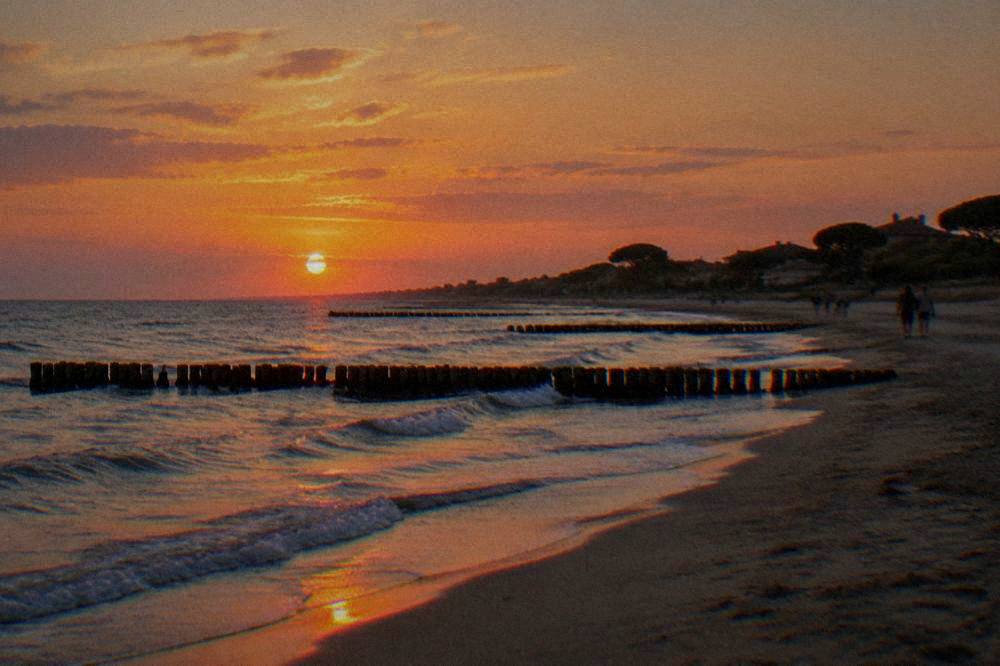
Ravenna's beaches begin about 8 km from the inland historic centre, where five resorts line roughly 35 km of low, sandy Adriatic shore. This guide covers what each one offers and how to reach it.
Short answer
The Ravenna beaches are Marina di Ravenna, Punta Marina, Lido Adriano, Lido di Classe and Lido di Savio, strung along about 35 km of coast and reached from the city by Start Romagna bus, bike or car. Ravenna itself is inland, so the mosaics and the sea are two separate halves of one day.
Ravenna is an inland city on the flat Po plain of Emilia-Romagna, and its beaches are a separate world: five resorts, Marina di Ravenna, Punta Marina, Lido Adriano, Lido di Classe and Lido di Savio, strung along roughly 35 km of low, sandy Adriatic shore. The historic centre, the one that holds the eight UNESCO monuments with their Byzantine mosaics, sits about 8 km from the nearest lido, so a beach day here always begins with a short hop outward from the mosaics toward the sea. This page on Ravenna Travel Guide sets out how that hop works, what each resort is like, and how the shoreline itself changes between the bathing season and the winter months.
Where Are The Ravenna Beaches, And How Far Is The Coast?
The Ravenna beaches sit on the Adriatic coast of Emilia-Romagna, between about 8 km and well over 20 km from the historic centre, along a shoreline that runs for about 35 km from the Cervia end to the Lido di Savio end. Ravenna itself is an inland city on the Po plain, so the sea is always a deliberate trip out rather than something you stroll to. The nearest resort, Marina di Ravenna, is the closest of the five to the centre.
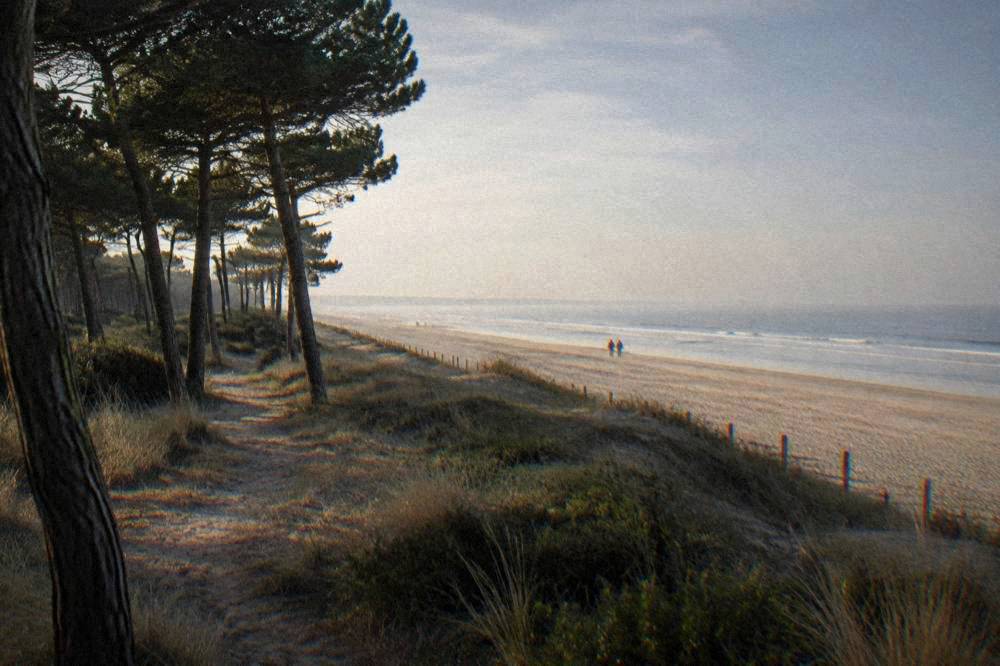
The relationship between city and coast shapes every visit. The centre is compact and walkable, packed with the monuments described in the Ravenna UNESCO sites guide, while the coast is a ribbon of pinewoods, resorts and sand that belongs to a different rhythm entirely. The pinewood belt between the city and the shore is part of the same landscape that protects the coast, and it is the reason the ride out feels greener than the map suggests.
The five resorts each grew around their own stretch of shore and their own access road, and locals treat them as distinct places rather than one continuous beach. Naming all five matters when you plan, because bus routes, parking and the character of the sand all differ from one to the next.
| Resort | Character of the shore | Position along the coast | What it is known for |
|---|---|---|---|
| Marina di Ravenna | Wide sand, busy lidos | Northern end, closest to the centre | The historic resort, marina and nightspots |
| Punta Marina | Sand backed by pinewood | Just south of Marina di Ravenna | Quieter family stretch, spa tradition |
| Lido Adriano | Long sandy beach | Middle of the Ravenna coast | Residential resort, cycle-friendly |
| Lido di Classe | Sand with wide dunes | Southern stretch | Pineta di Classe, calmer feel |
| Lido di Savio | Sandy shore at the southern edge | Southernmost of the five | Border with Cervia's coast |
Which Ravenna Beach Resort Should You Choose?
Marina di Ravenna is the resort for atmosphere and evening life, Punta Marina and Lido di Classe suit calmer family days, Lido Adriano works well for a low-key residential beach day, and Lido di Savio is the quiet southern option closest to Cervia. All five are sandy, all five are backed by the same coastal pinewood landscape, and none of them is walkable from the historic centre, so the choice is about mood and transport rather than scenery alone.
Marina di Ravenna is the oldest-established of the five and the one with the densest cluster of beach clubs, bars and evening venues, and it holds the city's marina at the canal mouth. The Comune di Ravenna's own pages place the winter market on the sea side of Piazza Dora Markus in Marina di Ravenna, running Wednesdays and Saturdays until 31 May, which tells you the resort keeps a life well beyond the summer weeks.
Punta Marina, immediately south, is the quieter sibling, with bathing establishments set among the pinewoods and a spa tradition that draws a family and wellness crowd. Lido Adriano, further down the coast, is largely residential, with long sand and an easygoing feel. Lido di Classe pairs its beach with the great Pineta di Classe, a wood that runs down almost to the water, and Lido di Savio marks the southern edge of the Ravenna coast before Cervia's salt-pan landscape begins.
Choosing between them is mostly choosing your travel style rather than ranking the sand. If you want evening options after your swim, head for Marina di Ravenna. If you want quiet, pinewood shade and space, the southern three are the better fit.
How Do You Get From Ravenna To The Beach?
The Ravenna beaches are reached by Start Romagna bus from the railway station, by bike along the flat roads and cycle paths, or by car via the coastal roads, and every option covers the 8 km or more between the centre and the shore. The municipal and regional transport pages put Start Romagna buses as the standard public link from the station to the resorts. Ravenna is flat Po-plain territory end to end, which is why cycling to the coast is a genuinely normal way to travel here.
The bus is the simplest car-free route. Start Romagna operates the coastal services from Ravenna station, and its winter timetable booklet lists the beach lines alongside the urban network, so the services run year-round rather than being a summer-only operation. The station itself is a short walk from the historic centre, which makes the whole chain, mosaics to sand, workable without a vehicle. Timetables change between the summer and winter seasons, so check the current departure times on the operator's site before you set out.
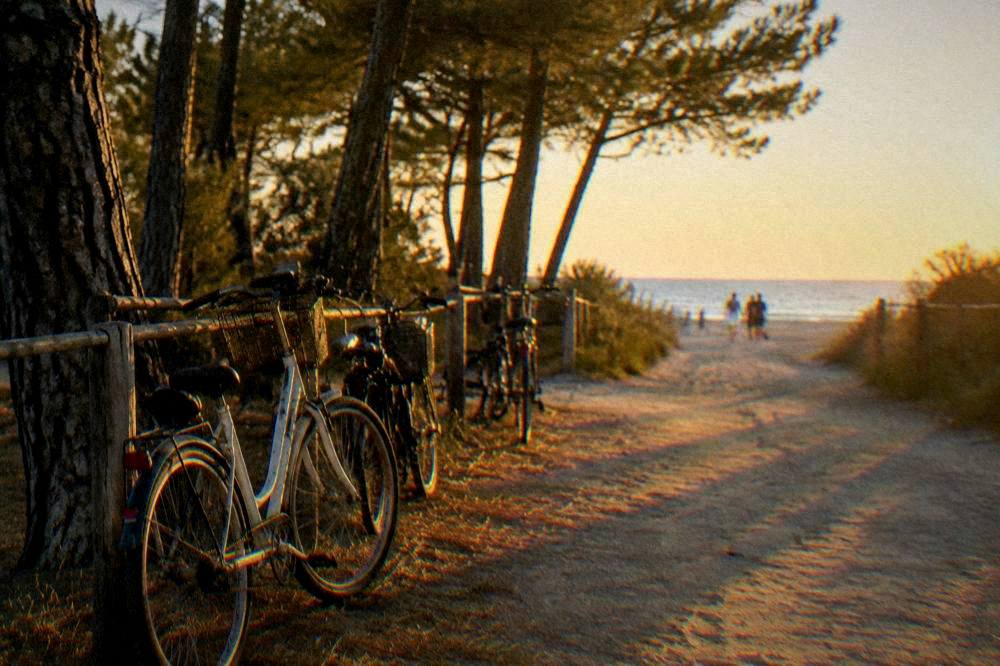
The bike option deserves more attention than it usually gets. The land is pancake-flat, the distances are moderate, and much of the route runs through or beside the pinewoods, with the Pineta di San Vitale and the coastal woods giving shade for the middle stretch. The site's getting around Ravenna guide covers the city end of that network.
By car, the coastal roads run straight out from the ring toward each resort, and parking in the resorts is a summer weekend consideration, so arrive before late morning in July and August. Drivers coming from farther afield may find the how to get to Ravenna guide useful for the city approach first, then the coast leg second.
To drive the coastal roads on your own schedule, book a rental car here.
| Way of reaching the coast | Where it starts | Best for | Things to check first |
|---|---|---|---|
| Start Romagna bus | Ravenna railway station | Car-free days, cruise passengers | Current seasonal timetable |
| Bike | Anywhere in the flat centre | Active travellers, pinewood routes | Bike hire opening hours |
| Car | Ring road, coastal roads out | Families with gear, southern resorts | Summer weekend parking |
| Organized day tour | Hotel or port pick-up | One-booked-day coast and lagoon visits | Operator's live listing |
A booked day that includes a beach lunch is another route onto this coast, and the listing for Check availability covers a private history and beach-lunch day that runs from Ravenna itself. Meanwhile the solo pick below is the lagoon-and-coast day trip this page features.
What Is There To Do At Marina Di Ravenna And The Northern Resorts?
Marina di Ravenna offers bathing establishments, the canal-mouth marina, evening bars and the winter market on Piazza Dora Markus, while Punta Marina next door offers pinewood-backed lidos and a quieter, family-and-wellness character. Together they form the northern half of the Ravenna coast and the half closest to the city, about 8 km out from the centre. Neither resort is part of the UNESCO city, and neither needs a ticket, so the day costs whatever the lido or the lunch costs.
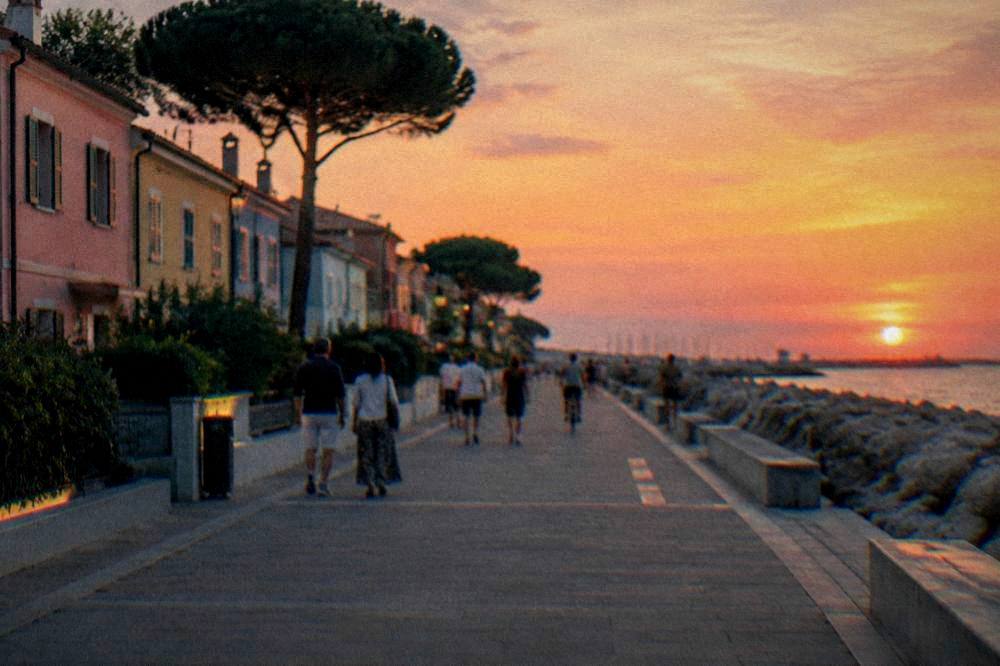
The northern pair is where the coast feels busiest. Marina di Ravenna's identity is tied to the canal harbour, where the Porto Corsini cruise terminal also sits, and the resort's evening scene is the strongest on this shoreline. The winter market detail is worth holding onto for shoulder-season travel: the Comune places it on the sea side of Piazza Dora Markus, Wednesdays and Saturdays until 31 May, so an out-of-season beach walk can end at a market stall rather than a closed seafront.
Punta Marina trades volume for calm. The pinewoods press close behind the bathing establishments, and the resort's spa tradition gives it a slower rhythm than its northern neighbour. Families looking for sand plus shade tend to land here.
One thing the sources are clear about for the colder months: each autumn a 25,000 cubic metre sand barrier is built at Punta Marina, Marina di Ravenna Sud and Lido di Savio, and it stays in place until spring 2027. That barrier changes the shape of the beach itself in winter, so a November walk meets a different shoreline from a July towel.
What About Lido Adriano, Lido Di Classe And Lido Di Savio?
Lido Adriano is the residential middle resort with long sand and a relaxed, cycle-friendly feel, Lido di Classe pairs its beach with the great Pineta di Classe reaching almost to the water, and Lido di Savio is the quiet southern stretch at the border with the Cervia coast. All three are sandy, all three sit well beyond walking distance from the centre, and all three are quieter than Marina di Ravenna in the evening.
Lido Adriano is the workhorse beach for many locals: apartments, a long shore and enough space that it rarely feels cramped outside peak weekends. The flat roads around it make it one of the easier resorts to reach by bike, and its position mid-coast means it works as a base for exploring in either direction.
Lido di Classe has the strongest natural setting of the five. The Pineta di Classe, a large coastal pinewood, runs down toward the beach and gives the resort a green frame that the others share only in part. The basilica of Sant'Apollinare in Classe, one of the eight UNESCO monuments, sits inland of this same area, so a southern beach day can genuinely combine a mosaic masterpiece and the sand. The Sant'Apollinare in Classe guide covers the basilica, and the Classis Ravenna museum guide covers the museum in the same zone.
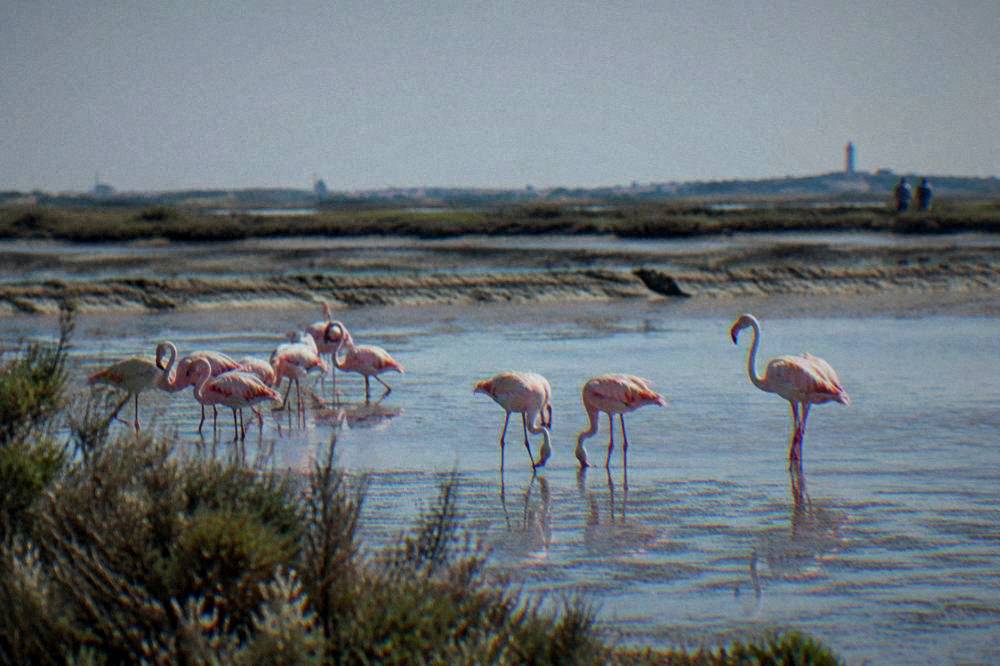
Lido di Savio, at the southern edge, is the least assuming of the five and the closest to the Cervia salt-pan landscape, where the visitor centre at Via Bova 61 opens on weekends and holidays with flamingos present year-round. That makes the far south of the Ravenna coast a genuine two-landscape day: sand in the morning, salt pans and birds in the afternoon.
When Is The Best Time Of Year For The Ravenna Beaches?
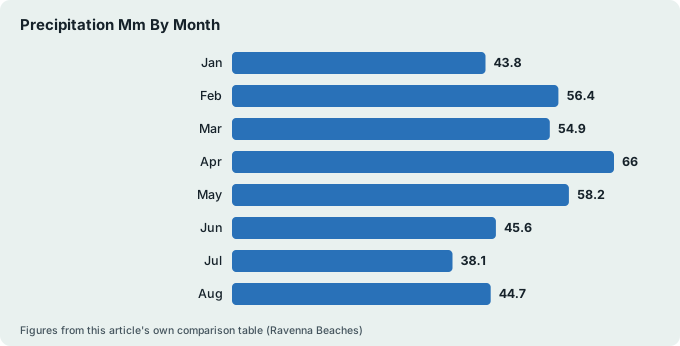
July and August are the full bathing months, with July the warmest at a 25.2 C mean and the driest at 38.1 mm of rain, per the modelled ERA5 1991 to 2020 normals the climate table holds, while June and September are comfortable shoulder months at 22.6 C and 20.3 C. May and October still work for walks at 17.9 C and 15.7 C, and the climate table is the source for every figure.
The shape of the year matters here because the Ravenna coast is not only a summer product. The table below summarises the modelled monthly normals, and the pattern is classic Po-plain Adriatic: warm, fairly dry summers, a spring and autumn that swing, and a wet peak in November at 78.3 mm.
| Month | Mean C | Precipitation mm |
|---|---|---|
| Jan | 5.1 | 43.8 |
| Feb | 5.8 | 56.4 |
| Mar | 9.4 | 54.9 |
| Apr | 13.1 | 66 |
| May | 17.9 | 58.2 |
| Jun | 22.6 | 45.6 |
| Jul | 25.2 | 38.1 |
| Aug | 25 | 44.7 |
| Sep | 20.3 | 57.9 |
| Oct | 15.7 | 66 |
| Nov | 10.6 | 78.3 |
| Dec | 6.1 | 63.7 |
For a combined mosaics-and-beach trip, June and September are the months that give you both halves at once: bathing weather on the shore and comfortable walking weather among the monuments, where the summer hours run until 2 November 2026 with 9:00 to 19:00 openings, before the winter schedule of 10:00 to 17:00 begins on 3 November 2026. The best time to visit Ravenna guide and the Ravenna weather guide unpack the same table for the city side of the trip.
July and August bring the crowds and the full lido operation, with every bathing establishment running and the evening scene at Marina di Ravenna at its loudest. November is the wettest month, and the winter sand barrier is in place on the beaches, which reshapes, rather than closes, the shoreline.
What Does The Winter Sand Barrier Mean For Your Beach Walk?
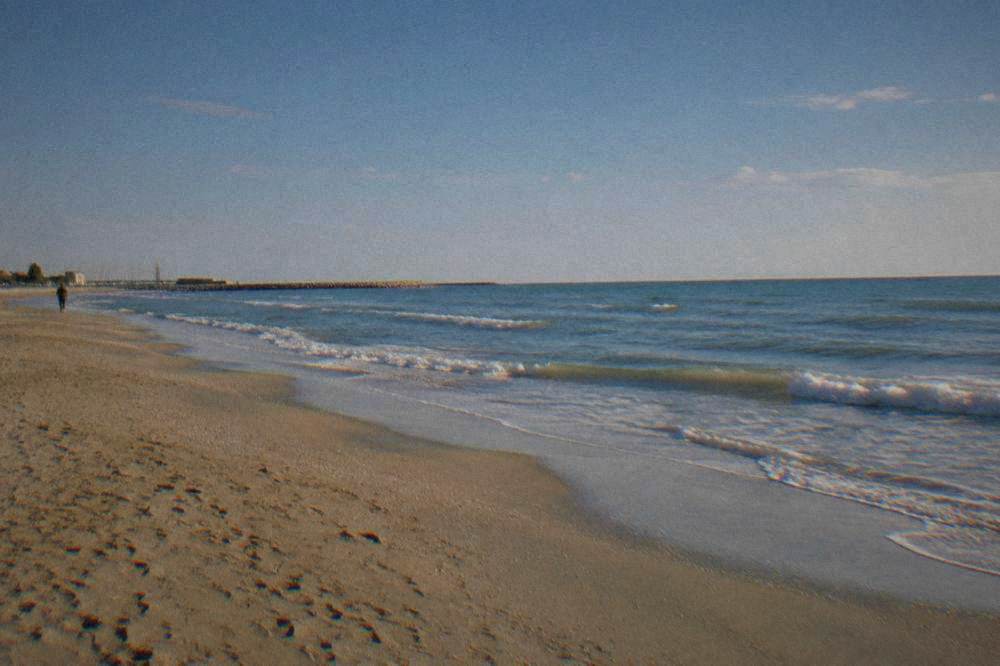
Each autumn a 25,000 cubic metre sand barrier is built along the Ravenna coast at Punta Marina, Marina di Ravenna Sud and Lido di Savio, and it stays in place until spring 2027, according to the Comune di Ravenna press release of August 2026. The barrier protects the shoreline from winter storms, and it changes what the beach looks like between autumn and spring, so winter walkers see a deliberately reshaped coast rather than the smooth summer sand.
This is one of those details that separates a well-informed visit from a surprised one. The barrier is a coastal-defence project, built after the summer season and removed or renourished in spring, and the Comune's announcement names the three affected stretches precisely. If your trip falls between late autumn and early spring and you have a specific resort in mind, checking the current state of that stretch on the municipal news pages before you go saves a disappointing walk.
The barrier does not close the coast. The promenades, the pinewoods and the winter market at Marina di Ravenna all keep running, and the off-season shore has its own appeal: empty sand, cold light and birdlife in the adjacent wetlands. Flamingos are present year-round in the Cervia salt pans to the south, and the Po Delta's birding areas stay active through winter, so the colder months convert this coast from a swimming destination into a walking-and-wildlife one.
For swimmers, the practical reading is simple: plan swims between June and September, plan walks and birdwatching the rest of the year, and treat the barrier as the visible mark of the season change.
Can You Swim, Cycle Or Birdwatch Along The Ravenna Coast?
Swimming belongs to the summer months, cycling works year-round on the flat coastal roads and pinewood paths, and birdwatching is a genuine year-round draw, with flamingos present in every season in the Cervia salt pans and herons and other wetland species across the Po Delta areas south of the Ravenna coast. The region's tourism pages list birdwatching at the Comacchio valleys, the Pialassa della Baiona and the Cervia salt pans, with tours and hides available year-round and winter viable.
The wetland network that flanks this coast is the part first-time visitors underestimate. The Punte Alberete flooded forest, the Valle Mandriole marsh and the Pineta di San Vitale sit between the city and the shore, with the Cà Vecchia visitor centre and the roughly 4 km Anello Dolce Salato trail giving a marked route through the habitat. Further south, the Cervia salt pans visitor centre at Via Bova 61 opens on weekends and holidays, with September to November hours of 10:00 to 12:30 and 14:30 to sunset.
Cycling ties the whole coast together. The flatness that makes the bus-and-bike combination easy also makes long shoreline rides realistic, and the pinewoods give shaded segments even at midday. A guided e-bike option exists that threads history and nature together, and the pick below shows what it covers.
Serious birders have a specialist option too: a birdwatching tour that guarantees 40 species on its listing.
| Coastal activity | Where it works best | Season | What to check |
|---|---|---|---|
| Swimming and lidos | All five resorts | June to September | Lido opening dates |
| Cycling | Lido Adriano, coastal paths | Year-round in mild weather | Hire availability |
| Birdwatching | Punte Alberete, Valle Mandriole, Cervia salt pans | Year-round, flamingos every season | Visitor-centre days |
| Pinewood walks | Pineta di Classe, Pineta di San Vitale | Year-round | Trail conditions after storms |
| Winter market | Piazza Dora Markus, Marina di Ravenna | Wednesdays and Saturdays to 31 May | Municipal listings |
Where Should You Stay Near The Ravenna Coast?
Staying on the coast means Marina di Ravenna for the evening scene and the marina, Punta Marina for spa-and-family calm, and Lido Adriano, Lido di Classe or Lido di Savio for quieter residential beach stays, while staying in the city keeps you beside the mosaics with the beaches a bus ride away. Both halves are covered in depth by this site's accommodation guides for the city and the shore.
The trade-off is honest and easy to state. A coast base gives you morning sand and sunset promenades but turns every mosaic visit into an outbound trip, while a city base reverses that. Families staying a week in summer usually land on the coast; visitors combining culture and a single beach day usually stay central. For the details, the where to stay in Ravenna guide covers the city's areas, and the best hotels in Ravenna guide covers the picks.
One cost to plan for is the tourist tax, an overnight charge that applies in Ravenna as across much of Romagna. The tariff in force from 1 January 2023 set per-night hotel rates at about EUR 1 for 1 and 2 star hotels, about EUR 2 for 3 star, about EUR 3 for 4 star and about EUR 4 for 5 star, with hostels at about EUR 1.20 and B&B accommodation at about EUR 1.50, and rates may have changed, so confirm the amount at booking.
What Else Combines Well With A Ravenna Beach Day?
A Ravenna beach day pairs naturally with the UNESCO mosaics in the centre, with Sant'Apollinare in Classe and the Classis Ravenna museum just inland of the southern beaches, with the Po Delta and Comacchio lagoon to the south, and with the Cervia salt pans on the southern edge of the coast. The Classe area is the easiest combination of all, because a UNESCO basilica, a city museum and the beach sit within one short hop of each other.
The southern combination deserves its own itinerary logic. Sant'Apollinare in Classe is open Monday to Saturday 8:30 to 19:00 and Sunday 13:30 to 19:00, the Classis Ravenna museum runs daily 10:00 to 17:00 with last entry 50 minutes before closing, and Lido di Classe is the beach on the same map, so a single bus or car loop can carry a morning mosaic, a museum hour and an afternoon on the sand. The Ravenna combo ticket guide explains how the mosaic ticketing works across the centre's monuments.
The lagoon combination runs the other direction. Comacchio, the fishing town in the Po Delta known for its canals and bridges, sits south of the Ravenna coast, and a guided day trip from Ravenna covers Ferrara and Comacchio in one booked itinerary. The listing for that trip shows what the day includes, and you can Check availability at the operator's page.
| Combination | What it pairs with the beach | Distance logic | Best season |
|---|---|---|---|
| Mosaics in the centre | Eight UNESCO monuments | Beach bus starts at the station | June, September |
| Classe area | Sant'Apollinare in Classe, Classis Ravenna | Same southern zone as Lido di Classe | Spring to autumn |
| Cervia salt pans | Flamingos and visitor centre | Southern edge of the coast | Year-round |
| Comacchio and Po Delta | Lagoon canals, boat nature tours | South of the coast | Spring to autumn |
| Mirabilandia | Major theme park near the coast | Inland of the coast, Ravenna area | Season ends 1 November 2026 |
Mirabilandia, the large theme park in the Ravenna area, closes its 2026 season on Sunday 1 November 2026, with autumn openings on weekends only, so it combines with a beach day strictly inside the warmer half of the year. The Mirabilandia guide covers planning for it.
How Does A Cruise Day Fit The Ravenna Beaches?
Cruise passengers dock at the Porto Corsini terminal, about 15 km from the historic centre, and the Visit Ravenna shuttle runs between the centre, the station area and the terminal in about 30 minutes, with the 2026 service running 3 May to 26 October. A beach stop is workable on a port day because Marina di Ravenna and the terminal share the same northern corner of the coast, though the shuttle's purpose is the city, not the sand.
The practical arithmetic for a port day is that the shuttle buys you the centre, and the centre buys you the mosaics. Adding the beach means either a short taxi or bus leg from the Marina di Ravenna area, or booking a private tour that folds the coast into the itinerary. The Ravenna cruise port guide and the Ravenna cruise port day guide cover the full decision tree, and the Bologna airport to Ravenna guide handles the fly-cruise arrival.
The 2026 cruise season is significant for this coast's future: 111 calls and about 390,000 passengers were planned for 2026, and the new terminal at Porto Corsini, built to handle two ships at once, is reported for inauguration in spring 2027 after its opening slipped from the earlier target. None of that changes the beach itself, but it explains why the Porto Corsini end of the coast keeps appearing in the news.
What Should You Pack And Know Before A Ravenna Beach Trip?
Pack for hot, exposed sand in July and August, when the climate table shows means of 25.2 C and 25 C and low rainfall, and pack layers plus a rain layer for spring and autumn, when means sit between 13.1 C and 17.9 C and monthly precipitation rises toward November's 78.3 mm. Bring or hire a bike if you plan to move between resorts, and bring binoculars if the wetlands are on your list, since the birding areas sit directly beside the coast.
Beyond clothing, three practicalities shape the day. First, lido operation and any bathing-establishment fees are set by each operator and are not published centrally, so check at the establishment when you arrive. Second, the buses run to seasonal timetables, and the winter booklet differs from the summer one, so verify the last return bus before you settle into an evening at Marina di Ravenna. Third, the historic centre is inland and car-restricted, with a camera-enforced limited traffic zone whose gates run on differing schedules and whose daily permit is bought at the parcometers, so a beach-by-car day should park in the resort rather than try its luck in the centre; the Ravenna parking and ZTL guide covers the details.
Food on the coast follows Romagna's tables rather than a separate seaside menu: piadina stands, grilled fish and the cappelletti and Romagna wines the Ravenna food guide describes. A cover charge, the coperto, is legal when printed on the menu, and tipping is not obligatory.
Common Questions About Ravenna Beaches
Does Ravenna have a beach?
Yes, but not in the city. Ravenna is an inland Po-plain city whose five beach resorts, Marina di Ravenna, Punta Marina, Lido Adriano, Lido di Classe and Lido di Savio, lie along about 35 km of coast, with the nearest about 8 km from the historic centre. The are there beaches near Ravenna answer page covers the question in full.
What are the best beaches in Ravenna?
There is no single ranking: Marina di Ravenna suits evenings and atmosphere, Punta Marina suits families and spa days, Lido Adriano is residential and relaxed, Lido di Classe adds the pinewood, and Lido di Savio is the quiet southern stretch. The best beaches in Ravenna answer page compares them.
How do I get from Ravenna to the beach without a car?
Take a Start Romagna bus from the railway station toward the resort of your choice, or cycle the flat roads through the pinewoods. The buses run year-round to seasonal timetables, so check the operator's current times before travelling.
Can you swim at the Ravenna beaches outside summer?
Swimming belongs to the warm months: the modelled ERA5 1991 to 2020 normals put July at a 25.2 C mean and September at 20.3 C, falling to 15.7 C in October. From late autumn the shore is a walking and birdwatching coast, and the winter sand barrier reshapes parts of it until spring 2027.
Which Ravenna beach is closest to the historic centre?
Marina di Ravenna is the closest of the five resorts, at about 8 km from the centre, and it is also the resort with the marina, the busiest lidos and the winter market on Piazza Dora Markus.
Can you combine the Ravenna mosaics and the beach in one day?
Yes, and it is the classic Ravenna day. The monuments open 9:00 to 19:00 in the summer schedule that runs to 2 November 2026, and the beach buses leave from the station a short walk from the centre, so a morning among the mosaics and an afternoon on the sand at Marina di Ravenna or Punta Marina is a realistic plan from June to September.
The Ravenna coast rewards exactly this kind of split planning: the city for the gold-ground mosaics and Dante's tomb, the shore for sand, pinewoods and flamingos, and the bus, bike or a booked day trip to stitch the two together.