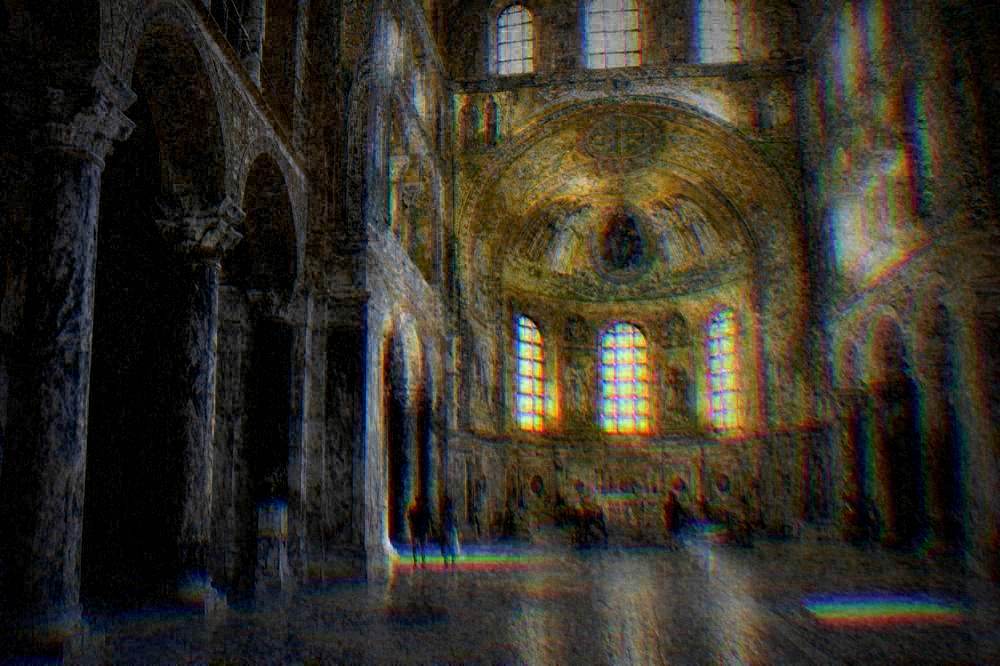
Ravenna Mosaic Workshop
A mosaic workshop is the one Ravenna activity where the city's UNESCO-listed art form passes through your own hands. This guide explains what a session covers, how studio visits compare with guided tours of the monuments, and how to plan a making day around the eight Early Christian sites.
Short answer
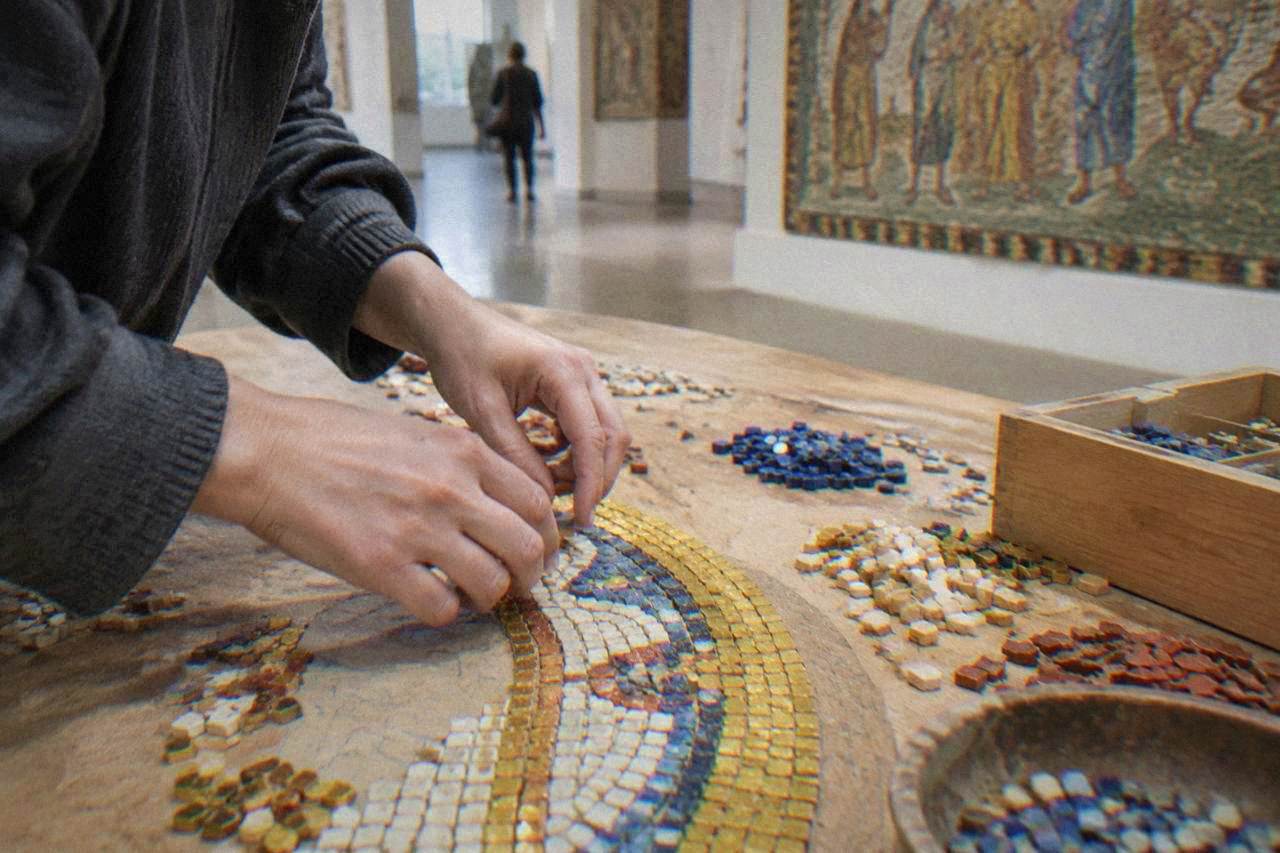
A Ravenna mosaic workshop is a hands-on session in a city studio where you cut and set glass tiles using the same direct method the city's Byzantine mosaicists used. Sessions run alongside the monument visits rather than replacing them, and several private tours pair a guided walk with a stop at a working mosaic studio.
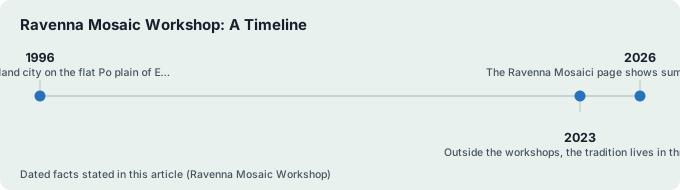
Ravenna, an inland city on the flat Po plain of Emilia-Romagna, holds eight Early Christian monuments inscribed by UNESCO in 1996, and the gold-ground glass mosaics inside them are the reason the city appears on world-heritage lists. A Ravenna mosaic workshop turns that heritage from something you stand beneath into something you make with your hands. The studios that keep the tradition alive sit a short walk from the monuments themselves, and a growing number of guided tours now build a studio stop into the walk between San Vitale and the Neonian Baptistery. This guide sets out what a session involves, how it fits a monument itinerary, and what to check before booking.
What Is A Ravenna Mosaic Workshop?
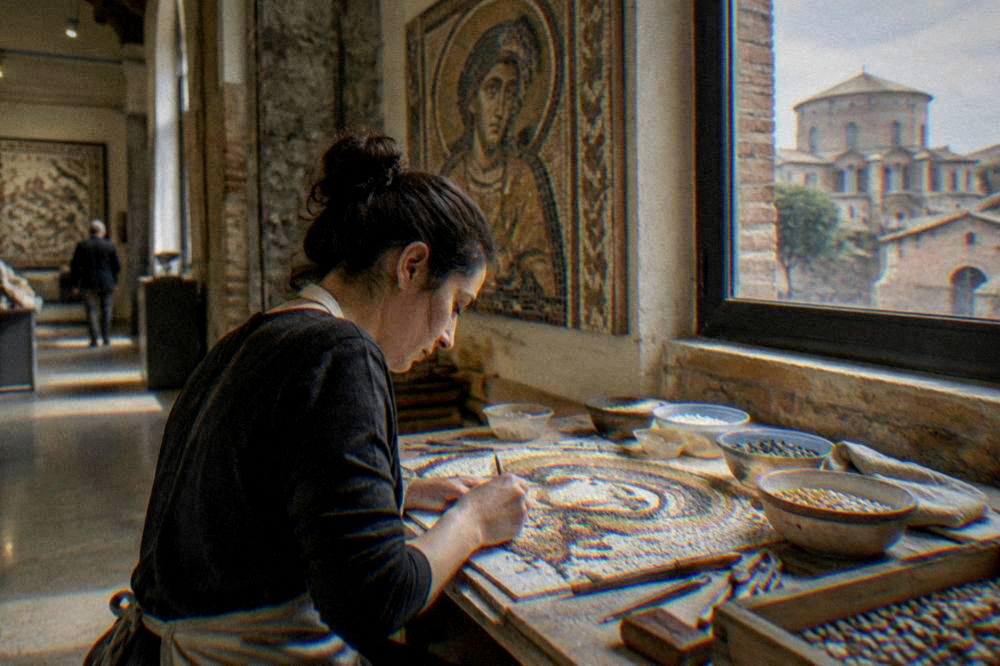
A Ravenna mosaic workshop is a practical session in a city studio where participants cut, shape and set glass tesserae, the small cubes of coloured and gold glass that make up the city's famous Byzantine mosaics, following the same direct-on-substrate method the historic mosaicists used. Sessions are taught by working craftspeople, materials and tools are supplied, and each participant leaves with a small finished panel of their own rather than a souvenir bought in a shop.
The workshop format exists because Ravenna's mosaic tradition never stopped. The monuments were decorated in the Early Christian period the UNESCO listing describes, but the city has carried a working community of mosaic restorers and artists continuously, trained in the same cutting and setting techniques the original workshops used. Studios today run beginner sessions that require no drawing skill: the pattern is prepared in advance, the tools are demonstrated, and the work is setting and adjusting tesserae rather than designing from scratch.
The direct method taught in these sessions is exactly what it sounds like. The tesserae are pressed one by one into a bed of adhesive or lime, face up, so the surface is visible as it grows. Roman and Byzantine floors and walls were largely made this way, and the emulsion of craft and material is the point of the session: the moment the marble-and-glass surface begins to reflect light at different angles is the moment the gold grounds of Galla Placidia stop being a photograph and start being a technique.
What Happens In A Typical M Workshop Session In Ravenna?
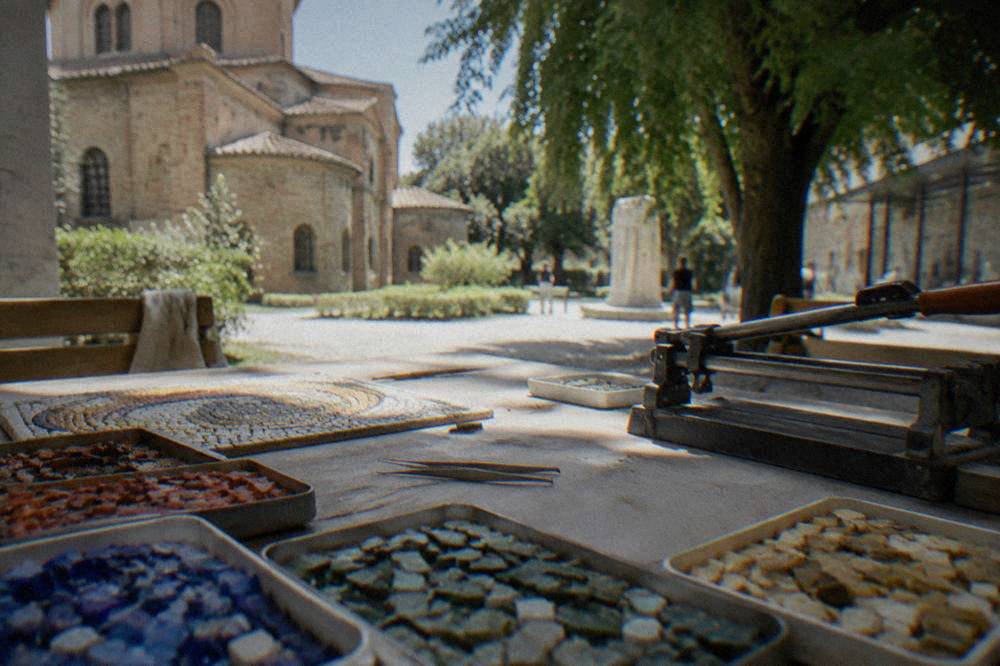
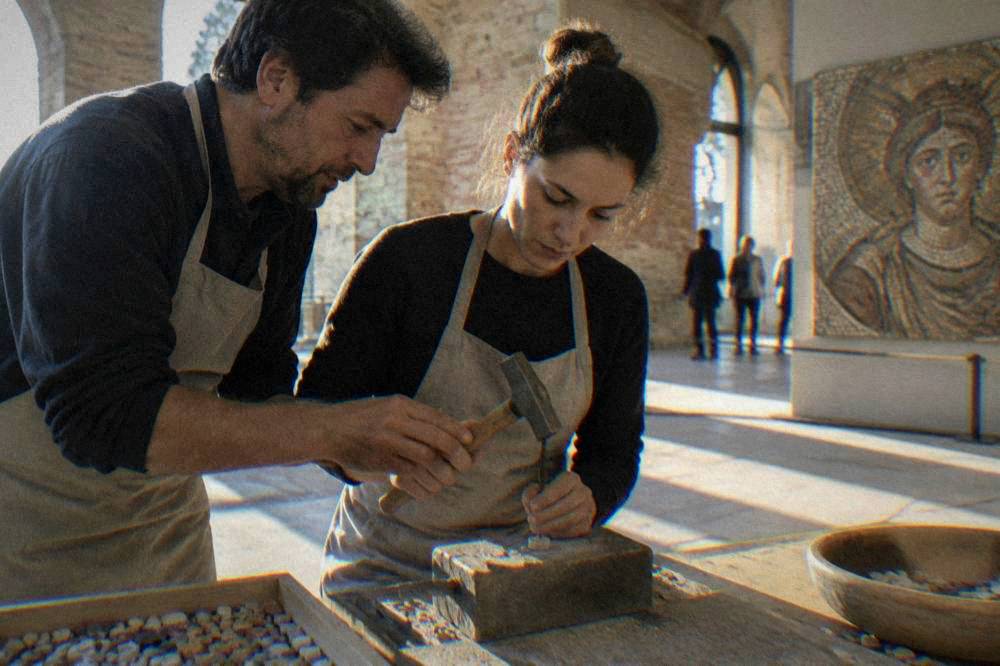
A typical session opens with a short introduction to Ravenna's mosaic heritage and the tools of the craft, moves to a demonstration of cutting tesserae with the classic hammer and hardie, and then hands the tools over: each participant sets their own tiles into a prepared design over the body of the class, with the instructor adjusting grip and spacing throughout. The session closes with grouting or finishing, and the small panel goes home with the maker the same day.
The hammer and hardie are the traditional pair: a heavy, blunt-edged hammer and a fixed blade set in a log or block, used together to snap marble and glass into usable cubes. The demonstration is usually the moment the room goes quiet, because cutting a clean, square tessera in one strike looks simple and is not. After that, the work is repetitive in the best sense: choose a cube, trim it if needed, press it in, look at the line it makes against its neighbour, adjust, repeat.
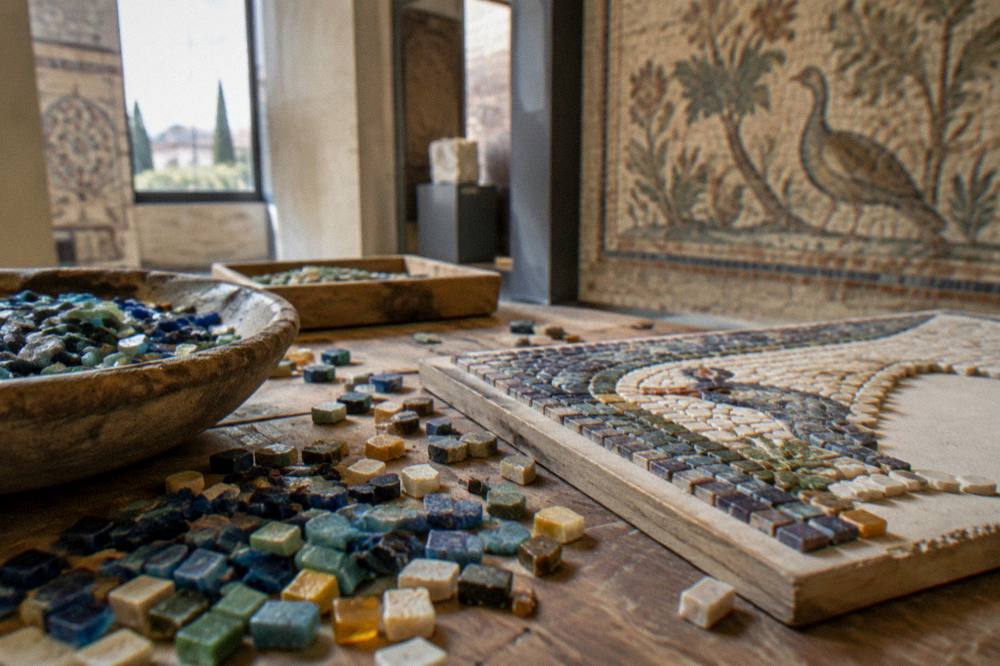
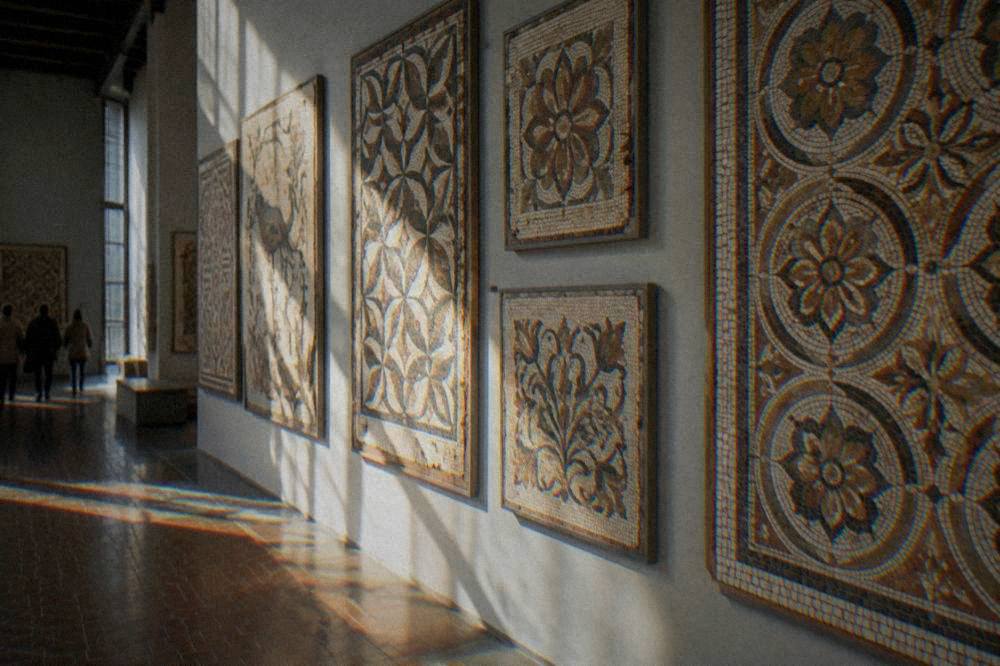
Patterns offered to beginners are typically small geometric or floral designs drawn from the city's own mosaic vocabulary, the star rounds and vine scrolls that recur across the monument floors. Gold leaf tesserae, glass cubes with a wafer of gold under a thin skin of glass, are sometimes available as an option, and they behave differently from marble: the setting angle matters, because gold catches light only when tilted, which is why the historic gold grounds appear to burn rather than shine.
What a session does not require is any prior skill. Instructors report that the main hurdle is not dexterity but patience, since the instinct is to rush the spacing and the result is visible in the gaps. By the second hour the work slows down, the lines even out, and the panel begins to read as a mosaic rather than as an arrangement of tiles.
A studio visit also comes built into some guided walks. The private tour that pairs a walking tour of the monuments with a visit to a working mosaic workshop is the clearest example on this site's roster, and it suits travellers who want the heritage and the craft in one booking rather than two.
How Does A Mosaic Workshop Fit Into A Day Of Monument Visits In Ravenna?
A workshop fits most naturally as a half-day block paired with a half-day of monument visits, because the historic centre is compact and walkable, the studios sit within it, and the Ravenna Mosaici combined ticket is valid for one week with one admission per monument, so the mosaics and the making need not compete for the same hours. A morning in San Vitale and the Neonian Baptistery followed by an afternoon session, or the reverse, is the standard shape.
The combined ticket structure is what makes the pairing easy. The Ravenna Mosaici ticket page lists reduced fares from EUR 9.50 for the two-monument itinerary covering Sant'Apollinare Nuovo and San Vitale, from EUR 11.50 for the four-monument version that adds Galla Placidia and the Neonian Baptistery, and from EUR 13.50 for the five-monument version that adds the Archiepiscopal Museum and the Chapel of St Andrew. The ticket is valid for one week, one admission per monument, and an entry time must be booked for each monument, with Galla Placidia and the Neonian Baptistery on mandatory timed entry with a few minutes inside each.
| Combined ticket | Monuments covered | Reduced fare |
|---|---|---|
| 2 monuments | Sant'Apollinare Nuovo, San Vitale | from EUR 9.50 |
| 4 monuments | adds Mausoleum of Galla Placidia, Neonian Baptistery | from EUR 11.50 |
| 5 monuments | adds Archiepiscopal Museum and Chapel of St Andrew | from EUR 13.50 |
Hours matter when stacking the two. The Ravenna Mosaici page shows summer hours of 9:00 to 19:00 from 8 March to 2 November 2026, and winter hours of 10:00 to 17:00 from 3 November 2026 to 6 March 2027, with the sites closed on 25 December and 1 January. Studios run their own schedules, and the pairing questions to ask at booking are whether the session time conflicts with a monument slot and whether the studio can hold a booking if a timed entry runs late.
The best-known monuments for seeing the finished craft are covered in detail elsewhere on this site, including the visitor guide to San Vitale and the walkthrough of the UNESCO sites. For the full ticket mechanics, including who qualifies for reduced and free entry, the combined ticket guide carries them.
Who Teaches Mosaic Workshops In Ravenna, And What Should You Check Before Booking?
Workshops in Ravenna are taught by working mosaicists, restorers and studio artists, several of them trained in the city's own conservation tradition, and the things to confirm before booking are the group size, whether materials and tools are included, what you take home, whether the session is in English or Italian, and the cancellation terms on the operator's live listing. Session content varies more between studios than price alone suggests, and the studio's own page answers each of these questions directly.
Group size is the first question because it shapes the session. A small table with one instructor means corrections arrive tile by tile; a larger class means demonstration and self-direction. Neither is wrong, but they are different products, and a traveller who wants hands-on correction should ask the question explicitly rather than assume it.
Materials matter in a specific way: gold tesserae are materially more expensive than coloured glass or marble, and sessions that include gold are sometimes priced differently from those that do not. The take-home piece is the second check, since some studios grout the panel during the session and send it home finished, while others send it home with setting adhesive still drying and grouting instructions for later. Both work; only one is finished on the day.
Language and logistics are the practical pair. Ravenna's studios work with international visitors routinely, but the language of instruction is worth confirming at booking, as is the meeting point, since studios sit inside the historic centre where access by car is restricted. For the craft tradition itself, the guide to the city's mosaic history sets out how the Byzantine technique reached the city and why it stayed.
Which Ravenna Monuments Best Prepare You For A Workshop?
The monuments that best prepare a workshop participant are the Mausoleum of Galla Placidia and the Neonian Baptistery for their dense vault mosaics, San Vitale for its gold-ground wall programmes, and Sant'Apollinare in Classe for its green paradise field, because each shows a distinct problem the craft had to solve: how to cover a curved vault, how to make gold read as light, and how to fill a large flat apse with a single readable image. Seeing these before cutting a single tessera changes what the hands understand.
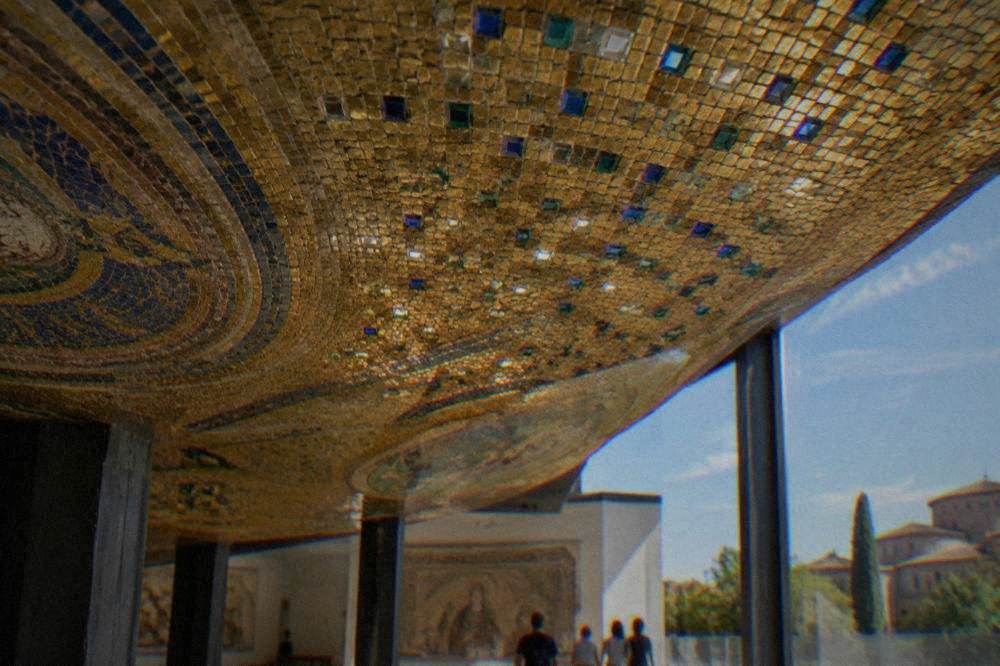
The vault of Galla Placidia is the classic first lesson. Its mosaic covers a cross-vaulted ceiling in deep blue, scattered with stars, and its effect depends on the angle of every tessera: the setters tilted the cubes so lamplight and daylight strike them differently across the day. A workshop participant who has stood under that vault knows why the instructor keeps saying to tilt the gold.
San Vitale teaches scale. Its walls carry gold-ground figure programmes, and the surfaces reward the slow look the workshop trains: the irregular spacing of hand-cut tesserae, visible up close, dissolves into smooth fields at viewing distance. The Neonian Baptistery, small and domed, shows the same effect compressed, and its ceiling is close enough that the individual setting angles can be read plainly. The dedicated guide to the baptistery covers what to look for on the dome.
| Monument | What it demonstrates to a workshop participant | Where it sits |
|---|---|---|
| Mausoleum of Galla Placidia | tesserae angled to catch light on a vaulted ceiling | historic centre, combo ticket |
| Neonian Baptistery | compressed dome mosaics readable tile by tile | historic centre, combo ticket |
| San Vitale | gold-ground wall programmes at scale | historic centre, combo ticket |
| Sant'Apollinare Nuovo | processional figures in a long band | historic centre, combo ticket |
| Sant'Apollinare in Classe | a green field apse in a rural setting | Classe, outside the centre |
Sant'Apollinare in Classe lies outside the centre in the Classe area, reachable by a short journey, and its apse shows a different register entirely: a green paradise field with standing figures, a reminder that not every mosaic surface is gold. The Classe basilica guide covers it in full, and the Classis Ravenna museum nearby continues the story of the ancient city the basilica served.
Can You Combine A Mosaic Workshop With A Guided Tour In Ravenna?
Yes: private tours on this site's roster pair a guided walk with a visit to a working mosaic workshop, most directly the private walking tour with a mosaic workshop visit, and a studio stop can otherwise be added independently around any guided or self-guided monument itinerary. The combined option suits travellers who want the interpretation and the craft demonstration in one arrangement, while booking the workshop separately allows the session to sit anywhere in the week the combined ticket allows.
The pairing works because both halves live in the same quarter. The studios sit within the historic centre, the monuments cluster within a walk of one another, and the railway station lies a short walk from the centre, so a morning guided walk can end at a studio door without transport. For travellers arriving from Bologna, the regional train covers about 84 km with a journey of about 1 hour to 1 hour 20, which makes a workshop afternoon reachable even on a day trip, though a full making session plus the five monuments is a full day and more.
The interpretation a guide adds is not decorative. The mosaic programmes are dense with figures and inscriptions, and the guided versions of the monument walks explain what is being looked at, which in turn makes the workshop's technique mean more. Travellers weighing the options can compare them on the mosaic tours guide, which sets out the differences between guided walks, ticket-included tours and private options.
How Much Time Should You Set Aside For A Mosaic Workshop In Ravenna?
Set aside a half day for the workshop itself and treat a first Ravenna visit as a two-day affair, one day for the monuments and one for the making, or a single long day if the workshop is the priority and the monument list is trimmed to two or three sites. The combined ticket's one-week validity means the two halves can be split across separate days, and that is the arrangement that puts the least pressure on either half.
The reason to protect the time is that a mosaic session cannot be hurried in a meaningful way. The craft's rhythm is set by the tesserae: each cube is cut, judged and placed, and the panel's quality is visible in the consistency of that rhythm. A session squeezed between a late monument entry and a dinner reservation keeps one eye on the clock, and the work shows it.
For travellers structuring a short visit, the one day in Ravenna and how many days in Ravenna guides set out the trade-offs. The compact centre means nothing in this plan requires a vehicle; the beaches at Marina di Ravenna and the other lidi are separate destinations 8 km or more from the centre and are reached by the Start Romagna bus, so a coast day and a workshop day should not be planned as one.
| Planning shape | Morning | Afternoon | Suits |
|---|---|---|---|
| Two relaxed days | 4 or 5 monuments on the combo ticket | workshop session | first-time visitors |
| One full day | workshop session | 2-monument combo, Sant'Apollinare Nuovo and San Vitale | day-trippers from Bologna |
| Split across a week | monuments on day one | workshop later in the week, same ticket window | cruise and long-stay visitors |
Timing around the seasons is simple: the monuments run the summer and winter hours the Ravenna Mosaici page publishes, and studios run their own calendars, so the check that matters is that both are open on the chosen day, with 25 December and 1 January closed at the state sites.
What Does The Ravenna Mosaic Tradition Look Like Outside The Workshops?
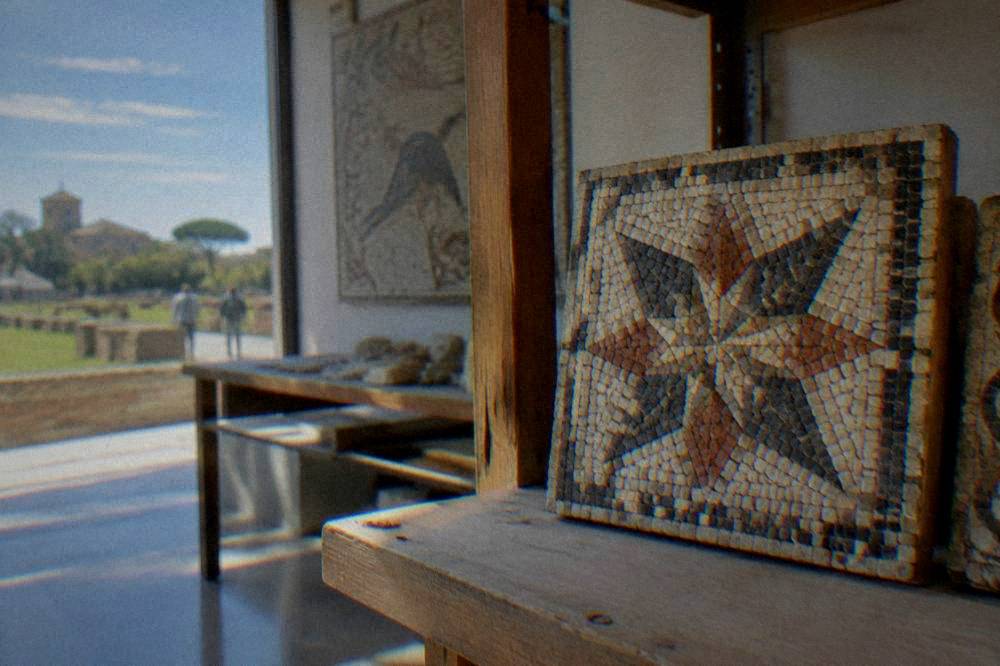
Outside the workshops, the tradition lives in three places: the eight UNESCO monuments themselves, the museums that hold detached mosaics and excavation material, including Classis Ravenna, which absorbed the collection of the former TAMO museum after it closed in 2023, and the contemporary mosaic scene, visible in the MAR art museum's exhibition programme and in public and decorative mosaic work across the city. The workshop is one door into a tradition with several.
The museum circuit rewards the same close looking the workshop trains. Classis Ravenna, in the Classe area, tells the story of the ancient city and its port, and its holding of mosaic material includes what the former TAMO museum exhibited before that museum closed in 2023. The Museo Nazionale, near San Vitale, holds further material from the city's churches, and the MAR, the city's art museum, shows the tradition in its contemporary continuation: its exhibition programme has included the Nicola Samori show Supremalia, running 17 October 2026 to 17 January 2027 per the museum's listings.
Admission across these museums sits in a modest band: Classis Ravenna charges EUR 8 full and EUR 6 reduced, the Museo Nazionale charges EUR 7 full and EUR 2 reduced, and the MAR charges EUR 8 full, EUR 6 reduced and EUR 3 for students, with the state museums and monuments free on the first Sunday of the month. These are the sites that sit outside the eight-monument UNESCO list, and they complement rather than duplicate it.
| Museum | Full ticket | Reduced | Closed |
|---|---|---|---|
| Classis Ravenna | EUR 8 | EUR 6 | 25 December |
| Museo Nazionale di Ravenna | EUR 7 | EUR 2 | Mondays |
| MAR | EUR 8 | EUR 6 | Mondays and 25 December |
| Museo Dante | EUR 5 | EUR 3.50 | Mondays and 25 December |
| Dante's tomb | free | none | 25 December |
For travellers whose interest is the mosaic art itself rather than the making, a private tour focused on the Byzantine mosaics walks the same monuments with the interpretation front and centre, and the Ravenna Travel Guide homepage collects the full range of options.
Is A Ravenna Mosaic Workshop Suitable For Children And Families?
A mosaic workshop in Ravenna is suitable for children from roughly primary-school age upward, because the craft's steps, choosing, placing and pressing tiles, need no prior skill, though the cutting of tesserae with the hammer and hardie is an instructor-led demonstration for younger participants rather than a hands-on stage. Families should confirm the minimum age and the family pricing on the operator's page before booking, since studios set their own limits.
The craft suits family groups for a plain reason: the work is immediately visible and immediately correctable. A misplaced tile is lifted and reset, the pattern grows quickly enough to hold attention, and the finished panel goes home with its maker. Sessions aimed at families usually simplify the pattern and shorten the cutting stage.
The rest of a family day in Ravenna is covered by the site's things to do in Ravenna collection, which includes the full monument itinerary and the Ravenna with kids guide. The is Ravenna worth visiting page answers the broader question for travellers still deciding.
What Should You Bring And Wear To A Mosaic Workshop In Ravenna?
Bring nothing but yourself and reading glasses if you use them: studios supply tools, tesserae, substrates and adhesives, and the practical clothing choices are simply closed shoes and nothing precious, because cutting marble and glass produces dust and occasional sharp fragments on the workbench. An apron is usually available at the studio, and any bag brought along should sit clear of the cutting area.
The dust is real but light. Marble and glass cut cleanly with the hammer and hardie, and the residue wipes from clothing, though silk and similar fabrics are the wrong choice for a working bench. The tools themselves are heavy and sharp-edged by design, so the closed-shoes rule is the one studios ask visitors to respect without exception.
The other practical item is timekeeping. Sessions begin with the safety and tool demonstration, and arriving late means missing the stage that makes the rest safe. Studios in the historic centre sit within the restricted-traffic zone, so anyone driving should plan parking outside the centre and walk in, a topic the getting around Ravenna guide covers along with the ZTL gates.
For travellers who prefer the city explained before the craft attempted, a private walk with a local expert can carry the historic context, leaving the studio session free to concentrate on the hands.
Where Does A Workshop Sit Among The Best Mosaic Experiences In Ravenna?
A workshop sits alongside the monument visits and the guided mosaic walks as the third of the city's three mosaic experiences: the monuments show the finished art, the guided walks explain it, and the workshop teaches the technique that produced it. Travellers with time for all three get the complete arc, while those with a single day choose between depth of looking and depth of making, a choice the combined ticket's one-week window makes easier to split.
If the walking version is the one that appeals, book a guided mosaic tour here.
The comparison is worth stating plainly because the three experiences are often confused in search results. A ticket-only visit shows the mosaics; a guided walk, like those compared on the mosaic tours guide, explains the programmes and the setting; a workshop puts the hammer in the participant's hand. None replaces the others, and the order matters less than the pairing.
| Experience | What it delivers | What it needs |
|---|---|---|
| Monument visit on the combo ticket | the finished mosaics, at your own pace | booked entry times, from EUR 9.50 reduced |
| Guided mosaic walk | interpretation of the programmes and technique | a booking, tickets sometimes included |
| Mosaic workshop | hands-on technique, a panel to take home | a half day, no prior skill |
How Do You Get To A Ravenna Mosaic Workshop From Bologna, The Coast Or The Cruise Port?
Most workshop studios sit inside Ravenna's historic centre, a short walk from the railway station, so the journey is simply the journey to Ravenna: direct regional trains from Bologna Centrale cover about 84 km in about 1 hour to 1 hour 20, buses from the coast resorts run on the Start Romagna network, and cruise passengers arrive through the Porto Corsini terminal about 15 km away, where the Visit Ravenna shuttle covers the transfer in about 30 minutes on the dates its 2026 page lists, 3 May to 26 October.
The station-to-centre walk is the fact that makes the whole plan easy: no workshop day in Ravenna needs a car, and the historic centre's restricted-traffic zone makes driving in the worse option. From Bologna, the regional service runs several times daily, and the Bologna to Ravenna and how to get to Ravenna guides hold the route detail. Travellers flying into Bologna's airport should know that no direct bus to Ravenna is listed: the route is the Marconi Express to Bologna Centrale, then the regional train, about 2 to 2.5 hours door to door.
Cruise passengers have the tightest arithmetic, and the cruise port day guide addresses it directly. A workshop session plus a monument visit is achievable on a full port day when the shuttle timing cooperates, but the booking to look for is a tour that bundles both halves with the transfer considered, rather than two separate reservations.
Common Questions About Ravenna Mosaic Workshops
Do I need any artistic skill for a mosaic workshop in Ravenna?
No. The patterns are prepared in advance, the tools are demonstrated, and the work is placing and adjusting tiles rather than drawing. Instructors report that patience matters more than talent, and the finished panel reflects care rather than prior training.
Can I visit a mosaic workshop in Ravenna without taking a class?
Yes. Several private tours include a visit to a working mosaic workshop as a stop on a guided walk, which shows the tools, the cutting technique and the studio without a making session. The listing for each tour states whether the stop is a demonstration or a hands-on class.
How long does a Ravenna mosaic workshop take?
Product durations render on each tour's own listing and are not typed on this page. As a planning matter, set aside a half day for a making session, and pair it with a half day of monument visits, since the combined ticket is valid for one week and the two halves can sit on separate days.
Is a mosaic workshop in Ravenna good for children?
From roughly primary-school age, yes: the placing and pressing steps suit young hands, while the cutting demonstration stays with the instructor. Confirm the minimum age and family pricing on the operator's page before booking, since each studio sets its own limits.
Do I take my mosaic home the same day?
That depends on the studio. Some sessions grout the panel during the class so it goes home finished, while others send it home with drying adhesive and grouting instructions. Ask at booking which applies to your session.
Where are the mosaic workshops in Ravenna located?
The studios sit within the historic centre, within a short walk of the station and the monument cluster. The centre is a restricted-traffic zone, so arrive on foot, by train or by bus, and park outside the centre if you are driving.
A mosaic workshop is the clearest way to understand what the UNESCO monuments hold, because after a session the gold grounds read as decisions, angles and cut lines rather than as decoration. Plan the making day alongside the monument day, let the one-week ticket window carry the split, and book the studio slot with the same care as a timed entry at Galla Placidia.