Ravenna 1 Day Itinerary
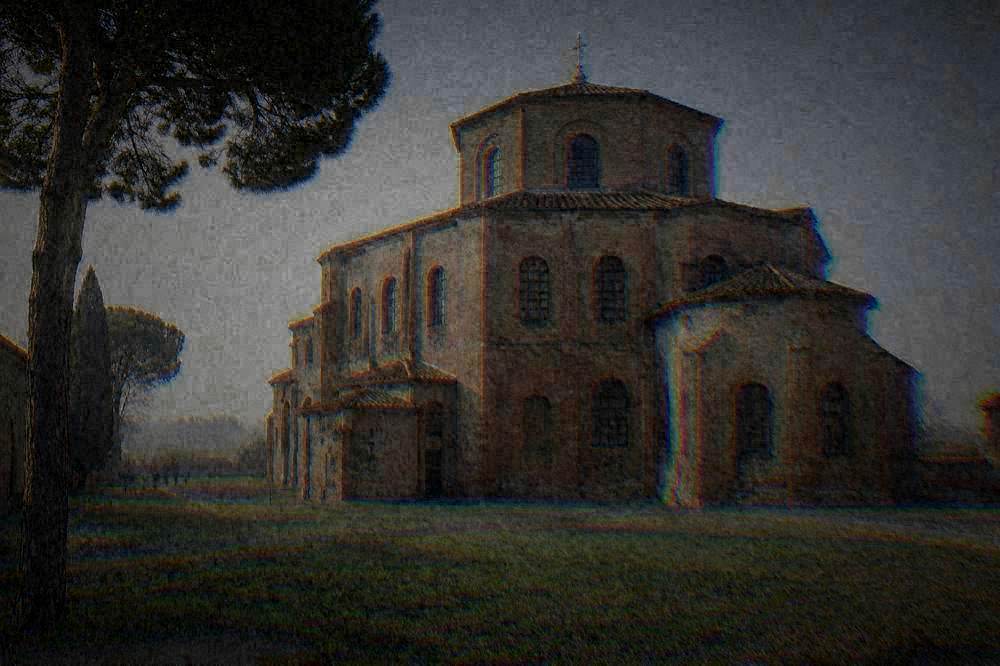
One day in Ravenna, in Emilia-Romagna, is enough to see the eight UNESCO Early Christian monuments if the ticket is bought with the timetable in mind. This itinerary sequences the mosaic sites, Dante's tomb and a proper lunch without rushing the gold.
Short answer
Buy the 5-monument Ravenna Mosaici combo, spend the morning at San Vitale, the Mausoleum of Galla Placidia and the Neonian Baptistery, then the afternoon at Sant'Apollinare Nuovo, the Archiepiscopal Museum, the Arian Baptistery and Dante's free tomb.
One day in Ravenna, an inland Po-valley city in Emilia-Romagna about 8 km from the Adriatic coast, is enough to see the eight monuments that UNESCO inscribed together in 1996 as the Early Christian Monuments of Ravenna. The trick is sequencing. The Ravenna Mosaici combo ticket is valid one week but each monument takes one admission, and two of the smallest ones, the Mausoleum of Galla Placidia and the Neonian Baptistery, run on mandatory booked entry times with stays of a few minutes each, as the official terms page states. This page lays out the day the sources support: monuments in the morning, Dante's tomb in the afternoon, and the margins of error the ticket rules create. For the wider picture, the Ravenna Travel Guide covers the city, the coast and every day trip.
How Do You Structure One Perfect Day In Ravenna?
A workable single day splits into three blocks: the morning for San Vitale, Galla Placidia and the Neonian Baptistery, which all stand within a short walk of each other; the early afternoon for lunch and Dante's free tomb; and the late afternoon for Sant'Apollinare Nuovo, the Archiepiscopal Museum, the Arian Baptistery and Piazza del Popolo. The Ravenna Mosaici hours give the frame: in winter, from 3 November 2026, everything runs 10:00 to 17:00, so the day starts later and ends tighter.
The official Ravenna Mosaici hours page sets two seasons. From 8 March to 2 November 2026 the main sites open 9:00 to 19:00, with last admissions at 18:30 or 18:45 depending on the monument. From 3 November 2026 to 6 March 2027 the same sites run 10:00 to 17:00, with last admission 16:30, and 16:45 at Galla Placidia and the Neonian Baptistery. Both seasons close 25 December and 1 January. A winter day therefore needs a firmer plan than a summer one, because the last timed slots at the two smallest monuments fill the end of the afternoon.
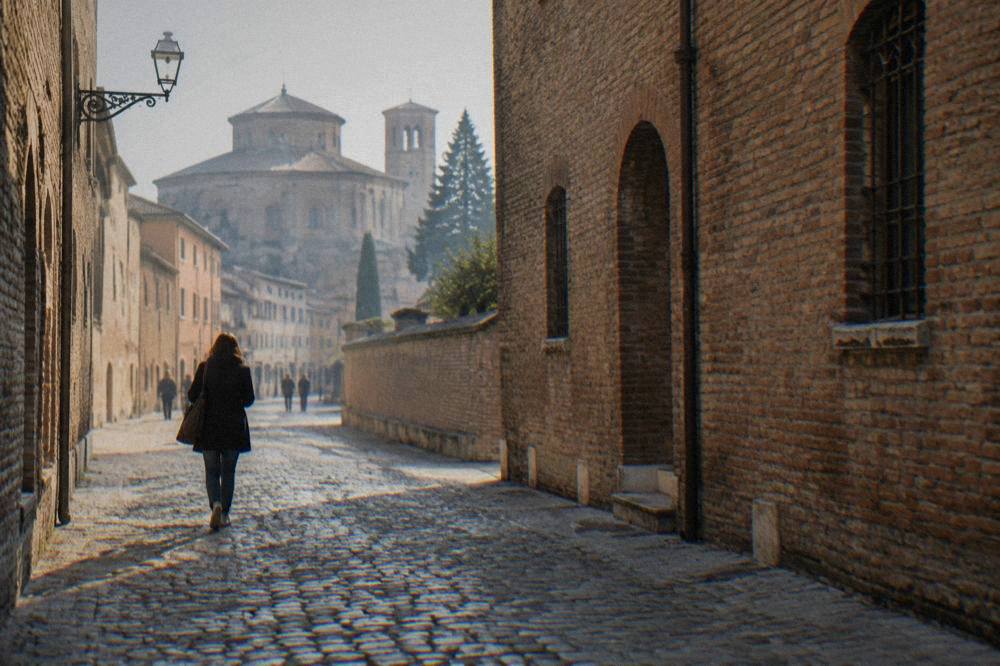
Distances are the reason the sequence works. The historic centre is small and flat, and the cluster around San Vitale, Galla Placidia, the Neonian Baptistery and the Archiepiscopal Museum is a short walk from the cluster around Sant'Apollinare Nuovo and Dante's tomb on Via di Roma. The railway station is a short walk from the centre too, so the plan holds whether the day starts from a hotel or from a train.
| Time | Stop | Why Here |
|---|---|---|
| 9:00 to 9:30 | Arrive, coffee near the station | Station is a short walk from the centre |
| 9:30 to 11:00 | San Vitale | Admission in slots, allow the longest visit |
| 11:00 to 12:00 | Galla Placidia and the Neonian Baptistery | Booked entry times, stays of a few minutes |
| 12:00 to 13:30 | Lunch | Piadina or cappelletti, see the food section |
| 13:30 to 14:15 | Dante's tomb and the basilica of San Francesco | Tomb is free, hours 10:00 to 18:00 November to March |
| 14:15 to 15:30 | Sant'Apollinare Nuovo and the Arian Baptistery | Both on the walk back toward the centre |
| 15:30 to 16:30 | Archiepiscopal Museum and Chapel | Last admission 16:30 in winter |
| 16:30 onwards | Piazza del Popolo, aperitivo | End the day in the main square |
Sant'Apollinare in Classe sits outside the centre in the Classe area and needs its own block of time; the section below weighs it honestly for a one-day visit.
Which Monuments Should Fill Your Morning In Ravenna?
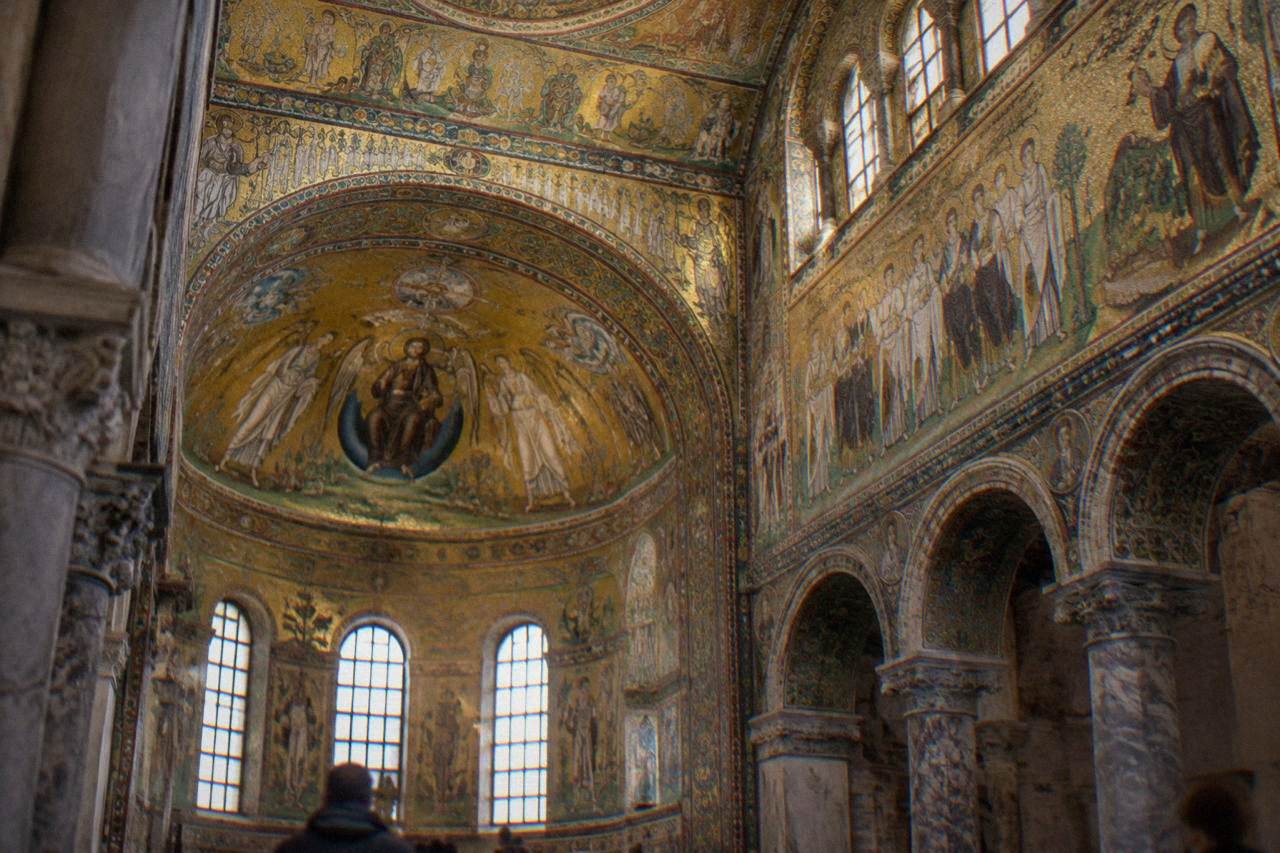
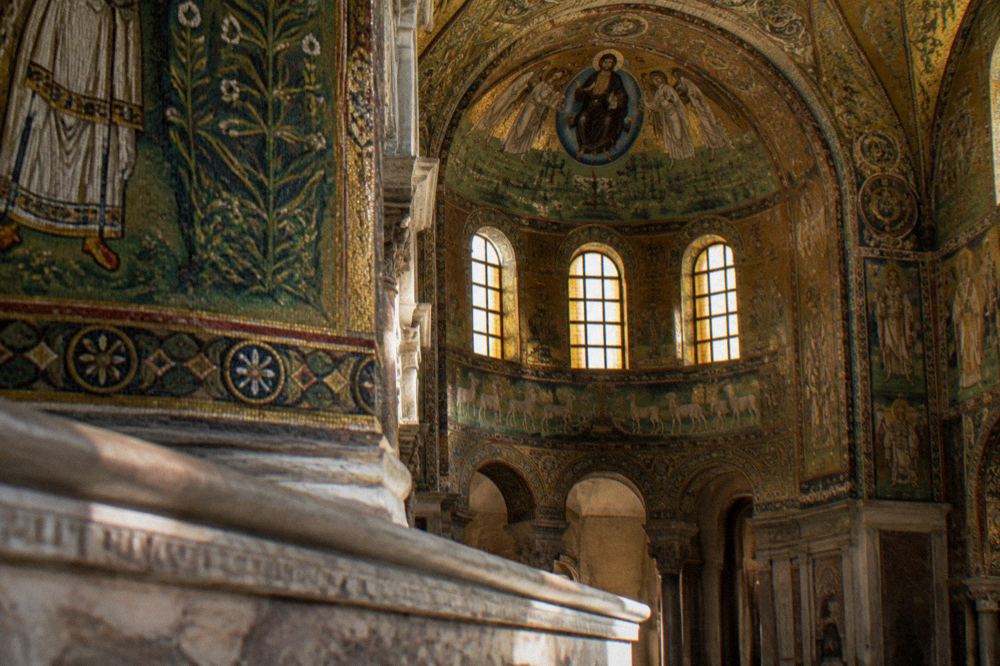
The morning belongs to the San Vitale cluster: the Basilica of San Vitale with its gold-ground vault mosaics, then the Mausoleum of Galla Placidia and the Neonian Baptistery, which are steps away and work only with pre-booked entry times. The Ravenna Mosaici terms page states that Galla Placidia and the Neonian Baptistery require a booked entry time and allow short stays of a few minutes, while San Vitale admits visitors in scheduled slots.
San Vitale is where the day's centre of gravity sits. The basilica's interior mosaics, the imperial panels and the vault, reward the longest stop of the morning, and the slot system means the entry time matters more than the arrival time. The basilica of San Vitale has its own page with what to look at in detail.
Galla Placidia is the small blue-and-gold vaulted chapel beside San Vitale. The mausoleum of Galla Placidia is one of the eight UNESCO monuments, and the few minutes inside are metered by staff at the door, so the best approach is to look up quickly and let the star-strewn vault do its work. The Neonian Baptistery nearby is a brick drum with a domed mosaic ceiling; the same booked-entry rule applies, and its floor level sits below the modern street, a detail worth knowing before stepping in.
Three monuments, one ticket, one square. That is the whole argument for putting them first: they share a cluster, they share the combo ticket, and their timed entries can be booked back to back. A guided walk covers the same cluster with the readings attached, which matters in monuments whose mosaics carry layers of meaning a panel cannot explain.
If the day is self-guided, the entry-time booking is the one piece of administration that cannot be left to the morning itself, because the popular slots at the two timed monuments go first.
What Does A Ravenna Mosaici Ticket Cost And How Does It Work?
Reduced combo fares start at EUR 9.50 for two monuments, EUR 11.50 for four and EUR 13.50 for five, per the Ravenna Mosaici prices page, and every combo is valid one week with one admission per monument and a booked entry time for each. Reduced rates apply to students, non-accredited journalists and paying groups over 20; children 0 to 10, Ravenna residents, ICOM members, licensed guides, and disability plus companion enter free.
The tiers are cumulative, and the two-monument ticket covers Sant'Apollinare Nuovo and San Vitale. The four-monument ticket adds Galla Placidia and the Neonian Baptistery, and the five-monument ticket adds the Archiepiscopal Museum with the Chapel of St Andrew. For a one-day itinerary the five-monument version is the natural fit, but a shorter day works on four. The full, non-reduced prices sit on the official page, which is where to check before buying.
| Combo | Monuments covered | Reduced fare | Notes |
|---|---|---|---|
| 2 monuments | Sant'Apollinare Nuovo, San Vitale | EUR 9.50 | Entry time still booked per monument |
| 4 monuments | Adds Galla Placidia, Neonian Baptistery | EUR 11.50 | Timed entry, stays of a few minutes |
| 5 monuments | Adds Archiepiscopal Museum and Chapel of St Andrew | EUR 13.50 | Complete central set |
Three monuments sit outside this ticket entirely. The Mausoleum of Theodoric costs EUR 6, with a concession at EUR 5 and EUR 2 for ages 18 to 25, and a EUR 7 combined ticket adds the Arian Baptistery and Theodoric's Palace, per the Visit Ravenna page. Sant'Apollinare in Classe is EUR 6 full and EUR 2 reduced. Dante's tomb is free. A traveller collecting all eight UNESCO monuments in one day therefore holds two or three tickets, not one.
A guided tour that bundles admission removes the booking chore, and the listing shows cancellation terms before payment is final. Whichever way the day is bought, the ticket to keep safe is the combo, because its one-week validity and one-admission rule mean a missed monument cannot simply be re-entered.
Where Should The Afternoon Take You In Ravenna?
After lunch the day moves to Via di Roma: Dante's tomb, which is free and open 10:00 to 18:00 from November to March and 10:00 to 19:00 from April to October, then Sant'Apollinare Nuovo and the Arian Baptistery, and finally the Archiepiscopal Museum and Chapel before its 16:30 winter last admission. Piazza del Popolo closes the day as the city's living room.
Dante died and is buried in Ravenna, and the municipal page for Dante's tomb confirms free entry with the seasonal hours above and a closure on 25 December. The tomb sits next to the basilica of San Francesco, a short walk from the mosaic cluster. Each September, on the second Sunday of the month, the city receives oil from the Tuscan hills for the lamp at the tomb, an offering the Comune records on its page.
Sant'Apollinare Nuovo, with its long processional mosaic walls, and the Arian Baptistery, EUR 3 full price with no reduced rate, sit a few streets apart. The basilica of Sant'Apollinare Nuovo and the Arian Baptistery each have dedicated pages. The Arian Baptistery's hours are split: Monday to Thursday mornings only, Friday to Sunday mornings and afternoons, so on a Monday the afternoon order should flip and put the baptistery first thing instead.
The Archiepiscopal Chapel and its museum close the monument list, and the marble chair and chapel mosaics reward the last reserved hour. Then the day can soften: Piazza del Popolo, the city's main square with its two column-bearing lions, is where the evening begins. The historic centre and its pacing for a longer stay are covered separately.
Should Sant'Apollinare In Classe Be On A One-Day Ravenna Itinerary?
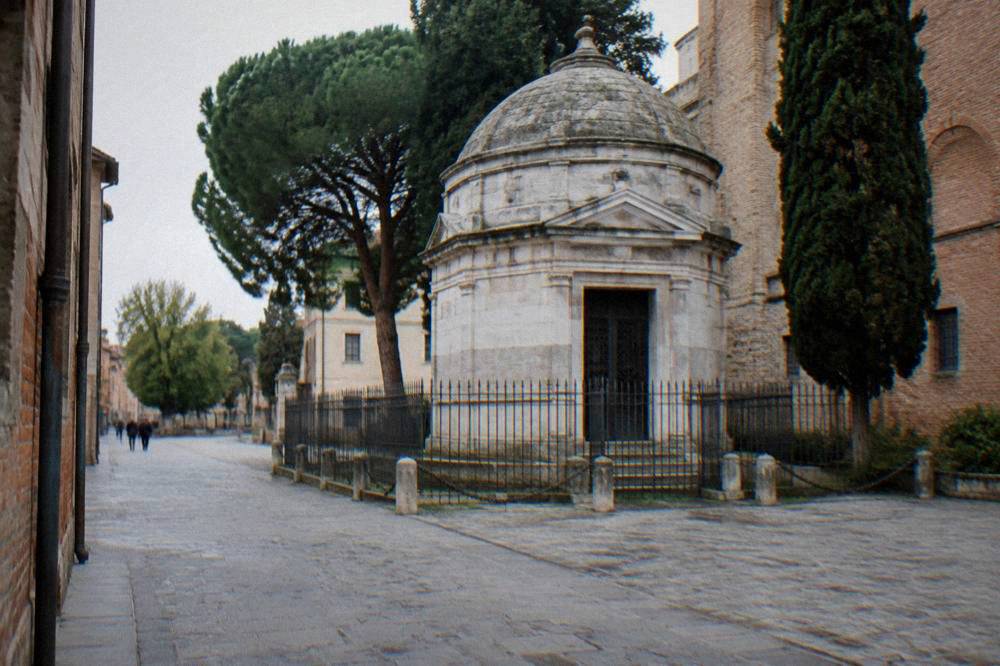
Sant'Apollinare in Classe, EUR 6 full and EUR 2 reduced, is open Monday to Saturday 8:30 to 19:00 and Sunday 13:30 to 19:00, but it stands in the Classe area outside the centre, so including it in one day means budgeting a separate outward and return trip and cutting time from the central cluster. On a strict single day the seven central monuments are the defensible set; Classe fits if the day starts early and the mosaics matter more than a relaxed lunch.
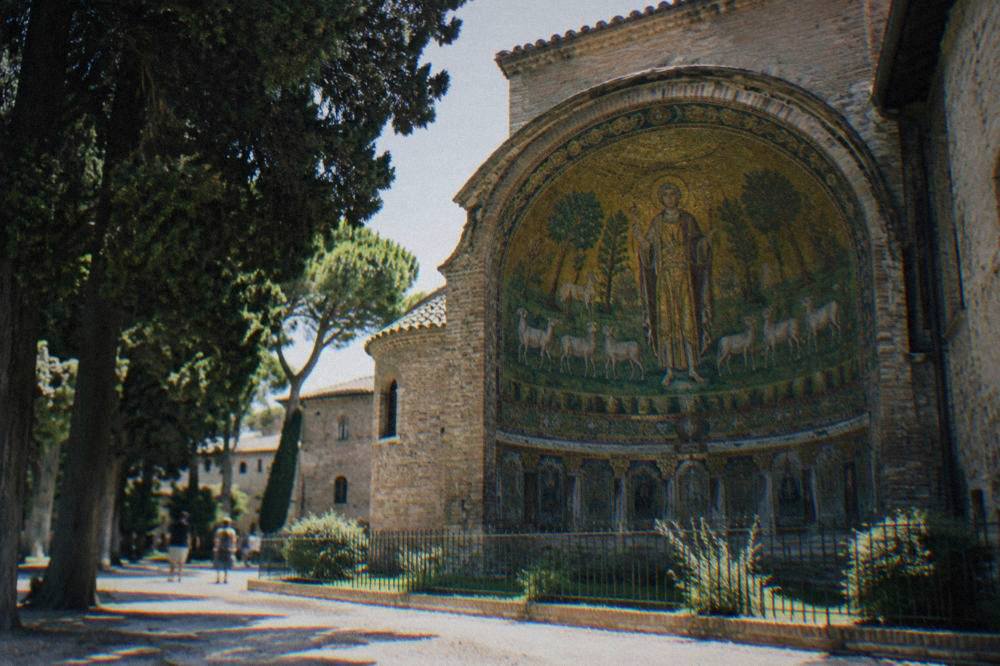
The basilica's green meadow mosaic apse is among the most photographed in the city, and the basilica of Sant'Apollinare in Classe page covers it in full. Next to it stands the Classis Ravenna museum, EUR 8 full and EUR 6 reduced, open daily 10:00 to 17:00 with last entry 50 minutes before closing, which also absorbed the collection of the former TAMO museum after TAMO closed in 2023. Doing both in one day is possible but tight.
What the sources do say is that the basilica is outside the centre and that its Sunday hours start at 13:30, which shapes any Sunday plan. A one-day visitor who wants Classe should check the local bus options on the day and treat the museum as optional.
Where Should You Eat On A One-Day Ravenna Itinerary?
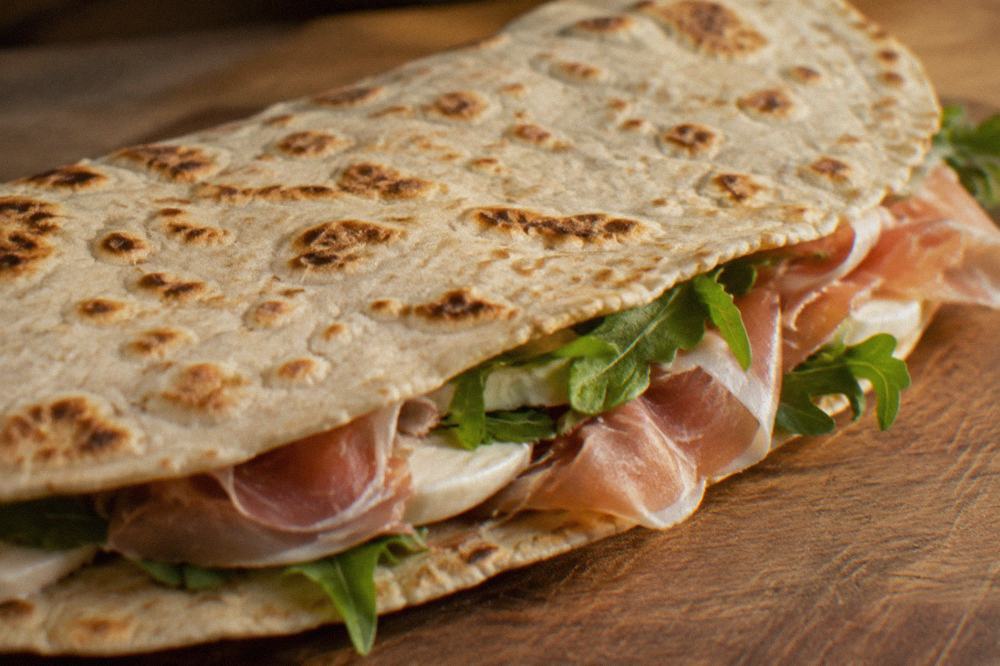
Lunch in Ravenna means the Romagna flatbread piadina for speed, or cappelletti in broth for a sit-down plate, and both are described dish-first on the Visit Ravenna food pages, which carry no prices here. A one-day itinerary benefits from a fast piadina stop near the monuments at midday and a slower dinner in the evening, because the timed entries do not bend for a long lunch.
Want the food folded into the sightseeing? Book a mosaics and food walking tour here.
Piadina is the region's everyday bread, cooked flat and folded around cheeses and cured meats; the piadina romagnola page traces it. Cappelletti, the small filled pasta served in capon broth, is the ceremonial dish, covered on the cappelletti page. No restaurant is named on this site, and no price is printed, so the working method is the one any visitor can repeat: read the posted menu outside, check that the cover charge, the coperto, is printed on it, which the law requires, and decide there.
A cover charge is legal when printed, tipping is not obligatory, and the itemised bill is the check. Between monuments, the streets around Via di Roma and Piazza del Popolo hold the density of bars and bakeries, and an afternoon gelato is part of the rhythm rather than a detour. Visitors who want the food and the mosaics stitched into one walk can take a tasting tour instead of splitting the day themselves.
What If It Rains Or You Have Extra Hours In Ravenna?
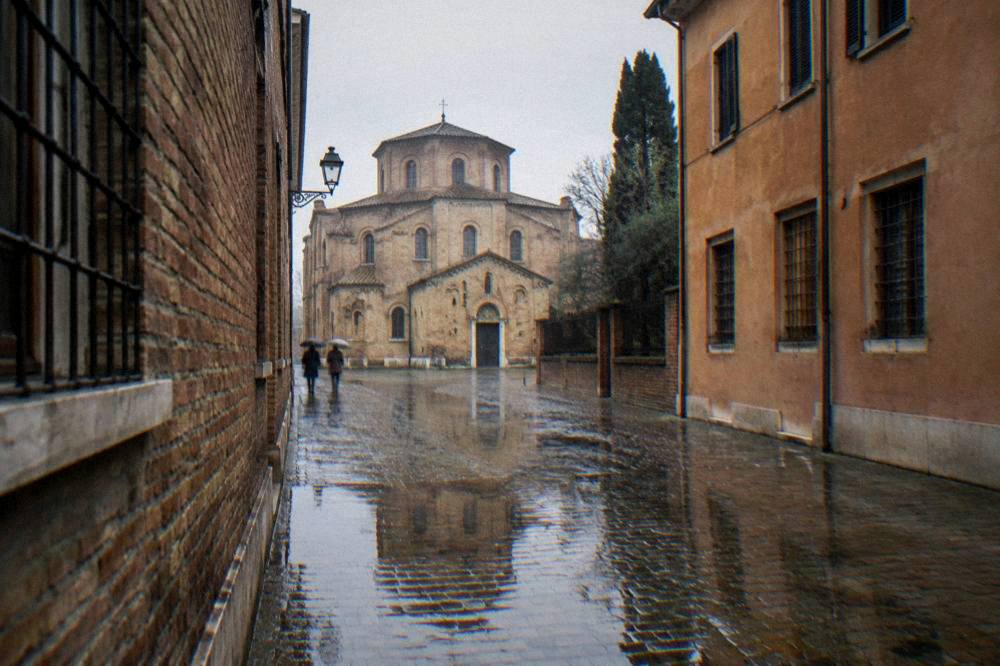
Rain barely dents this itinerary, because every monument on it is an interior, and the walk between clusters is short; the museums fill any leftover hours, with MAR at EUR 8 full, EUR 6 reduced and EUR 3 for students, the Museo Nazionale at EUR 7 and EUR 2 reduced, closed Mondays, and the Museo Dante at EUR 5 combined with EUR 3.50 reduced. The Domus dei Tappeti di Pietra varies its hours by season, so its page is the check before going.
The dedicated Ravenna in the rain itinerary handles a wet day in full. In outline: the mosaic interiors are the point of the city and they are all roofed, so rain mainly affects the walk between them and the appeal of Piazza del Popolo at dusk. The state museums and monuments are free on the first Sunday of the month, which can reshuffle a budget on the right date, though crowds follow the free entry.
For extra hours, the Classis Ravenna museum and the National Museum of Ravenna hold the city's longer history, and the MAR, closed Mondays, holds contemporary shows alongside its collection. A half-day version of the mosaic core, for visitors with even less time, is set out in Ravenna mosaics in half a day.
| Indoor option | Entry | Hours note |
|---|---|---|
| MAR, Museo d'Arte della Citta | EUR 8 full, EUR 6 reduced, EUR 3 students | Tue to Sat 9:00 to 18:00, Sun 15:00 to 19:00, closed Mon |
| Museo Nazionale di Ravenna | EUR 7 full, EUR 2 reduced | Closed Monday |
| Museo Dante | EUR 5 combined, EUR 3.50 reduced | Closed Monday |
| Domus dei Tappeti di Pietra | Check the official page for the price | Hours vary by season, check the official page |
| Ravenna Mosaici monuments | From EUR 9.50 reduced | 10:00 to 17:00 from 3 Nov 2026 |
What Does One Day In Ravenna Actually Cost?
A self-guided day costs the 5-monument combo from EUR 13.50 reduced, plus EUR 6 for Sant'Apollinare in Classe if added, or EUR 7 combined for the Mausoleum of Theodoric with the Arian Baptistery and Theodoric's Palace, plus lunch and a tourist tax that runs about EUR 1 to EUR 4 per night by hotel category, per the 2023 tariff, always to be confirmed at booking. Dante's tomb and the first-Sunday state museum entries cost nothing.
The tourist tax figures are GROK-sourced from a tariff in force from 1 January 2023 and may have changed, so the booking confirmation is the authority. What can be tabled is the ticket side of the day, which is fully priced by the official pages.
| Item | Fare | Source basis |
|---|---|---|
| 5-monument combo, reduced | EUR 13.50 | Ravenna Mosaici prices page |
| 4-monument combo, reduced | EUR 11.50 | Same page |
| Mausoleum of Theodoric | EUR 6, EUR 5 concession, EUR 2 ages 18 to 25 | Visit Ravenna page |
| Theodoric combined with Arian Baptistery and Palace | EUR 7 | Visit Ravenna page |
| Arian Baptistery alone | EUR 3 | cultura.gov.it |
| Sant'Apollinare in Classe | EUR 6, EUR 2 reduced | cultura.gov.it |
| Dante's tomb | Free | Comune di Ravenna |
Budget travellers have a fuller breakdown in Ravenna on a budget and free things to do in Ravenna.
What Could You Do With A Second Day From Ravenna?
A second day opens the day-trip ring: Bologna by direct regional train in about 1 hour to 1 hour 20 over about 84 km, Ferrara, Comacchio and the Po Delta, Faenza, Brisighella, Cervia, Rimini and San Marino, or Venice, each covered on this site, with the Ferrara and Comacchio day tour and the history and beach-lunch private tour as the two organised options that leave from Ravenna itself.
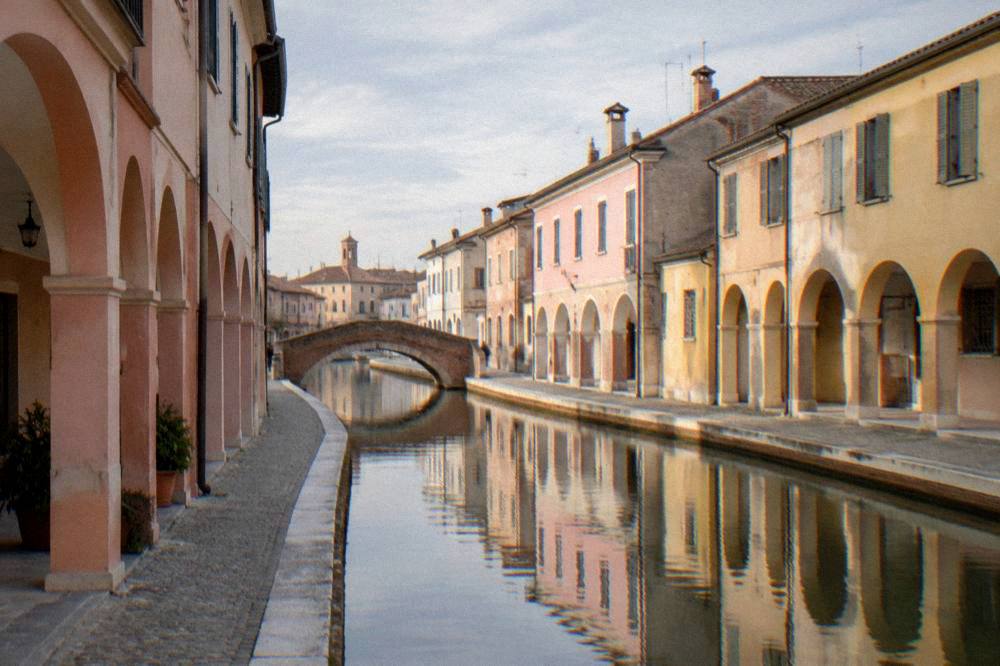
Venice, Florence and Rimini pages hold their own routes. Comacchio, with its lagoon and flamingos present year-round in the salt pans, and Ferrara together form the closest thing to a second Ravenna day: small, flat, mosaic-adjacent in spirit and reachable without a car for the train leg, though the last hops need local transport.
The same operator listing also runs a private day that pairs Ravenna's history with lunch on the coast, which suits travellers who want the beach resorts, 8 km or more from the centre at Marina di Ravenna and its neighbours, without organising the bus themselves.
Longer plans are already mapped: two days in Ravenna, three days in Ravenna, and the Ravenna weekend itinerary, while cruise passengers with a single ashore day have the dedicated Ravenna cruise port day plan, and the full sight list is at things to do in Ravenna.
Common Questions About One Day In Ravenna
Can you see Ravenna's mosaics in one day?
Yes. All the central UNESCO monuments except Sant'Apollinare in Classe sit in two walkable clusters, the combo ticket covers five of them with one-week validity, and the winter hours 10:00 to 17:00 still fit the full central set with a disciplined lunch.
What are the 8 UNESCO sites in Ravenna?
The Mausoleum of Galla Placidia, the Neonian Baptistery, Sant'Apollinare Nuovo, the Arian Baptistery, the Archiepiscopal Chapel, the Mausoleum of Theodoric, San Vitale and Sant'Apollinare in Classe, inscribed together in 1996.
Do you need to book entry times for Ravenna monuments?
The Ravenna Mosaici terms page requires a booked entry time per monument, and Galla Placidia and the Neonian Baptistery limit stays to a few minutes each. San Vitale admits in slots.
Is Dante's tomb free in Ravenna?
Yes, entry is free, open 10:00 to 18:00 from November to March and 10:00 to 19:00 from April to October, closed 25 December, per the Comune di Ravenna page.
Can you visit the beach on a one-day Ravenna itinerary?
The centre is inland, about 8 km from the coast, and the beaches need a Start Romagna bus, a bike or a car, so the coast works better as part of a second day or a dedicated coast itinerary than as an add-on to the mosaic day.
One day, booked entry times and two clusters of gold: that is Ravenna in a nutshell, and the sources above hold every figure needed to run the plan.