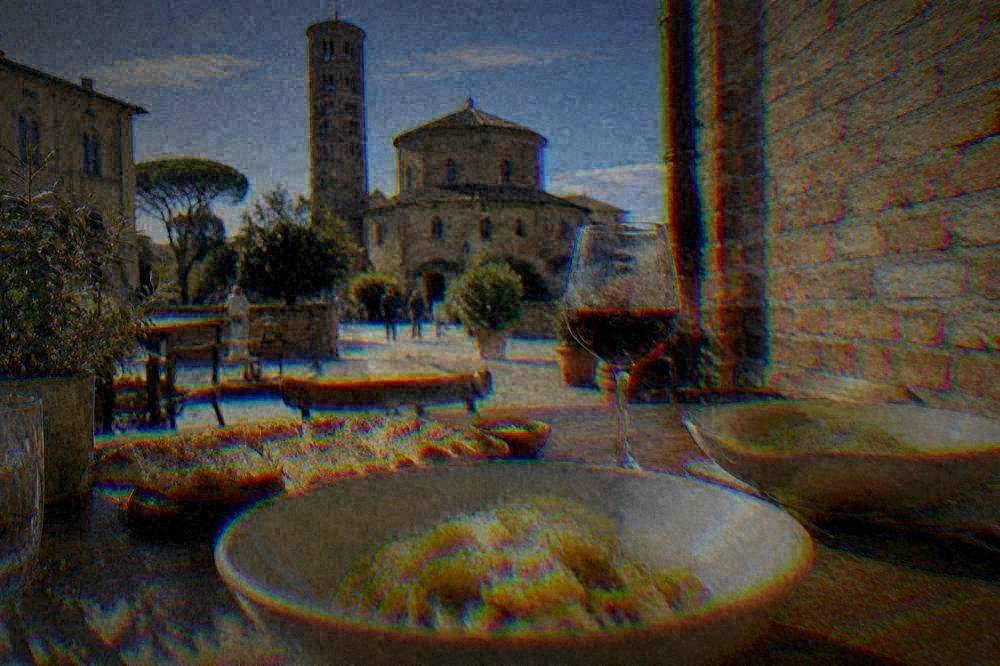
Romagna Wine: A Ravenna Guide To Sangiovese, Albana And Where To Taste
Ravenna sits in Emilia-Romagna, the region whose hills produce Sangiovese di Romagna and Albana di Romagna, and the city is a practical base for tastings, winery visits and wine-with-mosaics days.
Short answer
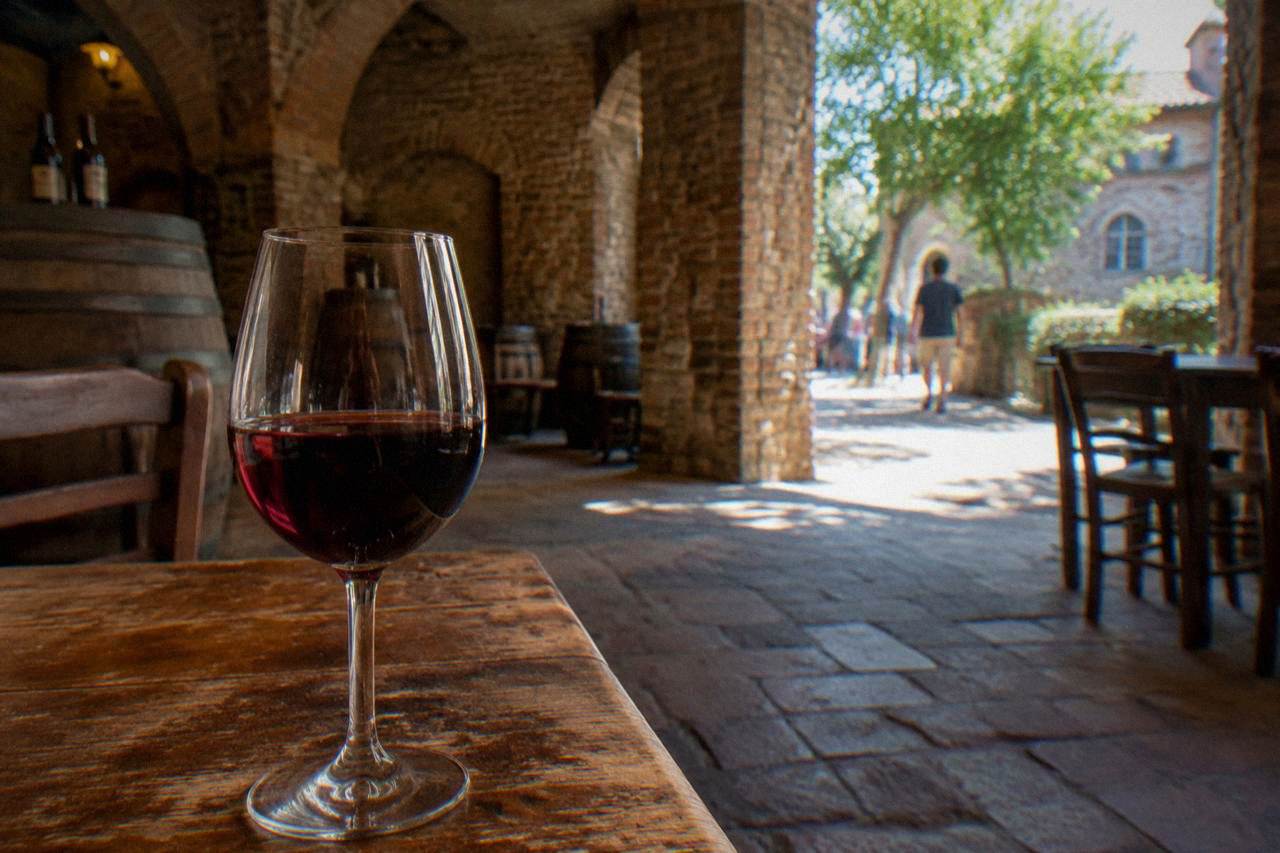
Romagna wine means above all Sangiovese di Romagna red and Albana di Romagna white, produced in the hills southeast and southwest of Ravenna. The city itself is a flat, inland mosaic town, so wine country is a short drive or a booked tour away rather than at the doorstep.
Ravenna, in Emilia-Romagna, Italy, is a flat inland city on the Po plain, about 8 km from the Adriatic coast, and it is surrounded on three sides by the wine country that gives the region its name in every bottle: Romagna. The hills behind the coastal strip and the ridge roads toward Brisighella and Faenza carry vineyards of Sangiovese, the red grape Romagna treats as its own, and Albana, the white that the hills south of the city have grown for centuries. The city itself is famous for its eight UNESCO Early Christian monuments with Byzantine mosaics and for Dante's tomb, and this guide, from the Ravenna Travel Guide editorial desk, covers how a visitor based in Ravenna puts a Romagna wine day together: what to look for in the glass, where tastings sit, which tours run, and what the local food scene does with a bottle of red.
What Is Romagna Wine, And Where Does It Sit Relative To Ravenna?
Romagna wine is the wine of the southeastern part of Emilia-Romagna, the hilly band that runs from around Ravenna and Faenza down toward Rimini and the Apennine foothills, and its two signature bottles are Sangiovese di Romagna red and Albana di Romagna white. Ravenna city is not vineyard land itself: it is a flat, inland mosaic city on the Po plain, and the vines begin in the hills you reach by car, tour or regional transport.
The distinction matters because travellers arrive expecting Tuscany-style vineyards at the city gates. They are not there. What Ravenna offers instead is a compact, walkable historic centre where the wine list in almost any trattoria is Romagna-led, and a surrounding region, Faenza, Brisighella, the hills toward the Apennines and the Po Delta flatlands toward Comacchio, that makes an easy day out. The Visit Ravenna food pages describe the local table in terms of piadina, cappelletti and Romagna wines, and that trio is the honest summary of what the region eats and drinks.
The naming can confuse first-time visitors, so it is worth being precise. Emilia-Romagna is one administrative region, but the wine tradition splits along an old cultural line: Emilia to the northwest, associated with Lambrusco and sparkling reds, and Romagna to the southeast, associated with Sangiovese and Albana. Ravenna sits firmly on the Romagna side, and every local list reflects that. When a menu in the city says "vino della casa", the house red is a Sangiovese from the hills behind the coast more often than anything else.
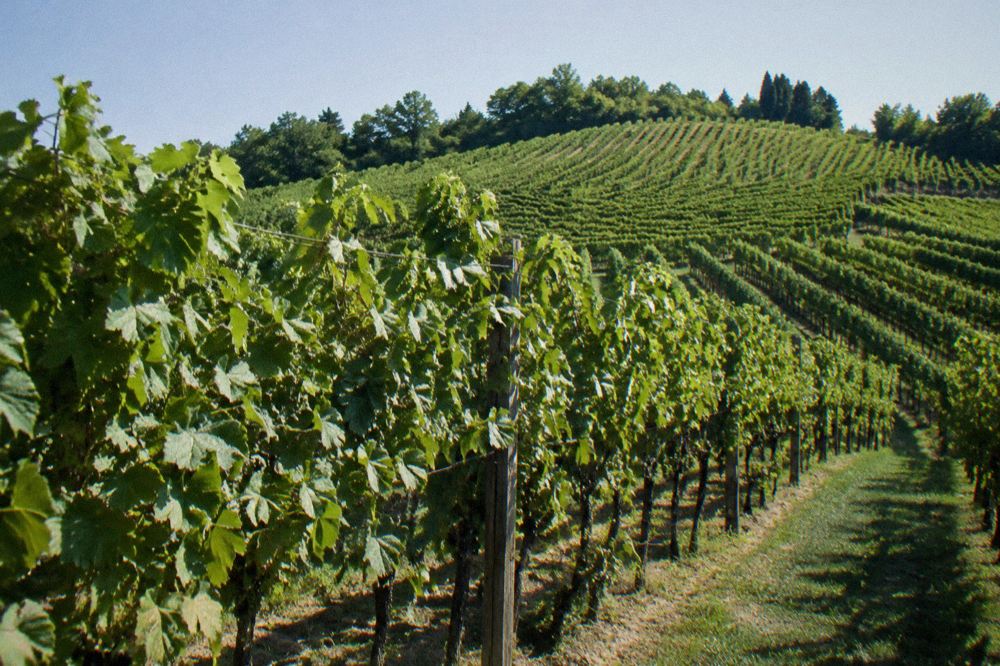
For context on how the region is laid out, our guide to reaching Ravenna and the one-day Ravenna itinerary cover the city end of the trip. Wine country is the layer on top of that: close enough that a half-day tasting works, far enough that you should plan transport rather than walk out of the centre and expect cellars.
Which Romagna Wines Should You Look For Around Ravenna?
The two names to look for are Sangiovese di Romagna, the region's red, typically dry and structured, and Albana di Romagna, the white, which ranges from dry to the sweet passito style; around them sit Trebbiano-based whites and the local sparkling options that Romagna producers pour by default. Any trattoria list in Ravenna's centre carries at least the first two, and piadina counters often stock a local red by the bottle.
Sangiovese di Romagna is the one to order when the plate is meaty: the regional tradition pairs it with grilled meats, cured pork and the slow-cooked Romagna dishes that fill autumn and winter menus. Albana is the white that travels with the region's fish courses and, in its passito form, with dessert. Neither needs a lecture: the lists in Ravenna are short, local and fairly priced by regional standards, and the staff at any address on our Ravenna restaurants guide will say in one sentence which producer is in the glass.
A useful habit is to ask what is open by the glass rather than work down the bottle list. Romagna's producers are numerous and small, so the glass list rotates, and it is the cheapest way to compare a Sangiovese with an Albana in the same meal. The Ravenna food guide covers the dishes these wines sit beside, from cappelletti in brodo to grilled piadina filled with squacquerone cheese.
It also helps to know what the label is telling you before you order. A basic Sangiovese di Romagna is the everyday pour, fresh and cherry-fruited, built for the table rather than the cellar. The same grape aged longer in wood carries the Superiore designation on the label, which points to a fuller, more structured wine that wants grilled meat or aged cheese beside it. On the white side, a dry Albana can be steel-fermented and lean or barrel-aged and broader, and the passito, made from dried grapes, is a dessert wine of real weight. Reading those three words, Superiore, passito and the producer's name, covers the decision you actually face on a Ravenna wine list.
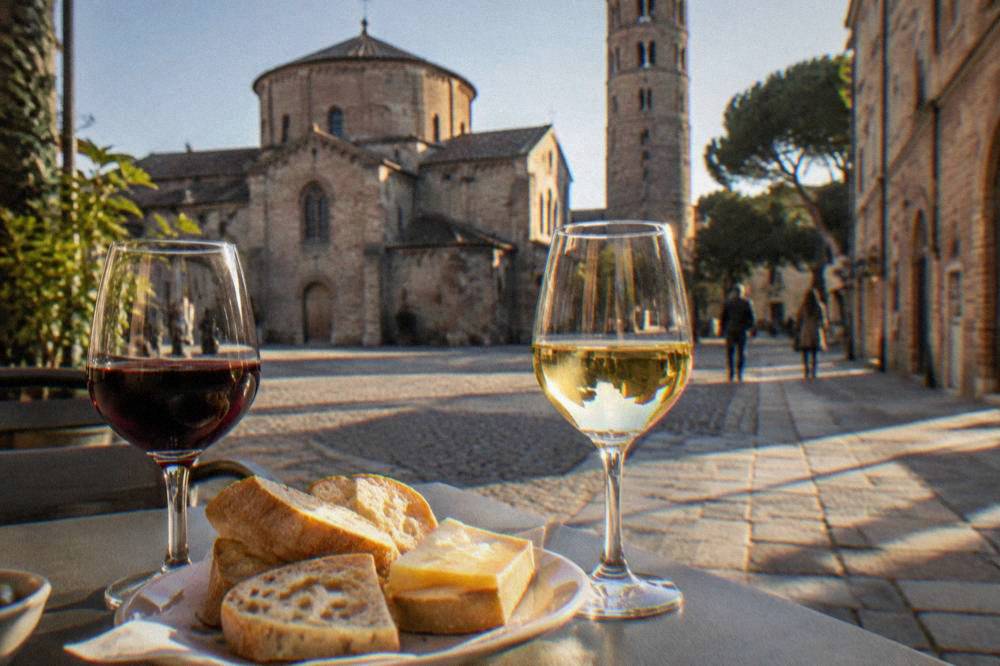
Where Can You Taste Romagna Wine In Ravenna Without Leaving The City?
The easiest tastings in Ravenna are the city's food-and-wine walking tours, which stop at local counters and pair Romagna wines with piadina, cheese and other regional bites, plus one winery visit option that leaves the city for a tasting with food nearby; both are bookable products whose prices and ratings are shown on the operator's live listing rather than quoted here.
The guided walk format suits Ravenna because the centre is small and flat. A mosaics-and-food tour covers the UNESCO monuments in the same outing as the tastings, which is the efficient version of a Ravenna day: mosaics in the morning, glass in hand by afternoon. The listing for the mosaics and food walk shows what is included, and the winery visit listing shows the tasting and food arrangement at the cellar itself.
To combine the UNESCO interiors with the tastings, book a private mosaic and food tour here.
For a self-guided evening, the rule of thumb is simple: sit down in a trattoria in the historic centre, order the house Sangiovese, and read the menu for piadina, cappelletti and passatelli. Ravenna's dining scene is described dish by dish on the piadina guide and the cappelletti guide, and the wine follows the food naturally.
There is also a middle path between the booked tour and the lone trattoria table: the counters. Ravenna's centre has piadinerie and wine counters where a glass and a filled flatbread cost little and turn over quickly, and they are where the working city drinks. Late afternoon into evening is when they fill. Ask what is local, pay at the till, and stand or perch as the Romans of this region do. A cover charge, the coperto, is legal when it is printed on the menu, so read the top of the list before ordering, and check the itemised bill at the end. Tipping is not obligatory anywhere in Italy.
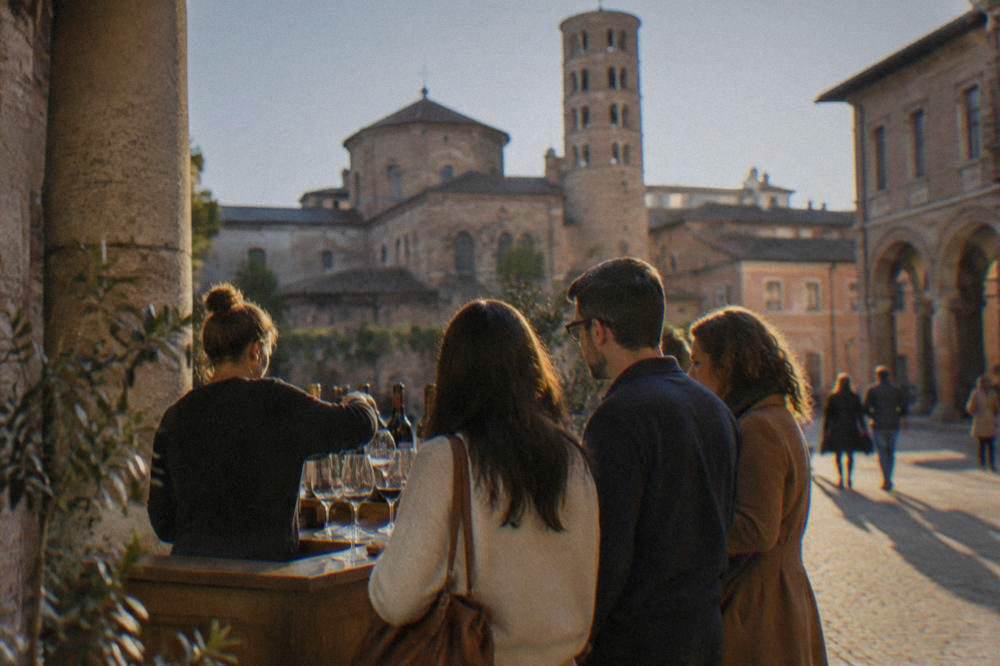
Can You Visit A Winery From Ravenna In A Day?
Yes, a winery visit from Ravenna is a realistic half-day or day trip: one verified tour in the roster runs a winery visit with wine and food tasting near Ravenna, and the region's cellar doors sit in the hills beyond Faenza and Brisighella, which are also reachable as independent day trips. The winery product's price, rating and review count render on its listing, and cancellation terms are shown at booking.
The guided option is the low-friction one. It handles the drive, the appointment and the pacing, and it is the right call for anyone without a car. Check the date and the meeting point on the operator's page before committing, because cellar visits depend on the producer's calendar.
The independent version rewards a little planning. Faenza and Brisighella, both covered in our day-trip guides, sit in the hills where the region's best-known cellars cluster, and both towns are worth the trip with no wine at all: Faenza for ceramics, Brisighella for its ridge walk and small hill town atmosphere. A car makes the cellar-hopping easy; without one, base the day in one of the towns and book a single appointment.
Two practical notes for the independent route. First, Italian cellar doors work by appointment more often than by open door: email or call a day or two ahead, in Italian if you can manage a sentence, and confirm the tasting fee and what it includes. Second, if you are driving back to Ravenna, the region's roads are flat and fast between the hills and the city, but the legal blood-alcohol limit in Italy is low and a tasting of several pours can reach it, so nominate a driver who skips the tasting or book the guided product and let someone else take the wheel.
Which Romagna Foods Pair With The Local Wine?
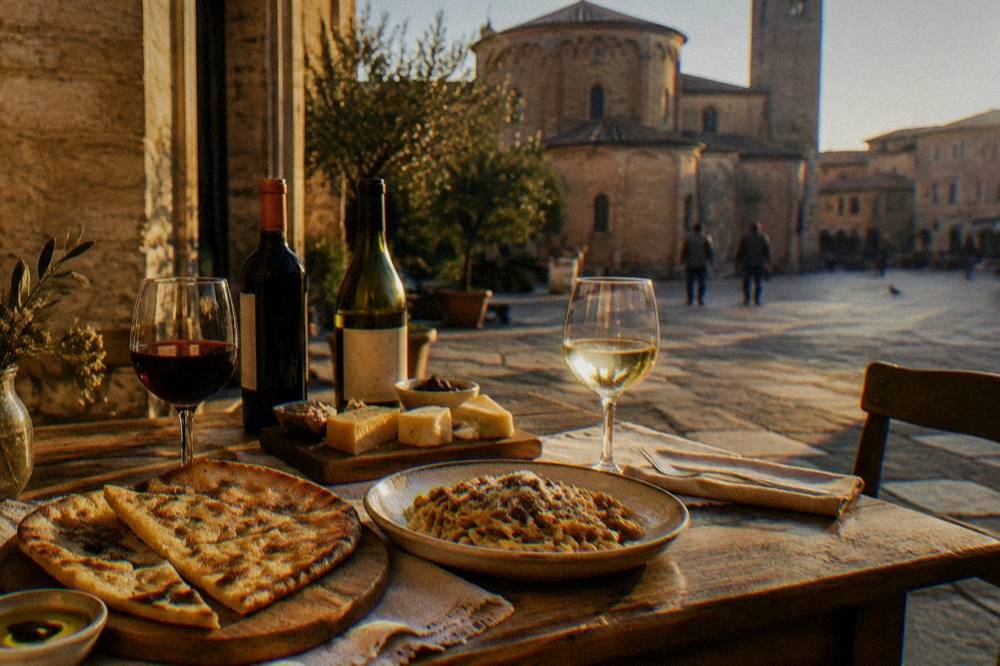
The classic Romagna pairings are Sangiovese with grilled and roasted meats and with aged cheeses, and Albana with piadina filled with fresh squacquerone, fish from the Adriatic and lighter first courses; cappelletti in brodo, the region's filled pasta, sits in the middle and works with either depending on the filling. These are the dishes every Ravenna menu is built around.
The pairing logic is not precious in Romagna. The tradition, as the Visit Ravenna food pages present it, is rustic: flatbread, cured pork, soft cheese, filled pasta and wine from the nearest hills. A practical table for planning a meal:
| Dish | What It Is | Wine That Suits It |
|---|---|---|
| Piadina with squacquerone | Flatbread filled with fresh soft cheese | Albana, dry white |
| Cappelletti in brodo | Small filled pasta served in capon broth | Sangiovese or Albana |
| Passatelli | Bread-and-cheese dumplings in broth or dry | Sangiovese |
| Grilled meats | Romagna-style mixed grill | Sangiovese di Romagna |
| Adriatic fish | Grilled or fried fish from the coast | Albana, dry white |
| Passito dessert | Sweet dried-grape Albana with dessert | Albana passito |
The through-line is freshness and fat. Squacquerone is a young, tangy cheese that collapses into warm flatbread, and a crisp Albana cuts through it. The broth of a cappelletti dish is rich but delicate, which is why both wines work: the white if the filling is cheese, the red if it is meat. Passatelli, made from bread crumbs and cheese pressed into dumplings, want the red's grip. And the passito at the end of the meal is the region's one gesture toward ceremony, poured in small glasses alongside a dry almond biscuit or a piece of hard cheese.
The food-and-cooking side of a Ravenna trip is deep enough to fill a second day. The Ravenna food tours and cooking classes guide lists the formats, from market-to-table classes to gelato making, and several of them end with a glass of something local on the table.
When Is The Best Time Of Year For A Romagna Wine Trip From Ravenna?
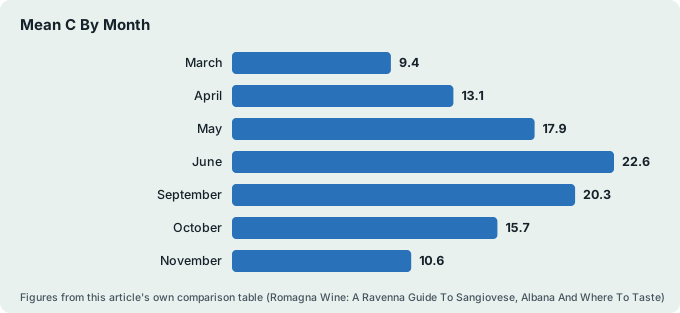
The harvest period, early autumn, is the season the climate table supports for a wine-focused visit: September and October bring mild mean temperatures of about 20.3 and 15.7 degrees C to Ravenna with rainfall comparable to spring, and the vineyards and the mosaic monuments are both at their busiest and most pleasant. Spring, April to June, is the other good window.
The climate figures are modelled ERA5 normals for 1991 to 2020, and they describe Ravenna's flat plain rather than the hills, but the pattern holds for the region: a warm, dry July and August, and a wet November. The monthly picture:
| Month | Mean C | Precipitation mm |
|---|---|---|
| March | 9.4 | 54.9 |
| April | 13.1 | 66.0 |
| May | 17.9 | 58.2 |
| June | 22.6 | 45.6 |
| September | 20.3 | 57.9 |
| October | 15.7 | 66.0 |
| November | 10.6 | 78.3 |
November is the wettest month at 78.3 mm and July the driest at 38.1 mm. The full breakdown, including winter months, sits on the Ravenna weather guide, and the seasonal trade-offs for the whole trip are on the best time to visit Ravenna. For a wine trip specifically, autumn has the added pull of the harvest in the hills, and the Ravenna Festival's autumn trilogy, "Mozart 1791", runs 13 to 17 November 2026 at Teatro Alighieri if you want an evening performance after a day of tasting.
Winter deserves a mention too, because it is when the city is quietest and the tastings move indoors. The monuments run their winter hours from 3 November 2026, 10:00 to 17:00, which still leaves a full evening for a long dinner, and the Teatro Alighieri season opens in December 2026. One caution for the beach-minded: a 25,000 cubic metre sand barrier is built each autumn at Punta Marina, Marina di Ravenna Sud and Lido di Savio and stays until spring 2027, so the winter shoreline is a working construction site rather than a postcard.
How Does A Wine Day Fit With The Mosaics And Ravenna's Other Sights?
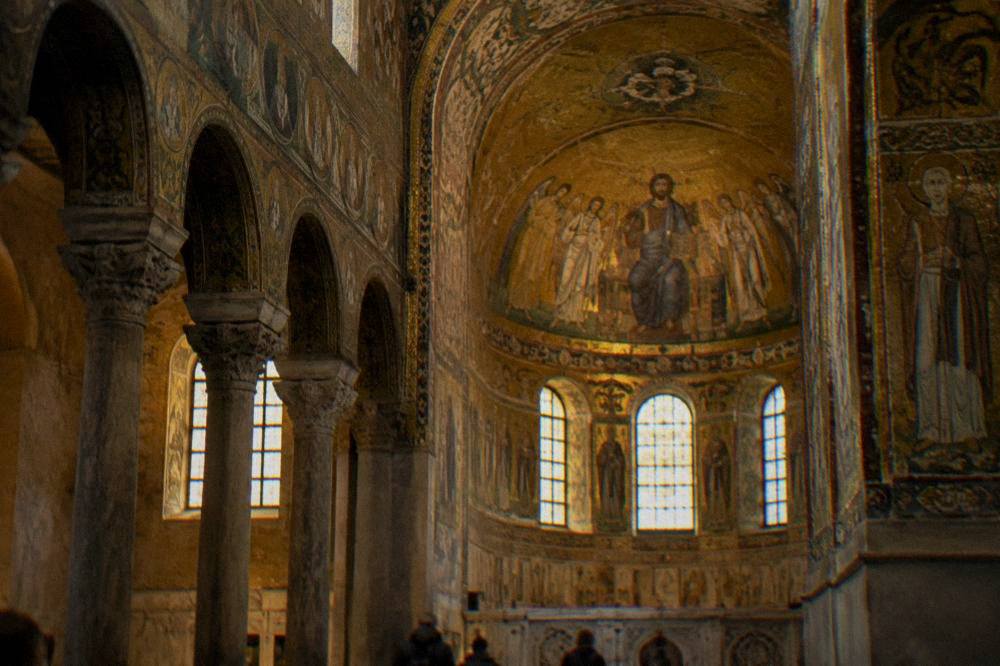
A wine day in Ravenna pairs naturally with the mosaics because the combo ticket is valid for one week with one admission per monument, so you can split the eight UNESCO monuments across mornings and give an afternoon to a tasting or a winery without wasting the ticket; timed-entry monuments such as Galla Placidia and the Neonian Baptistery are booked per entry time, and their stays are a few minutes each.
The combo mechanics come from the Ravenna Mosaici ticket page: reduced fares start at EUR 9.50 for two monuments, with the four- and five-monument reduced fares a few euros more, and the five-monument itinerary covers Sant'Apollinare Nuovo, San Vitale, Galla Placidia, the Neonian Baptistery and the Archiepiscopal Museum with its chapel. The full detail, including what the reduced rate covers, is on the Ravenna combo ticket guide and the Ravenna mosaics guide. Reduced rates apply to students, non-accredited journalists and paying groups over 20; children 0 to 10, Ravenna residents, ICOM members, licensed guides and visitors with a disability plus companion enter free.
A sample split, using the printed monument hours:
| Site | Winter Hours (3 Nov 2026 To 6 Mar 2027) | Last Admission |
|---|---|---|
| San Vitale | 10:00 to 17:00 daily | 16:30 |
| Sant'Apollinare Nuovo | 10:00 to 17:00 daily | 16:30 |
| Archiepiscopal Museum | 10:00 to 17:00 daily | 16:30 |
| Galla Placidia | 10:00 to 17:00 daily | 16:45 |
| Neonian Baptistery | 10:00 to 17:00 daily | 16:45 |
| Dante's tomb | 10:00 to 18:00 (Nov to Mar) | Before closing |
Dante's tomb is free, which makes it the easy add-on on any mosaic morning. The wider list of the eight UNESCO monuments is on the UNESCO sites guide.
A concrete day built on those hours looks like this: book the first timed entry of the morning at Galla Placidia, walk next door to San Vitale while the mosaics are still quiet, then cross the centre to the Neonian Baptistery and Sant'Apollinare Nuovo before lunch. Eat in the historic centre, with a glass of the local red. In the afternoon either take the winery tour pickup or, on a two-day stay, leave the Archiepiscopal Museum and the Classe basilica for the next morning, since the ticket still has days left on it. Sant'Apollinare in Classe sits outside the centre in the Classe area, Monday to Saturday 8:30 to 19:00 and Sunday 13:30 to 19:00, and it pairs well with the Classis Ravenna museum in the same outing.
What Are The Best Wine-Adjacent Day Trips From Ravenna?
The best wine-adjacent day trips from Ravenna are Faenza and Brisighella in the hills, both reachable as regional day trips, and Comacchio with the Po Delta to the north, where a verified tour combines Ferrara and Comacchio in one outing; Bologna, about 84 km away by direct regional train in about 1 hour to 1 hour 20, is the big-city option with the largest wine lists.
Faenza is the ceramics town whose surrounding hills carry cellars; Brisighella is the small ridge town that anchors one of Romagna's best-known olive oil and wine areas; Comacchio, the lagoon town north of Ravenna, is about fish, eels and flamingos rather than vines, but it is the day trip that best combines water landscapes with long lunches. The verified timings and distances the sources give:
| Day Trip | What The Sources Say | Journey Figure |
|---|---|---|
| Bologna | Direct regional train via Castelbolognese, about 84 km | About 1 hour to 1 hour 20 |
| Rimini | Direct regional train south along the coast | About 42 to 58 minutes |
| Faenza | Regional train or car, hills and ceramics beyond | Short regional hop |
| Brisighella | Hill town in the olive and wine band | Car or regional connection |
| Comacchio | Lagoon town, boat trips among flamingos year-round | Tour or car |
The Ferrara and Comacchio day tour is the one product in the roster built for exactly this kind of day, and it is the featured tour on this page: it moves the trip out of the city and into the Po Delta's water landscape while keeping Ravenna as the base.
Flamingos stay in the Comacchio salt pans and the Cervia salt pans all year, and the Cervia salt pans visitor centre on Via Bova 61 opens weekends and holidays, so the autumn and spring wine weekends overlap with good birdwatching windows. Cervia itself is covered on its own guide, and it pairs a salt-pan visit with a seaside lunch stop. If the hills are the draw instead, the Rimini line runs south along the coast and connects toward the Malatesta towns, and Rimini itself is laid out on our Ravenna versus Rimini comparison for anyone splitting a week between the two.
Common Questions About Romagna Wine And Ravenna
Can you visit a Romagna winery without a car from Ravenna?
Yes, through a booked tour. A winery visit with wine and food tasting near Ravenna is among the verified products, and the listing shows the meeting arrangement and what is included. For independent visits in the Faenza and Brisighella hills, a car is the practical choice.
Which Romagna wine should you order with piadina?
The regional habit, as the Visit Ravenna food pages present it, is a dry Albana with piadina and soft squacquerone cheese, and a Sangiovese di Romagna with grilled meats and cured pork. Either works with a mixed board.
Is Ravenna itself a wine region?
No. Ravenna is a flat, inland city on the Po plain, about 8 km from the coast, known for its eight UNESCO Early Christian monuments and Dante's tomb. The vineyards are in the hills beyond, toward Faenza, Brisighella and the Apennine foothills.
When is harvest season for Romagna wine?
Early autumn. The climate table shows September and October with mild means of 20.3 and 15.7 degrees C in Ravenna, which is the comfortable window for visiting both the vineyards and the mosaic monuments.
Do Ravenna food tours include wine?
Several do. The mosaics and food walking tour includes tastings alongside the monuments, and its inclusions and cancellation terms are shown on the operator's live listing before you book.
Can you combine the mosaics and a tasting in one day?
Yes. The Ravenna Mosaici combo ticket is valid for one week with one admission per monument, so a morning of mosaics and an afternoon tasting fit inside a single ticket, and the guided mosaics-and-food tours do both in one outing.
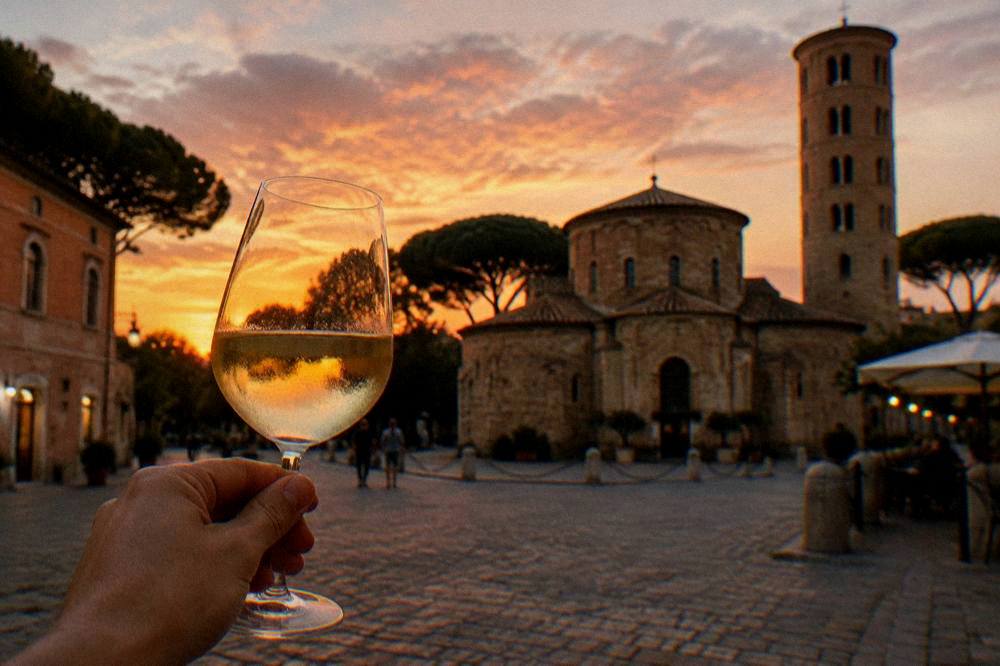
The short version: base yourself in Ravenna, give the mosaics their mornings while the combo ticket's one-week validity does the scheduling for you, and let a booked tasting, a winery visit or a Ferrara and Comacchio day carry the afternoons. Sangiovese in the glass, piadina on the plate and a glass-fronted Byzantine apse an hour earlier is the combination this region does better than anywhere else in Italy.